Biology
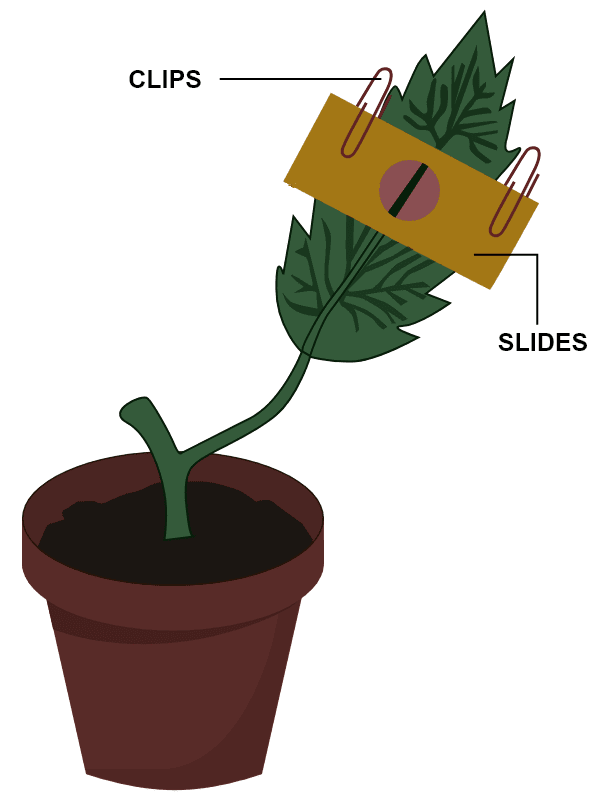
Given below is an experiment to demonstrate the magnitude of transpiration in a dicot leaf. Read the information given below and fill in the blanks.
Transpiration is the process of loss of water as water vapour from the aerial parts of the plant. It is the essential driving force for the ascent of sap. Less than 1% of the water absorbed by the roots is used in photosynthesis and plant growth. The rest of the water is lost during transpiration.
Pieces of dried (a) …………… paper are fixed to the two surfaces of a leaf. The leaf should remain attached to the plant. The plant is exposed to bright sunlight for a few hours. The colour of the paper on the lower surface of the leaf turns (b) …………… faster than the one on the upper surface. This proves that more (c) …………… occurs from the (d) …………… surface of the leaf as it has a greater number of (e) …………… .
Answer
Pieces of dried (a) cobalt chloride paper are fixed to the two surfaces of a leaf. The leaf should remain attached to the plant. The plant is exposed to bright sunlight for a few hours. The colour of the paper on the lower surface of the leaf turns (b) pink faster than the one on the upper surface. This proves that more (c) transpiration occurs from the (d) lower surface of the leaf as it has a greater number of (e) stomata.
Related Questions
Which of the following statements are correct?
P — Night blindness is caused by the deficiency of Vitamin A.
Q — Utriculus gives dynamic balance to the body.
R — Neuron is a single cell.
S — Fossil fuels are inexhaustible sources of energy.
- Q and S
- R and S
- P and Q
- P and R
Name the following:
(a) The endocrinal cells which secrete testosterone.
(b) The fluid which surrounds the developing embryo.
(c) A national campaign in India which aims to eliminate open defecation.
(d) Hormone responsible for the bending of a plant shoot towards light.
(e) The sensory organ present in the Cochlea for hearing.
Arrange the terms in each group in the correct order. Write them in a logical sequence beginning with the term that is underlined.
(a) Follicular phase, Luteal phase, Menstrual phase, Ovulatory phase.
(b) Oval window, Auditory canal, Cochlea, Ear ossicles.
(c) Retina, Eyeball, Sclera, Choroid.
(d) Arterioles, Vein, Artery, Capillaries.
(e) Parturition, Implantation, Ovulation, Fertilisation.
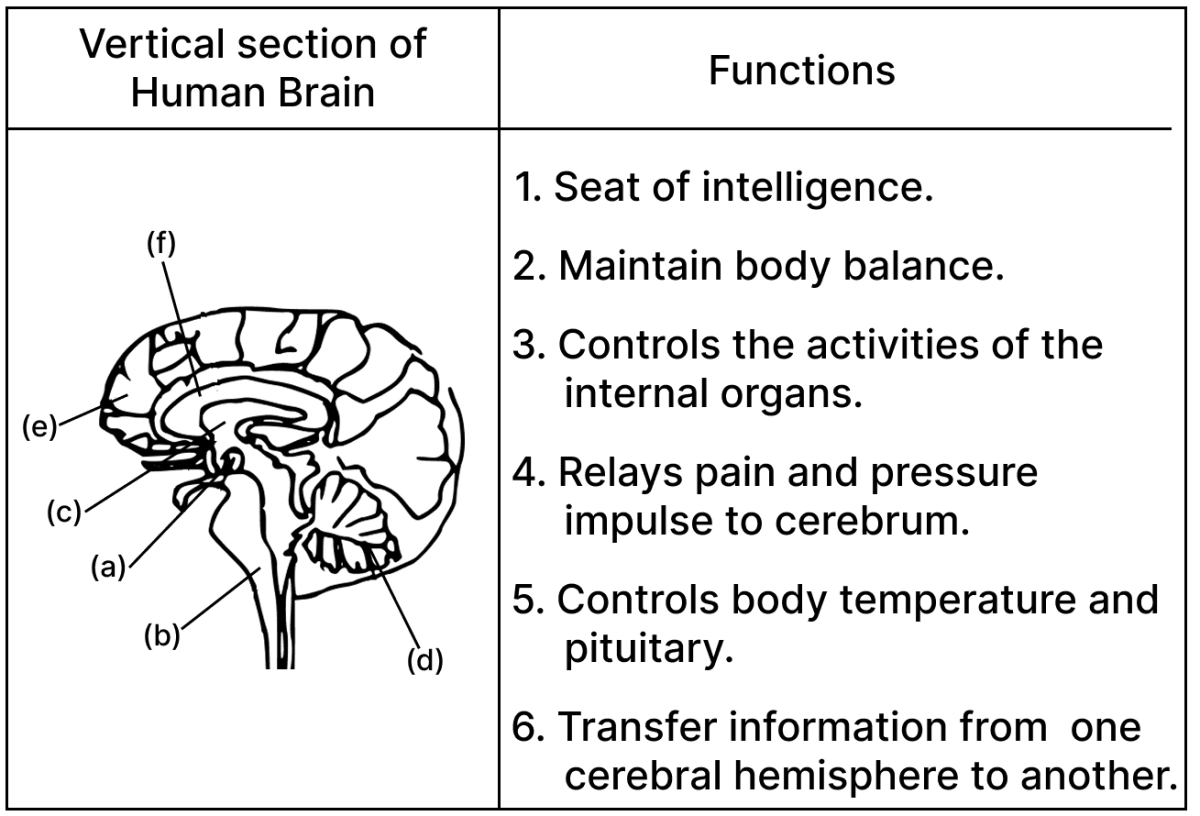
Given below is a vertical section of the human brain. Match the structures marked (a) to (e) with their correct functions.
Example: (f) – 6. Transfer information from one cerebral hemisphere to another.