Mathematics
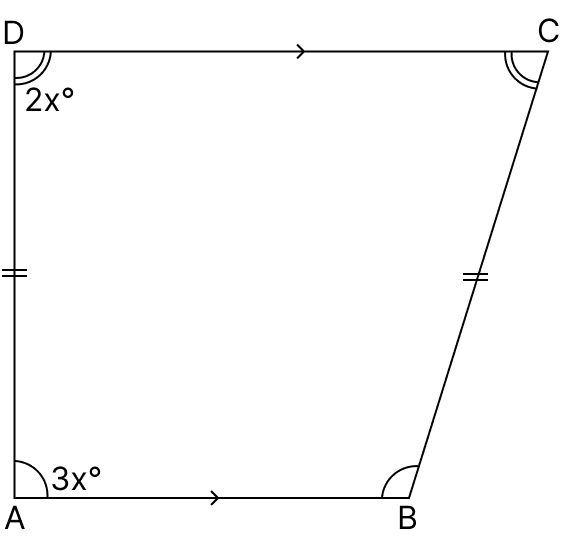
In the given figure, ABCD is an isosceles trapezium in which ∠CDA = 2x° and ∠BAD = 3x°. Find all the angles of the trapezium.
Rectilinear Figures
1 Like
Answer
We know that,
Sum of adjacent co-interior angles of a trapezium = 180°
∴ ∠A + ∠D = 180°
⇒ 3x + 2x = 180°
⇒ 5x = 180°
⇒ x =
⇒ x = 36°.
∠A = 3x = 3(36°) = 108°
∠D = 2x = 2(36°) = 72°
∠B = ∠A = 108° [∵ base angles of an isosceles trapezium are equal]
∠C = ∠D = 72° [∵ base angles of an isosceles trapezium are equal]
Hence, ∠A = 108°, ∠C = 72°, ∠B = 108° and ∠D = 72°.
Answered By
1 Like
Related Questions
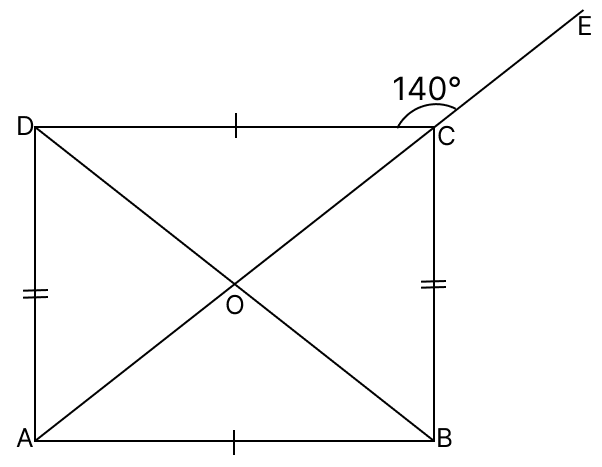
In the given figure, ABCD is a rectangle whose diagonals intersect at O. Diagonal AC is produced to E and ∠ECD = 140°. Find the angles of △ OAB.
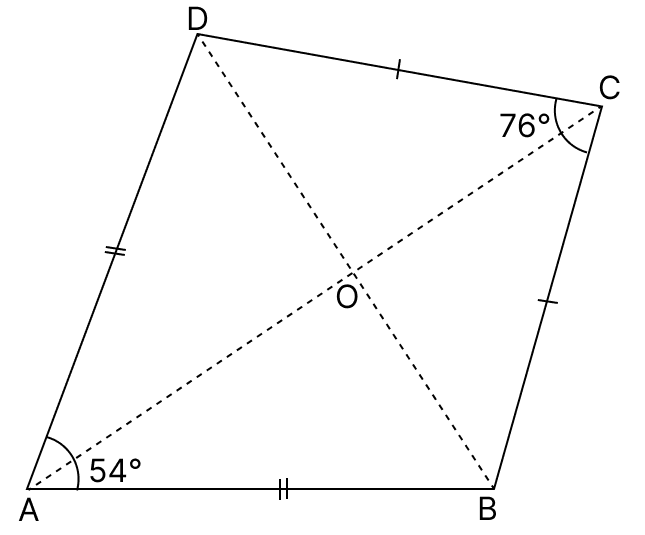
In the given figure, ABCD is a kite whose diagonals intersect at O. If ∠DAB = 54° and ∠BCD = 76°, calculate :
(i) ∠ODA
(ii) ∠OBC.
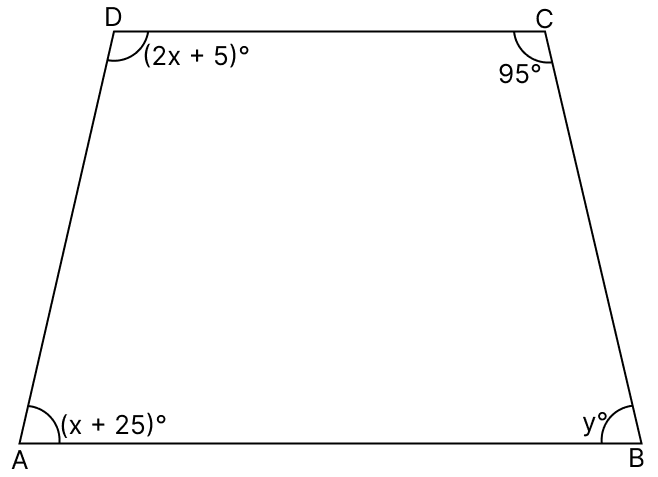
In the given figure, ABCD is a trapezium in which ∠A = (x + 25)°, ∠B = y°, ∠C = 95° and ∠D = (2x + 5)°. Find the values of x and y.
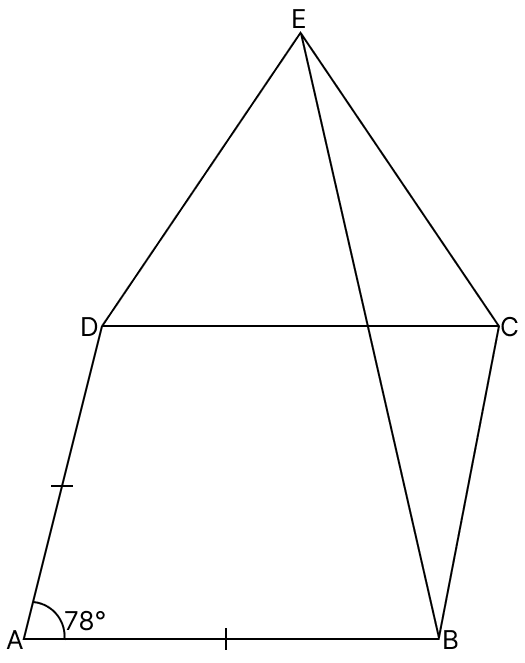
In the given figure, ABCD is rhombus and △EDC is a equilateral. If ∠BAD = 78°, calculate :
(i) ∠CBE
(ii) ∠DBE