
Mathematics
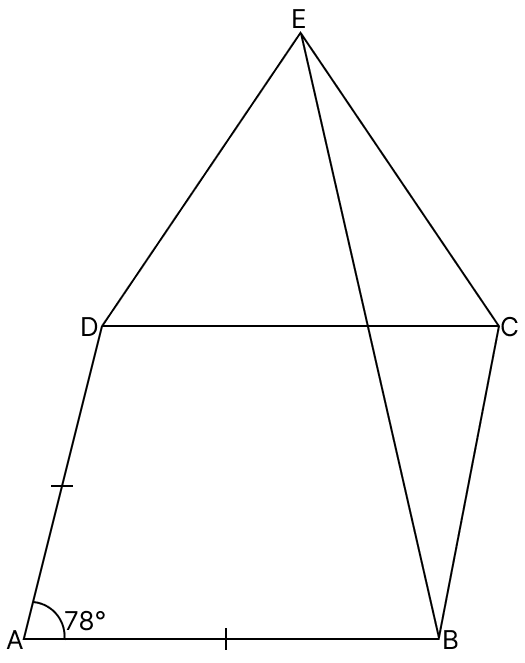
In the given figure, ABCD is rhombus and △EDC is a equilateral. If ∠BAD = 78°, calculate :
(i) ∠CBE
(ii) ∠DBE
Rectilinear Figures
1 Like
Answer
(i) In rhombus ABCD,
⇒ ∠C = ∠A = 78° (Opposite angles of rhombus are equal)
The sum of adjacent angles of a rhombus is always 180°.
⇒ ∠A + ∠B = 180°
⇒ 78° + ∠B = 180°
⇒ ∠B = 180° - 78° = 102°.
In △ DBC,
⇒ DC = CB (Sides of rhombus are equal in length) …..(1)
⇒ ∠CDB = ∠CBD = x (let) (In a triangle angles opposite to equal sides are equal.)
By angle sum property of triangle,
⇒ ∠CDB + ∠CBD + ∠BCD = 180°
⇒ x + x + ∠BCD = 180°
⇒ 2x + 78° = 180°
⇒ 2x = 180° - 78°
⇒ 2x = 102°
⇒ x =
⇒ ∠CDB = ∠CBD = 51°.
Given,
DEC is an equilateral triangle, so all the sides of triangle are equal.
∴ DC = EC …….(2)
From equations (1) and (2), we get :
⇒ CB = EC
In triangle CEB,
⇒ ∠CEB = ∠CBE = y (let) [Angles opposite to equal sides in a triangle are equal]
By angle sum property of triangle,
⇒ ∠CEB + ∠CBE + ∠ECB = 180°
⇒ y + y + (∠ECD + ∠BCD) = 180°
⇒ 2y + (60° + 78°) = 180°
⇒ 2y + 138° = 180°
⇒ 2y = 180° - 138°
⇒ 2y = 42°
⇒ y =
⇒ ∠CBE = 21°.
Hence, ∠CBE = 21°.
(ii) From figure,
⇒ ∠DBE = ∠CBD - ∠CBE
⇒ ∠DBE = 51° - 21° = 30°.
Hence, ∠DBE = 30°.
Answered By
1 Like
Related Questions
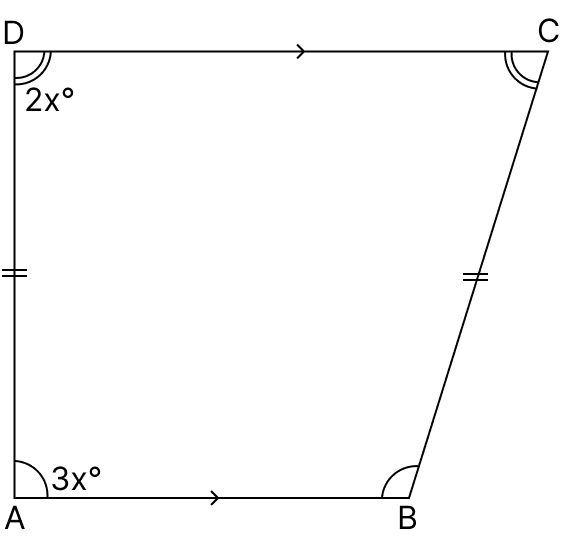
In the given figure, ABCD is an isosceles trapezium in which ∠CDA = 2x° and ∠BAD = 3x°. Find all the angles of the trapezium.
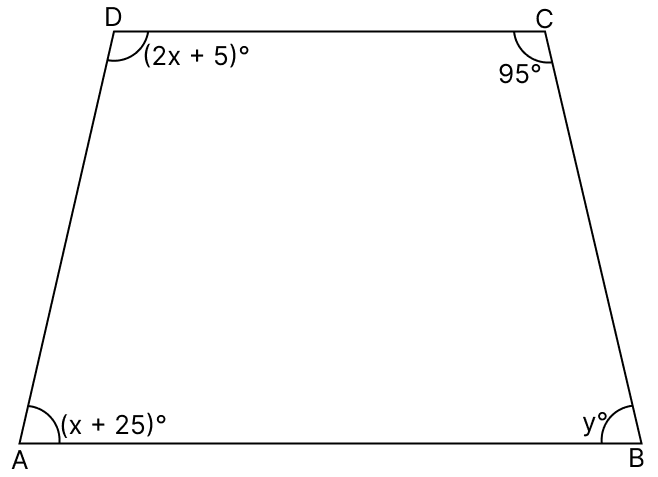
In the given figure, ABCD is a trapezium in which ∠A = (x + 25)°, ∠B = y°, ∠C = 95° and ∠D = (2x + 5)°. Find the values of x and y.
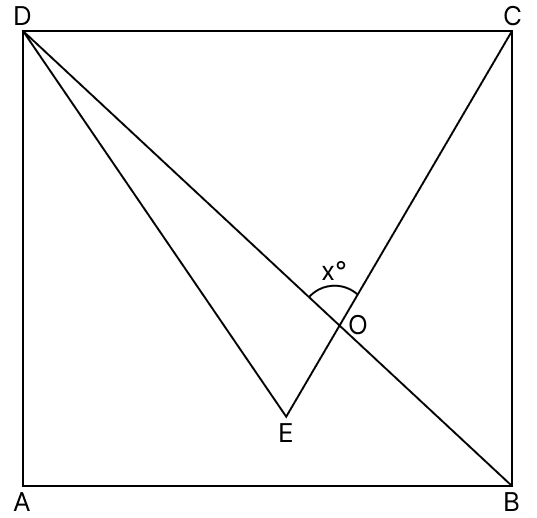
DEC is an equilateral triangle in a square ABCD. If BD and CE intersect at O and ∠COD = x°, find the value of x.
If one angle of a parallelogram is 90°, show that each of its angles measures 90°.