
Mathematics
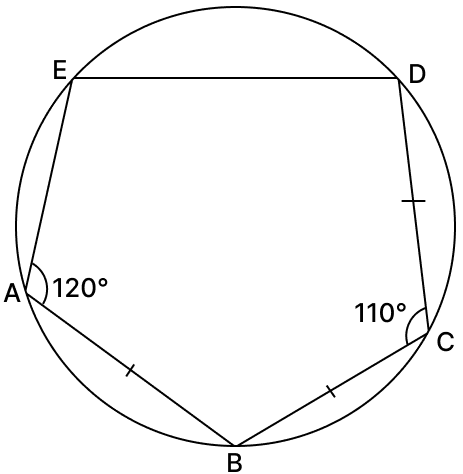
In the given figure, ABCDE is a pentagon inscribed in a circle. If AB = BC = CD, ∠BCD = 110° and ∠BAE = 120°, find :
(i) ∠ABC
(ii) ∠CDE
(iii) ∠AED
(iv) ∠EAD
Circles
2 Likes
Answer
Join AD, AC and BD.
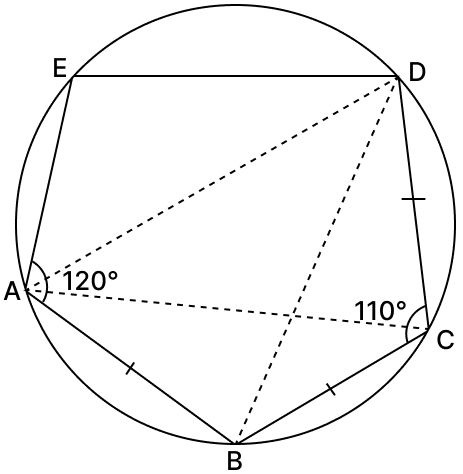
We know that,
In the same circle, equal chords cut off equal arcs.
Since, chord AB = chord CD
Thus, arc AB = arc CD.
We know that,
Equal chords subtend equal angles at the circumference of the same circle.
Thus,
∠ACB = ∠DAC
Since, these are alternate angles as well thus, AD must be parallel to BC.
Since, in quadrilateral ABCD, AD // BC and non parallel sides AB = DC.
Thus, ABCD is an isosceles trapezium.
In an isosceles trapezium,
Base angles are equal.
Thus, ∠ABC = ∠BCD = 110°.
ABCD is a cyclic quadrilateral.
⇒ ∠BCD + ∠BAD = 180° (Sum of opposite angles = 180°)
⇒ 110° + ∠BAD = 180°
⇒ ∠BAD = 180° - 110°
⇒ ∠BAD = 70°.
Given, ∠BAE = 120°
From figure,
⇒ ∠EAD = ∠BAE - ∠BAD = 120° - 70° = 50°.
In triangle ABC,
AB = BC
⇒ ∠BAC = ∠BCA = x (let) (Angles opposite to equal sides are equal)
By angle sum property of triangle,
⇒ ∠ABC + ∠BAC + ∠BCA = 180°
⇒ 110° + x + x = 180°
⇒ 2x = 180° - 110°
⇒ 2x = 70°
⇒ x = 35°.
Thus, ∠BAC = 35°.
Since, equal chords subtends equal angles at the circumference of the same circle.
Since, chord BC = chord CD. Thus,
∠CBD = ∠BAC = 35°.
Also,
∠CBD = ∠ADB = 35° (Alternate angles are equal)
In triangle ABD,
⇒ ∠ABD + ∠ADB + ∠BAD = 180°
⇒ ∠ABD + 35° + 70° = 180°
⇒ ∠ABD + 105° = 180°
⇒ ∠ABD = 180° - 105° = 75°.
In cyclic quadrilateral ABDE,
⇒ ∠ABD + ∠AED = 180° (Sum of opposite angles = 180°)
⇒ 75° + ∠AED = 180°
⇒ ∠AED = 180° - 75° = 105°.
In triangle CBD,
BC = CD
⇒ ∠CDB = ∠CBD = 35° (Angles opposite to equal sides are equal)
In cyclic quadrilateral ABDE,
⇒ ∠BAE + ∠BDE = 180° (Sum of opposite angles = 180°)
⇒ 120° + ∠BDE = 180°
⇒ ∠BDE = 180° - 120° = 60°.
From figure,
∠CDE = ∠CDB + ∠BDE = 35° + 60° = 95°.
(i) Hence, ∠ABC = 110°.
(ii) Hence, ∠CDE = 95°.
(iii) Hence, ∠AED = 105°.
(iv) Hence, ∠EAD = 50°.
Answered By
1 Like
Related Questions
If two sides of a cyclic quadrilateral are parallel, prove that:
(i) its other two sides are equal,
(ii) its diagonals are equal.
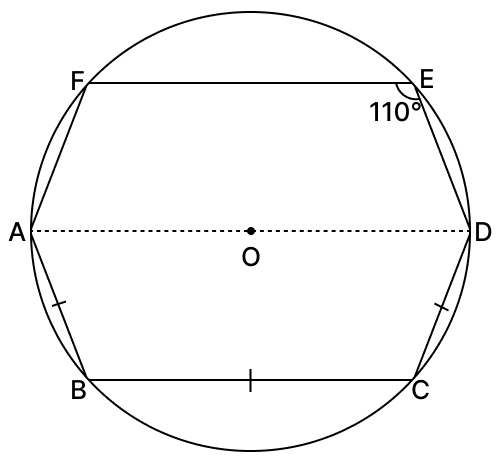
In the given figure, AB, BC and CD are equal chords of a circle with centre O and AD is a diameter. If ∠DEF = 110°, find :
(i) ∠AEF
(ii) ∠FAB
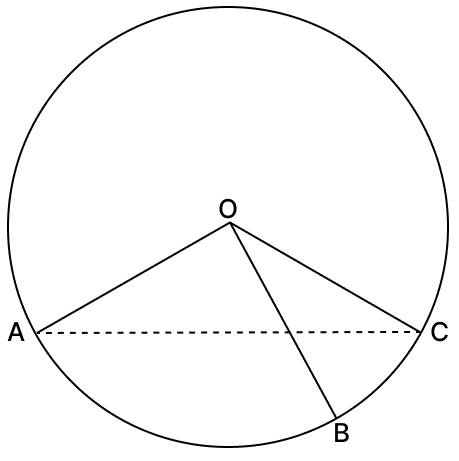
In the given figure, arc AB = twice arc BC and ∠AOB = 80°. Find:
(i) ∠BOC
(ii) ∠OAC
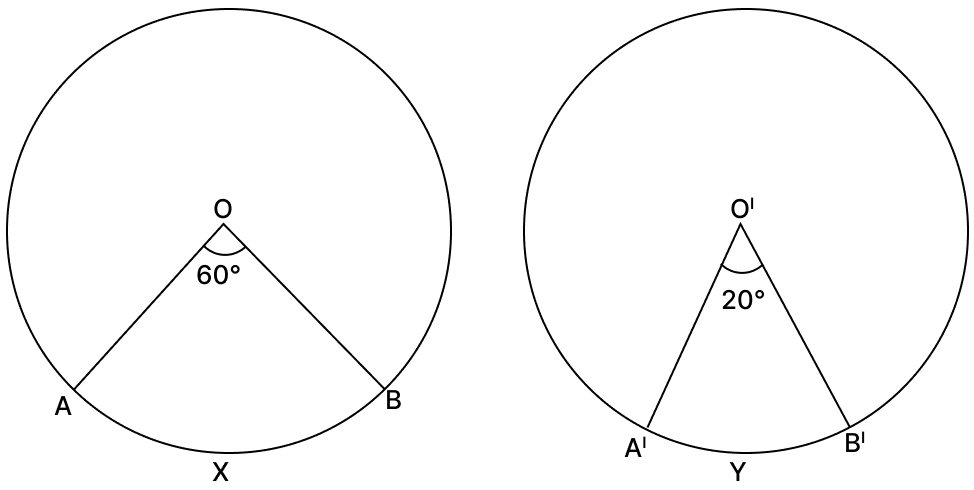
Assertion (A): In the figure, two congruent circles have centres O and O′.
Arc AXB subtends an angle of 60° at the centre O and arc AYB′ subtends an angle of 20° at the centre O′.
Then the ratio of arcs AXB and AY′B′ is 3 : 1.
Reason (R): Congruent arcs of a circle subtend equal angles at the centre.
A is true, R is false.
A is false, R is true.
Both A and R are true.
Both A and R are false.