Mathematics
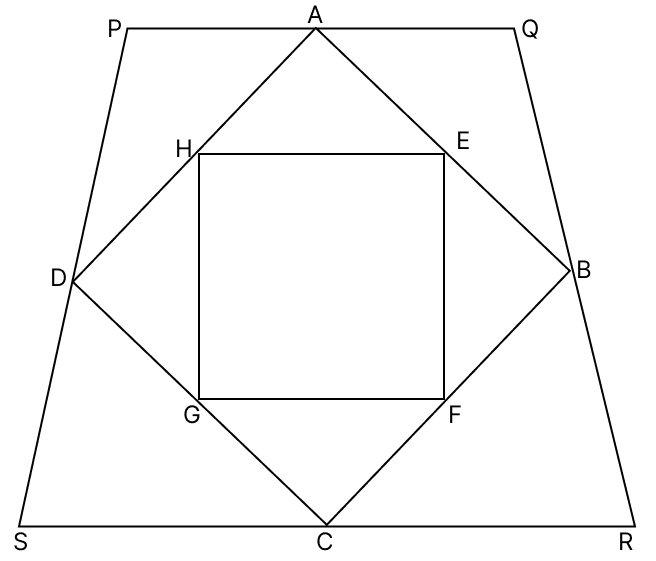
In the given figure, A, B, C and D are mid-points of PQ, QR, RS and PS respectively. E, F, G and H are mid-points of AB, BC, CD and AD respectively. Which type of quadrilaterals are ABCD and EFGH?
Mid-point Theorem
2 Likes
Answer
Join QS, PR, AC and BD.
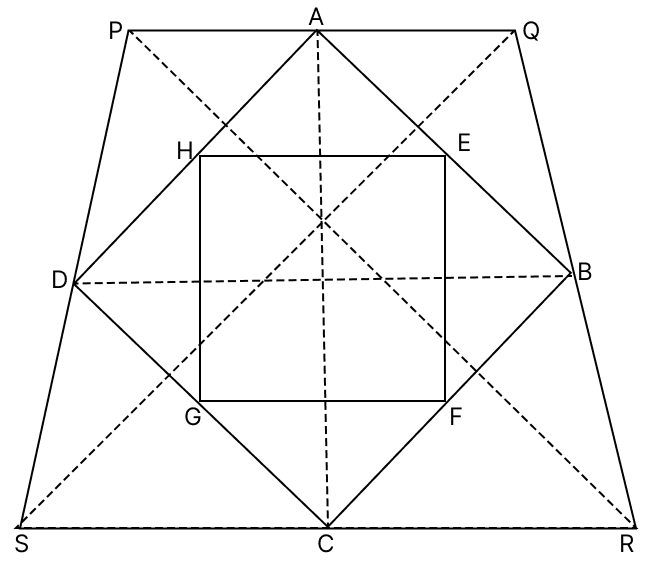
By mid-point theorem,
The line segment joining the mid points of any two sides of a triangle is parallel to the third side and is equal to half of it.
In △QRP,
A and B are midpoints of PQ and QR respectively.
∴ AB || PR and AB = PR (By midpoint theorem) …..(1)
Similarly in △PRS,
D and C are midpoints of PS and RS respectively.
∴ DC || PR and DC = PR (By midpoint theorem) …..(2)
In △PQS,
D and A are midpoints of PS and PQ respectively.
∴ DA || QS and DA = QS (By midpoint theorem) …..(3)
Similarly in △QRS,
B and C are midpoints of QR and SR respectively.
∴ BC || QS and BC = QS (By midpoint theorem) …..(4)
From (1) and (2) we get,
AB = DC and AB || DC
From (3) and (4) we get,
DA = BC and DA || BC
Since, opposite sides are parallel and equal.
Thus, ABCD is a parallelogram.
In △ABC,
E and F are midpoints of AB and BC respectively.
∴ EF || AC and EF = AC (By midpoint theorem) …..(5)
Similarly in △ADC,
H and G are midpoints of AD and CD respectively.
∴ GH || AC and GH = AC (By midpoint theorem) …..(6)
In △ABD,
H and E are midpoints of AD and AB respectively.
∴ EH || BD and EH = BD (By midpoint theorem) …..(7)
Similarly in △BCD,
F and G are midpoints of BC and CD respectively.
∴ FG || BD and FG = BD (By midpoint theorem) …..(8)
From (5) and (6) we get,
EF = GH AND EF || GH
From (7) and (8) we get,
EH = FG and EH || FG
Since, opposite sides are parallel and equal.
Thus, EFGH is a parallelogram.
Hence, ABCD and EFGH are parallelograms.
Answered By
1 Like
Related Questions
D and E are the mid-points of the sides AB and AC respectively of △ABC. DE is produced to F. To show that CF is equal and parallel to DA, we need an additional information, which is :
DE = EF
AE = EF
∠DAE = ∠EFC
∠ADE = ∠ECF
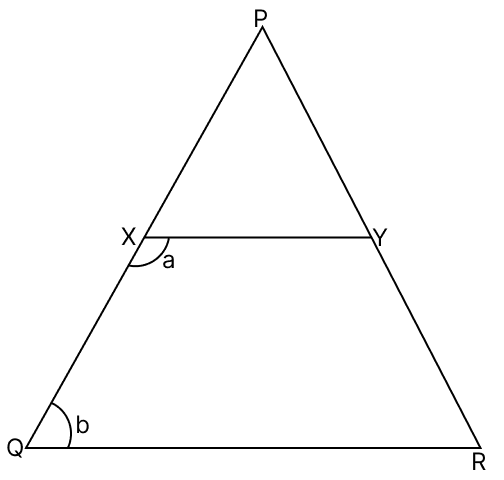
In which of the following cases you will get 2XY = QR for the given figure?
(i) When PX = QX and PY = RY
(ii) When PX = QX and a + b = 180°
Only in case (i)
Only in case (ii)
In both the cases
None of these
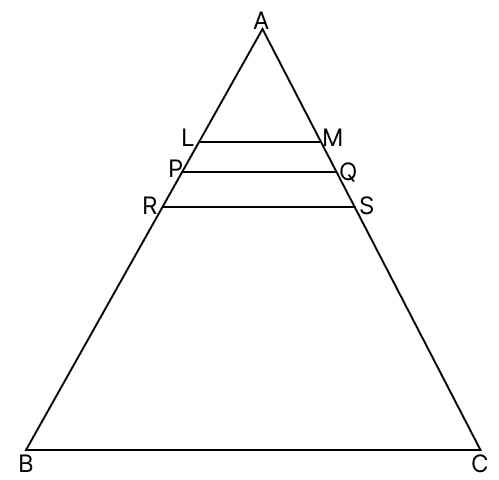
In the figure, R is the mid-point of AB, P is the mid-point of AR and L is the mid-point of AP. If RS, PQ and LM are parallel to each other, then the length of BC is :
3 LM
4 LM
6 LM
8 LM
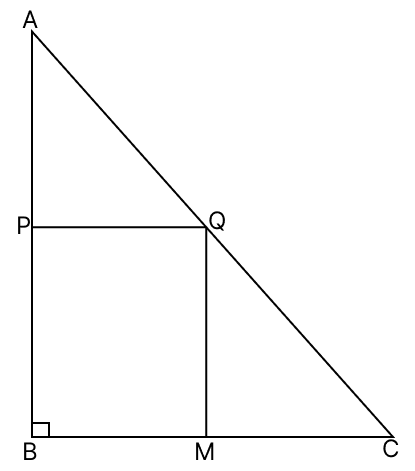
In the given figure, △ABC is a scalene triangle in which ∠B = 90°. P is the mid-point of AB, PQ || BC and QM ⊥ BC. Which type of quadrilateral is PQMB?