Mathematics
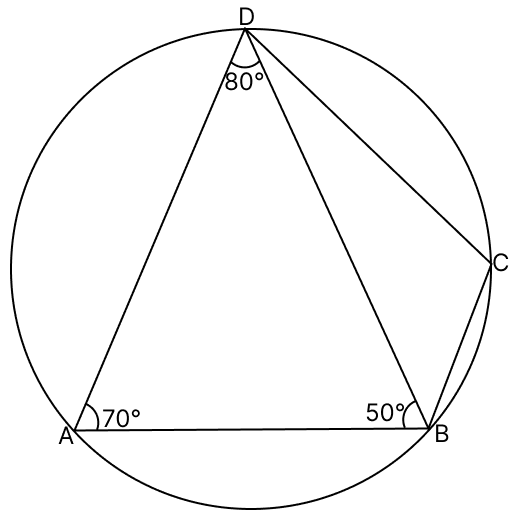
In the given figure, ∠BAD = 70°, ∠ABD = 50° and ∠ADC = 80°. Calculate :
(i) ∠BDC
(ii) ∠BCD
(iii) ∠BCA.
Circles
1 Like
Answer
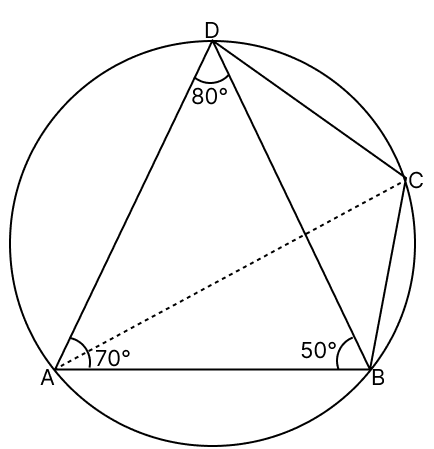
(i) By angle sum property of a triangle we get,
In ΔABD,
⇒ ∠BAD + ∠ABD + ∠ADB = 180°
⇒ 70° + 50° + ∠ADB = 180°
⇒ 120° + ∠ADB = 180°
⇒ ∠ADB = 180° - 120°
⇒ ∠ADB = 60°.
From figure,
⇒ ∠BDC = ∠ADC - ∠ADB
⇒ ∠BDC = 80° - 60°
⇒ ∠BDC = 20°.
Hence, ∠BDC = 20°.
(ii) We know that,
Sum of opposite angles of a cyclic quadrilateral is 180°.
⇒ ∠BAD + ∠BCD = 180°
⇒ 70° + ∠BCD = 180°
⇒ ∠BCD = 180° - 70°
⇒ ∠BCD = 110°.
Hence, ∠BCD = 110°.
(iii) We know that,
Angles in the same segment of a circle are equal.
⇒ ∠BCA = ∠ADB
⇒ ∠BCA = 60°.
Hence, ∠BCA = 60°.
Answered By
1 Like
Related Questions
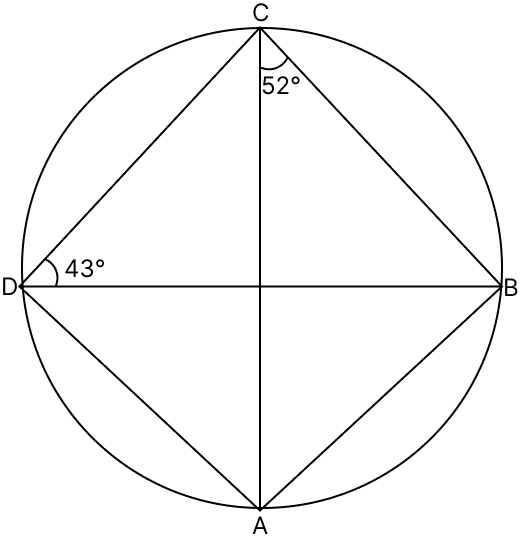
In the given figure, ∠ACB = 52° and= ∠BDC = 43°. Calculate
(i) ∠ADB
(ii) ∠BAC
(iii) ∠ABC.
In the given figure, O is the centre of the circle. If ∠AOB = 140° and ∠OAC = 50°, find :
(i) ∠ABC
(ii) ∠BCO
(iii) ∠OAB
(iv) ∠BCA
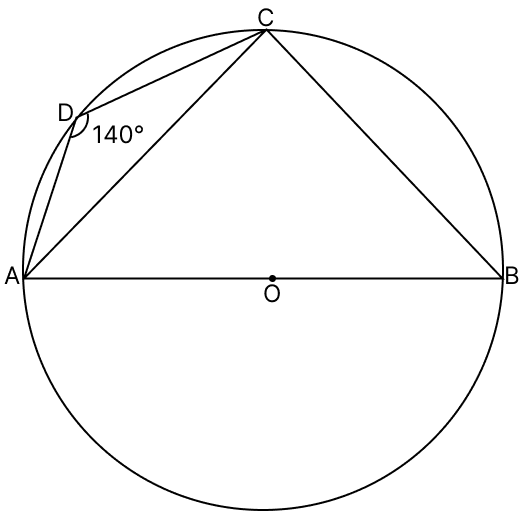
In the given figure, O is the centre of the circle. If ∠ADC = 140°, find ∠BAC.
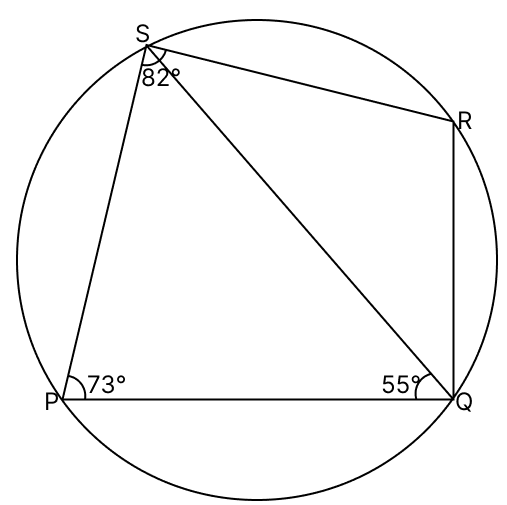
PQRS is a cyclic quadrilateral. Given ∠QPS = 73°, ∠PQS = 55° and ∠PSR = 82°, calculate ∠QRS, ∠RQS and ∠PRQ.