Mathematics
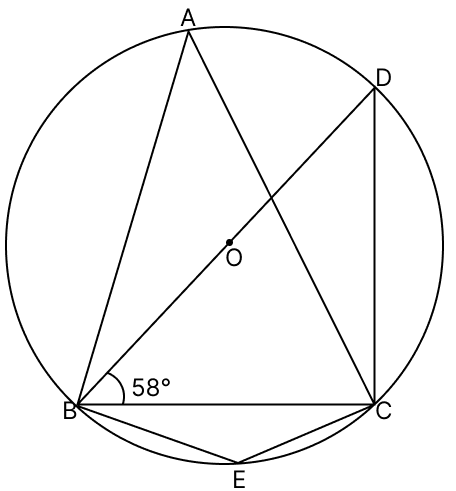
In the given figure, ∠DBC = 58° and BD is a diameter of the circle. Calculate :
(i) ∠BDC
(ii) ∠BEC
(iii) ∠BAC
Answer
(i) Given that BD is a diameter of the circle.
We know that,
Angle in a semicircle is a right angle.
So, ∠BCD = 90°
Also given that,
∠DBC = 58°
In ∆BDC,
⇒ ∠DBC + ∠BCD + ∠BDC = 180° [Angle sum property of triangle]
⇒ 58° + 90° + ∠BDC = 180°
⇒ 148° + ∠BDC = 180°
⇒ ∠BDC = 180° - 148° = 32°.
Hence, ∠BDC = 32°.
(ii) We know that, the opposite angles of a cyclic quadrilateral are supplementary.
So, in cyclic quadrilateral BECD
⇒ ∠BEC + ∠BDC = 180°
⇒ ∠BEC + 32° = 180°
⇒ ∠BEC = 180° - 32° = 148°
Hence, ∠BEC = 148°.
(iii) In cyclic quadrilateral ABEC,
⇒ ∠BAC + ∠BEC = 180° [Sum of opposite angles of a cyclic quadrilateral = 180°]
⇒ ∠BAC + 148° = 180°
⇒ ∠BAC = 180° - 148° = 32°.
Hence, ∠BAC = 32°.
Related Questions
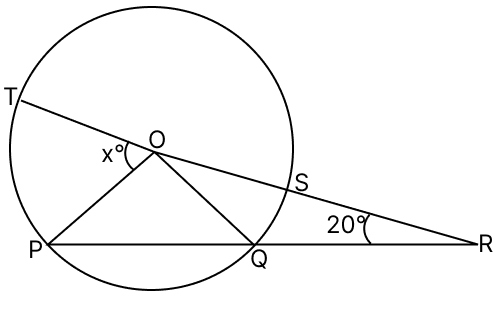
In the given figure, O is the centre of the circle. If QR = OP and ∠ORP = 20°, find the value of x giving reasons.
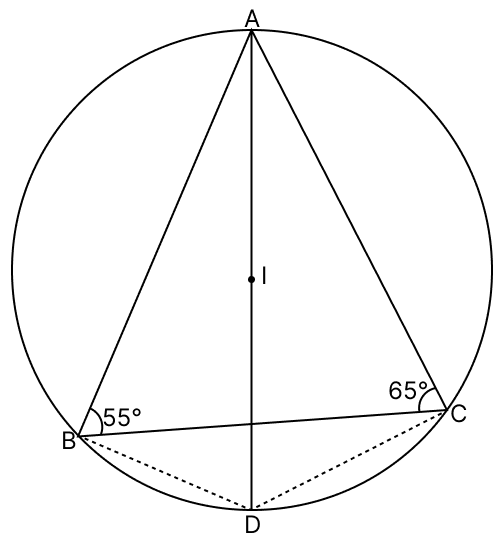
In the given figure, I is the incentre of Δ ABC. Here AI produced meets the circumcircle of Δ ABC at D. If ∠ABC = 55° and ∠ACB = 65°, calculate :
(i) ∠BCD
(ii) ∠CBD
(iii) ∠DCI
(iv) ∠BIC
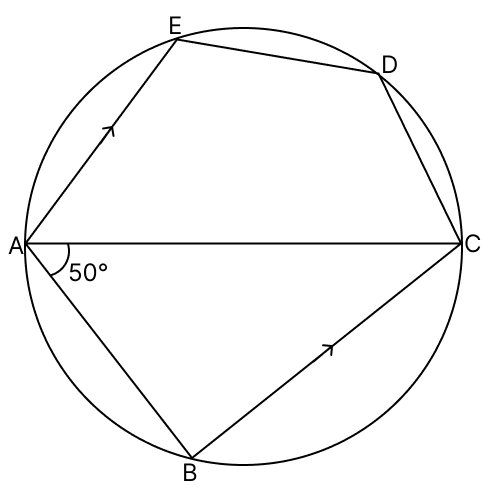
In the given figure, ABCDE is a pentagon inscribed in a circle such that AC is a diameter and side BC ∥ AE. If ∠BAC = 50°, find giving reasons :
(i) ∠ACB
(ii) ∠EDC
(iii) ∠BEC
Hence prove that BE is also a diameter.
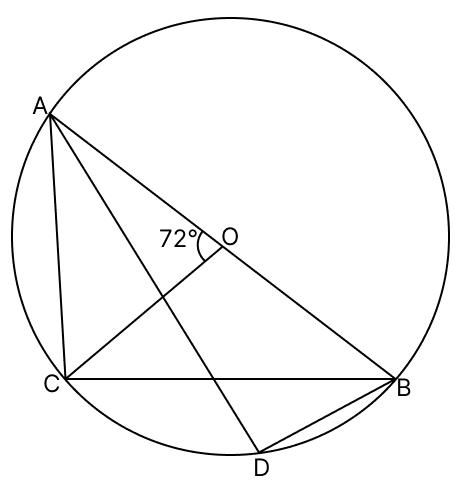
In the given figure, O is the centre of the circle and AB is a diameter. If AC = BD and ∠AOC = 72°, find:
(i) ∠ABC
(ii) ∠BAD
(iii) ∠ABD