KnowledgeBoat Logo
|

Mathematics

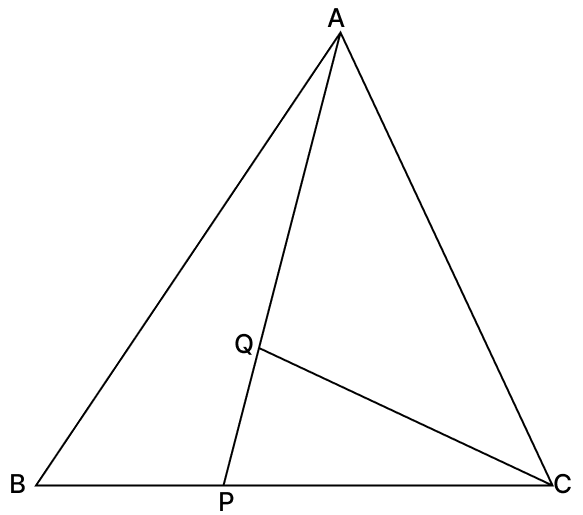
In the given figure, P is a point on side BC of ΔABC such that BP : PC = 1 : 2 and Q is a point on AP such that PQ : QA = 2 : 3. Show that :

ar (ΔAQC) : ar (ΔABC) = 2 : 5.

In the given figure, P is a point on side BC of ΔABC such that BP : PC = 1 : 2 and Q is a point on AP such that PQ : QA = 2 : 3. Show that. Quadrilaterals, R.S. Aggarwal Mathematics Solutions ICSE Class 9.

Theorems on Area

1 Like

Answer

Given,

BP : PC = 1 : 2

BPPC=12\dfrac{BP}{PC} = \dfrac{1}{2}

PC = 2BP

From figure,

In the given figure, ABCD is rhombus and △EDC is a equilateral. If ∠BAD = 78°, calculate Quadrilaterals, R.S. Aggarwal Mathematics Solutions ICSE Class 9.

BC = BP + PC = BP + 2BP = 3BP.

PCBC=2BP3BP=23\dfrac{PC}{BC} = \dfrac{2BP}{3BP} = \dfrac{2}{3}.

PC = 23\dfrac{2}{3} BC

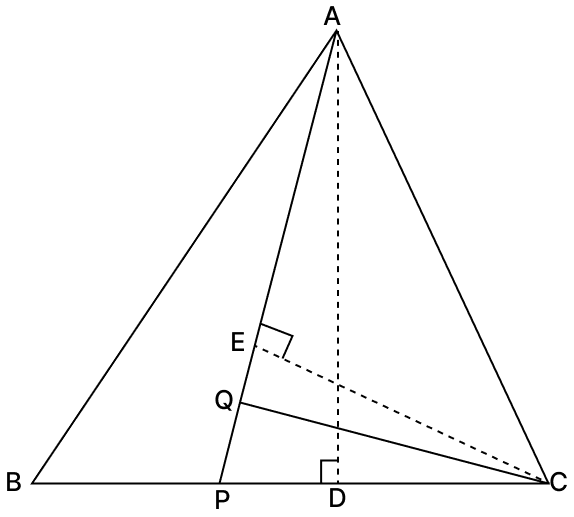
Let AD be the altitude on BC.

Area of △ABC = 12\dfrac{1}{2} × BC × AD ……(1)

Area of △APC=12×PC×ADArea of △APC=12×23BC×AD ….(2)\Rightarrow \text{Area of △APC} = \dfrac{1}{2} \times PC \times AD \\[1em] \Rightarrow \text{Area of △APC} = \dfrac{1}{2} \times \dfrac{2}{3} BC \times AD \text{ ….(2)}

Dividing equation (2) by equation (1) we get,

Area of Δ APCArea of Δ ABC=12×23BC×AD12×BC×ADArea of Δ APCArea of Δ ABC=23Area of Δ APC=23Area of Δ ABC.....(3)\Rightarrow \dfrac{\text{Area of Δ APC}}{\text{Area of Δ ABC}} = \dfrac{\dfrac{1}{2}\times \dfrac{2}{3} BC \times AD}{\dfrac{1}{2}\times BC \times AD} \\[1em] \Rightarrow \dfrac{\text{Area of Δ APC}}{\text{Area of Δ ABC}} = \dfrac{2}{3} \\[1em] \Rightarrow \text{Area of Δ APC} = \dfrac{2}{3} \text{Area of Δ ABC}…..(3)

Given,

PQ : AQ = 2 : 3

Let PQ = 2x and AQ = 3x

From figure,

AP = PQ + AQ = 2x + 3x = 5x.

AQAP=3x5x=35\dfrac{AQ}{AP} = \dfrac{3x}{5x} = \dfrac{3}{5}

AQ = 35AP\dfrac{3}{5}AP

Let CE be the altitude on side AP.

Area of △AQC = 12\dfrac{1}{2} × AQ × CE …..(4)

Area of △APC = 12\dfrac{1}{2} × AP × CE ……(5)

Dividing equation (4) by equation (5) we get,

Area of Δ AQCArea of Δ APC=12×AQ×CE12×AP×CEArea of Δ AQCArea of Δ APC=12×35AP×CE12×AP×CEArea of Δ AQCArea of Δ APC=35Area of Δ AQC=35Area of Δ APCArea of Δ AQC=35×23Area of Δ ABCArea of Δ AQC=25Area of Δ ABCArea of Δ AQC:Area of Δ ABC=2:5.\Rightarrow \dfrac{\text{Area of Δ AQC}}{\text{Area of Δ APC}} = \dfrac{\dfrac{1}{2} \times AQ \times CE}{\dfrac{1}{2}\times AP \times CE} \\[1em] \Rightarrow \dfrac{\text{Area of Δ AQC}}{\text{Area of Δ APC}} = \dfrac{\dfrac{1}{2}\times \dfrac{3}{5} AP \times CE}{\dfrac{1}{2}\times AP \times CE} \\[1em] \Rightarrow \dfrac{\text{Area of Δ AQC}}{\text{Area of Δ APC}} = \dfrac{3}{5} \\[1em] \Rightarrow \text{Area of Δ AQC} = \dfrac{3}{5} \text{Area of Δ APC} \\[1em] \Rightarrow \text{Area of Δ AQC} = \dfrac{3}{5} \times \dfrac{2}{3} \text{Area of Δ ABC} \\[1em] \Rightarrow \text{Area of Δ AQC} = \dfrac{2}{5} \text{Area of Δ ABC} \\[1em] \Rightarrow \text{Area of Δ AQC}:\text{Area of Δ ABC} = 2 : 5.

Hence, proved that ar (ΔAQC) : ar (ΔABC) = 2 : 5.

Answered By

3 Likes


Related Questions