Mathematics
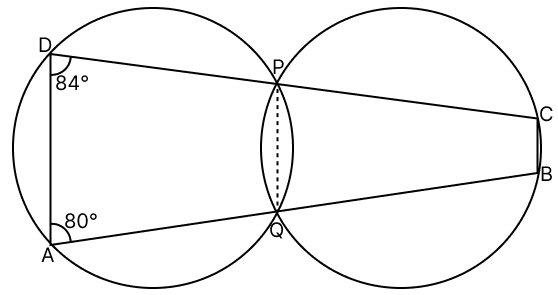
In the given figure, the two circles intersect at P and Q. If ∠A = 80° and ∠D = 84°, calculate :
(i) ∠QBC
(ii) ∠BCP
Answer
PQAD is a cyclic quadrilateral as all vertices lie on the circumference of the circle.
Sum of opposite angles of cyclic quadrilateral = 180°
⇒ ∠DAQ + ∠DPQ = 180°
⇒ 80° + ∠DPQ = 180°
⇒ ∠DPQ = 180° - 80°
⇒ ∠DPQ = 100°.
Also,
⇒ ∠PDA + ∠PQA = 180°
⇒ 84° + ∠PQA = 180°
⇒ ∠PQA = 180° - 84°
⇒ ∠PQA = 96°.
Since exterior angle of a cyclic quadrilateral is equal to the opposite interior angle.
(i) ∠QBC = ∠DPQ = 100°.
Hence, ∠QBC = 100°.
(ii) ∠BCP = ∠PQA = 96°.
Hence, ∠BCP = 96°.
Related Questions
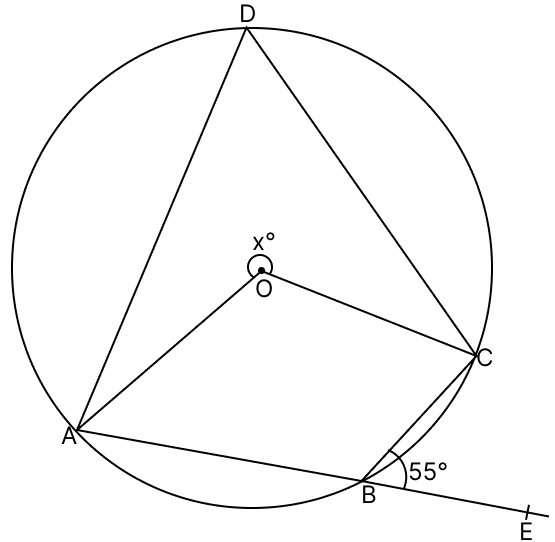
In the given figure, O is the centre of a circle and ABE is a straight line. If ∠CBE = 55°, find :
(i) ∠ADC
(ii) ∠ABC
(iii) the value of x.
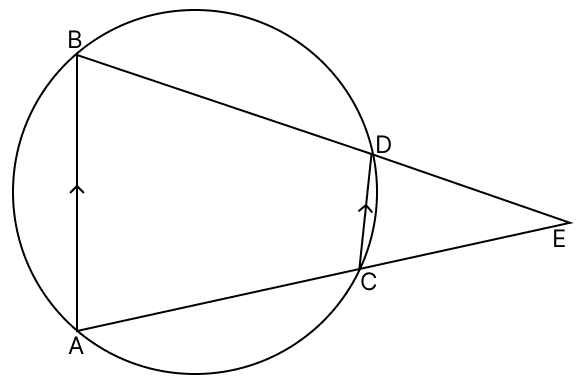
In the given figure AB and CD are two parallel chords of a circle. If BDE and ACE are straight lines, intersecting at E, prove that Δ AEB is isosceles.
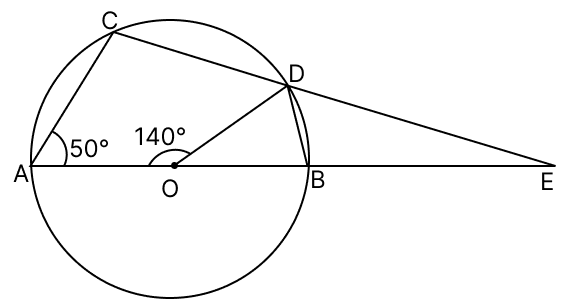
In the given figure, O is the centre of the circle. If ∠AOD = 140° and ∠CAB = 50°, calculate :
(i) ∠EDB
(ii) ∠EBD
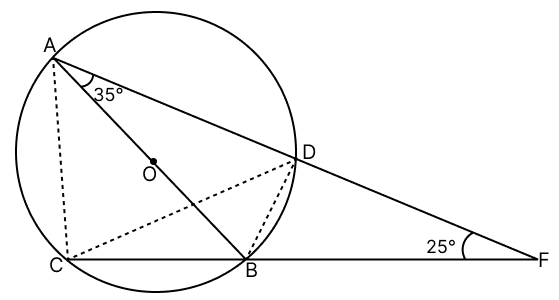
In the given figure, AB is a diameter of a circle with centre O. If ADF and CBF are straight lines, meeting at F such that ∠BAD = 35° and ∠BFD = 25°, find :
(i) ∠DCB
(ii) ∠DBC
(iii) ∠BDC