Biology
Given below is the internal structure of an ovule. Read the information below the diagram and fill in the blanks:

Ovule is located in the inner part of the ovary. It is destined to become the seed and the ovary to become the fruit. The number of ovules in the ovary vary from species to species. It can be one or more.
Each ovule has one or two protective coverings, the integuments. The integuments leave a small opening called the (a) …………… at one end. Enclosed by the integuments is the (b) ………………(a mass of food laden cells), and further inside it, is the embryo sac. Embryo sac contains one (c) …………… and two (d) …………… at one end. Three (e) …………… cells are found at the opposite end of embryo sac.
Answer
Each ovule has one or two protective coverings, the integuments. The integuments leave a small opening called the Micropyle at one end. Enclosed by the integuments is the Nucellus (a mass of food laden cells), and further inside it, is the embryo sac. Embryo sac contains one Egg cell and two Synergids at one end. Three Antipodal cells are found at the opposite end of embryo sac.
Related Questions
The given figures A and B show …………… and …………… conditions which favour cross-pollination.
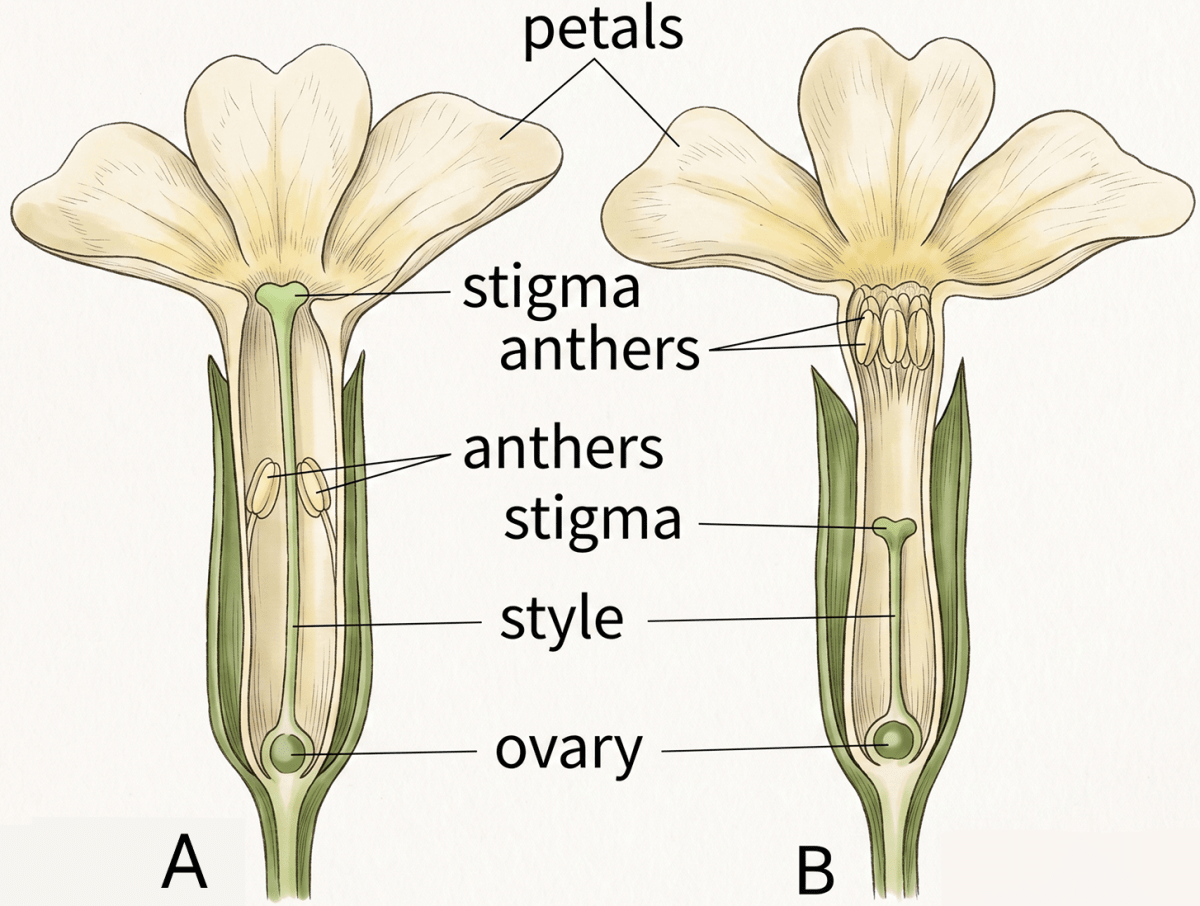
- Herkogamy and Heterostyly
- Heterostyly and Herkogamy
- Herkogamy and Homogamy
- Heterostyly and Homogamy
Look at the table given below and identify the kind of pollination that usually occurs in the flower mentioned.
Flower Kind of pollination Hibiscus P Hydrilla Q Wheat R - P — Entomophily, Q — Hydrophily, R — Anemophily
- P — Hydrophily, Q — Elephophily, R — Anemophily
- P — Ornithophily, Q — Anemophily, R — Elephophily
- P — Ornithophily, Q — Hydrophily, R — Entomophily
State the name of the chief pollinating agent against the corresponding plant by choosing from those given in brackets.
- Dahlia……(Crow, butterflies, mosquito).
- Maize…….(Bees, locusts, rain, wind).
- Vallisneria………(Wind, water, ants, rabbits).
Fill in the blanks with suitable words.
- Transfer of pollen grains from anthers to stigma of the same flower is called …………… .
- Different timings for maturation of gynoecium and androecium, is called …………… .
- …………… is a water-pollinated flower.