Biology
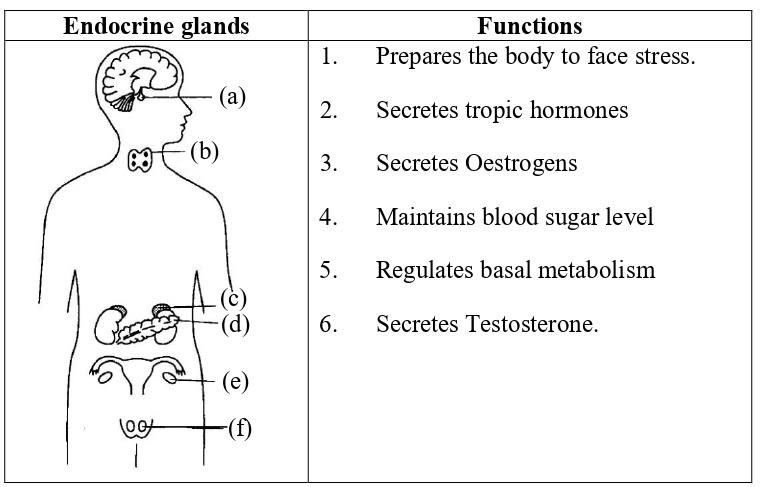
Given below is an outline of the human body showing the important endocrine glands. Match the glands marked (a) to (e) with their correct functions:
Example: (f) – 6. Secretes Testosterone.
Answer
(a) → (2)
(b) → (5)
(c) → (1)
(d) → (4)
(e) → (3)
Explanation
(a) is Pituitary gland, its function is (2) Secretes tropic hormones.
Tropic hormones stimulate other endocrine glands to secrete their hormones; for example, TSH from the pituitary activates the thyroid to release thyroxine.
(b) is Thyroid gland, its function is (5) Regulates basal metabolism.
The thyroid gland produces hormones (like thyroxine) that regulate basal metabolism, the rate at which the body uses energy at rest to maintain vital functions like breathing and heartbeat.
(c) is Adrenal gland, its function is (1) Prepares the body to face stress.
The adrenal gland releases hormones like adrenaline, which help the body respond to stress by increasing heart rate, breathing, and energy supply, preparing the body for "fight or flight" action.
(d) is Pancreas, its function is (4) Maintains blood sugar level.
The pancreas produces hormones like insulin and glucagon, which help maintain blood sugar levels by lowering or raising the glucose in the blood as needed.
(e) is Ovaries, its function is (3) Secretes Oestrogens.
The ovaries produce the hormone oestrogen, which helps in the development of female secondary sexual characteristics and regulates the menstrual cycle and reproductive functions.
Related Questions
Arrange the terms in each group in the correct order. Write them in a logical sequence beginning with the term that is underlined.
(a) Palisade cells, Cuticle, Upper epidermis, Spongy cells.
(b) Hepatic portal vein, Stomach, Hepatic vein, Liver.
(c) Cyton, Dendrites, Synaptic cleft, Axon endings.
(d) Insulin release, High blood sugar, Lowers blood sugar, Stimulates glucose uptake from blood.
(e) Sperm duct, Seminiferous tubule, Epididymis, Efferent ducts.
Read the explanations given below and name the structures:
Example: The tubules which produce sperms.
Answer: Seminiferous tubules
(a) The canal through which the testes descend down into the scrotum just before the birth of a male baby.
(b) The part of the brain that regulates the peristaltic movement of the alimentary canal.
(c) A structure that collects the soundwaves and conducts them through the external auditory canal.
(d) The point of attachment of two chromatids of a chromosome.
(e) Regulation of the opening and closing of stomata.
Write the overall chemical equation for photosynthesis.
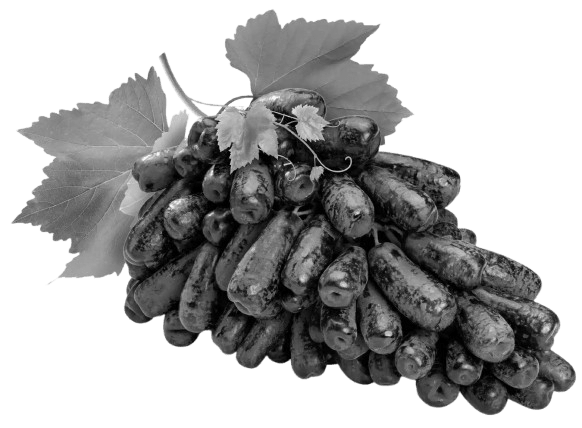
Ramesh is a farmer who has a vineyard and cultivates grapes. To improve the shape of the grapes and make them elongated he sprays a particular phytohormone at the time of fruiting.
(a) Name the phytohormone that Ramesh sprays on the plant at the time of fruiting.
(b) These grapes are said to be seedless. What is the technical term for the formation of such fruits?