KnowledgeBoat Logo
|

Mathematics

Given that sin θ = (ab)\Big(\dfrac{a}{b}\Big), then cos θ is equal to:

  1. (ba)\Big(\dfrac{b}{a}\Big)

  2. (ab2a2)\Big(\dfrac{a}{\sqrt{b^2 - a^2}}\Big)

  3. (bb2a2)\Big(\dfrac{b}{\sqrt{b^2 - a^2}}\Big)

  4. (b2a2b)\Big(\dfrac{\sqrt{b^2 - a^2}}{b}\Big)

Trigonometric Identities

1 Like

Answer

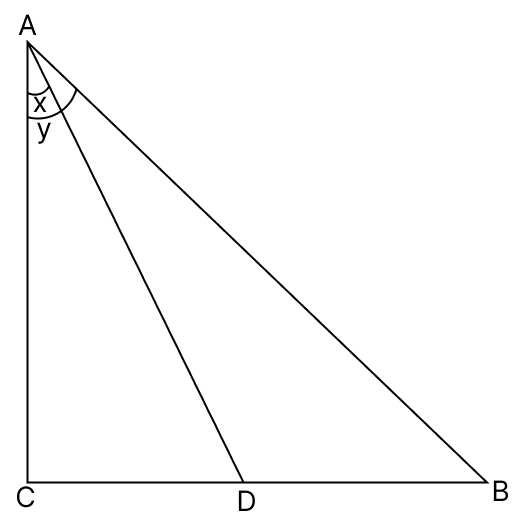
Let ABC be a right angle triangle with ∠B = 90° and ∠C = θ.

By formula,

sinθ=perpendicularhypotenuse\sin \theta = \dfrac{\text{perpendicular}}{\text{hypotenuse}}

Substituting values we get :

ab=ABAC\dfrac{a}{b} = \dfrac{AB}{AC}

Let AB = ak and AC = bk.

In right angle triangle ABC,

⇒ AC2 = AB2 + BC2

⇒ (bk)2 = (ak)2 + BC2

⇒ b2k2 = a2k2 + BC2

⇒ BC2 = b2k2 - a2k2

⇒ BC = kb2a2\sqrt{b^2 - a^2}

By formula,

cosθ=basehypotenuse=BCAC=kb2a2bk=b2a2b.\cos \theta = \dfrac{\text{base}}{\text{hypotenuse}} \\[1em] = \dfrac{BC}{AC} \\[1em] = \dfrac{k\sqrt{b^2 - a^2}}{bk} \\[1em] = \dfrac{\sqrt{b^2 - a^2}}{b} .

Hence, option 4 is the correct option.

Answered By

1 Like


Related Questions