
Physics
You are given three resistors of magnitude 3 Ω each. You can join them either in a series or in a parallel combination. How will you arrange them so that the equivalent resistance would become:
(a) maximum
(b) minimum
(Your answer must be accompanied by proper mathematical calculations)
Current Electricity
6 Likes
Answer
Given,
Number of resistors = 3
Resistance of each resistor, R = 3 Ω
(a) To get maximum equivalent resistance: Connect all in series combination, resistances simply add:
This is the maximum possible equivalent resistance using all three.
(b) To get minimum equivalent resistance: connect all in parallel combination.
By the reciprocal formula:
This gives the minimum possible equivalent resistance.
Answered By
2 Likes
Related Questions
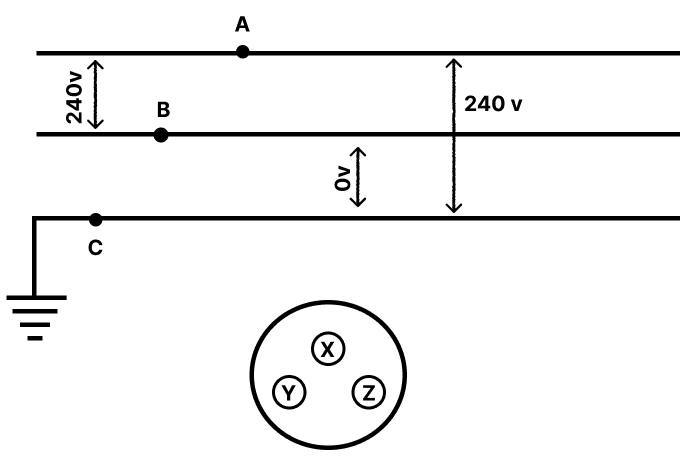
Redraw the diagram by linking points A, B, and C to points X, Y, and Z on the socket.
Ashish, Sameer, Aditya and Mohit were sitting on the terrace of Ashish’s house listening to the songs playing on Aditya’s mobile phone Mohit, sitting in one corner, a little distance away from the others, requests to increase the volume of the songs. But Aditya says the volume is full. Sameer, being a smart guy, gets up, goes into the kitchen, brings an empty steel glass, places the mobile phone inside it and solves the problem. What is the reason for Sameer to keep the mobile phone in the glass?
In a gold atom (atomic number 79), an electron revolves around the nucleus in a circular orbit. There is a strong electrostatic force between the positively charged nucleus and the negatively charged electron. Though the total positive charge possessed by the nucleus is much higher than the negative charge of the electron, there is no displacement of the electron in the direction of the force.
(a) Name the force responsible for the movement of the electron around the nucleus in its own orbit.
(b) In the absence of such force, what would happen to the movement of the electron?
A straight wire is passed vertically through cardboard sprinkled with iron filings.
(a) When current is passed through the wire in the upward direction, it is seen that the iron fillings are arranging themselves in a definite pattern. Why?
(b) What would happen to this arrangement if more current were passed through the wire?