Biology
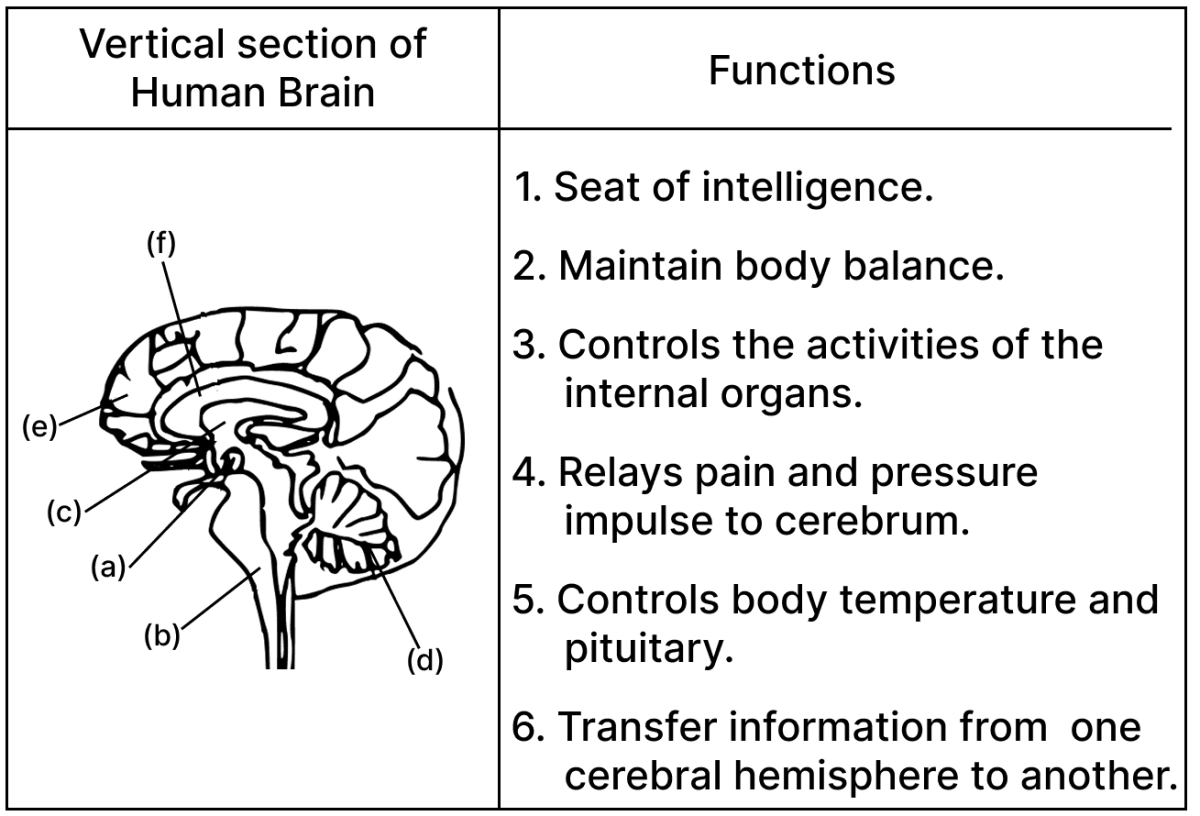
Given below is a vertical section of the human brain. Match the structures marked (a) to (e) with their correct functions.
Example: (f) – 6. Transfer information from one cerebral hemisphere to another.
Answer
(a) → (5)
(b) → (3)
(c) → (4)
(d) → (2)
(e) → (1)
Explanation
(a) is Hypothalamus its function is to (5) Control body temperature and pituitary.
(b) is Medulla oblongata its function is to (3) Control the activities of the internal organs.
(c) is Thalamus its function is to (4) Relay pain and pressure impulse to cerebrum.
(d) is Cerebellum its function is to (2) Maintain body balance.
(e) is Cerebrum its function is the (1) Seat of intelligence.
Related Questions
Given below is an experiment to demonstrate the magnitude of transpiration in a dicot leaf. Read the information given below and fill in the blanks.
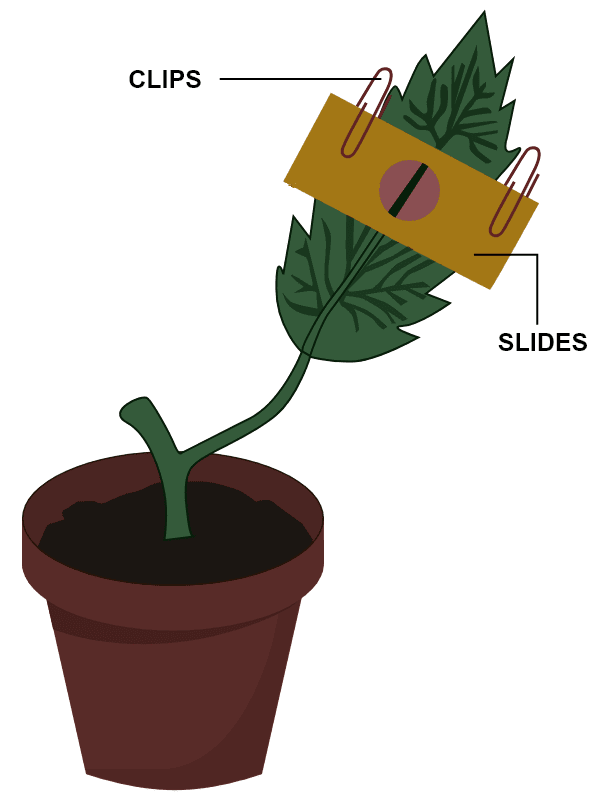
Transpiration is the process of loss of water as water vapour from the aerial parts of the plant. It is the essential driving force for the ascent of sap. Less than 1% of the water absorbed by the roots is used in photosynthesis and plant growth. The rest of the water is lost during transpiration.
Pieces of dried (a) …………… paper are fixed to the two surfaces of a leaf. The leaf should remain attached to the plant. The plant is exposed to bright sunlight for a few hours. The colour of the paper on the lower surface of the leaf turns (b) …………… faster than the one on the upper surface. This proves that more (c) …………… occurs from the (d) …………… surface of the leaf as it has a greater number of (e) …………… .
Arrange the terms in each group in the correct order. Write them in a logical sequence beginning with the term that is underlined.
(a) Follicular phase, Luteal phase, Menstrual phase, Ovulatory phase.
(b) Oval window, Auditory canal, Cochlea, Ear ossicles.
(c) Retina, Eyeball, Sclera, Choroid.
(d) Arterioles, Vein, Artery, Capillaries.
(e) Parturition, Implantation, Ovulation, Fertilisation.
Read the explanations given below and name the structures:
Example: A cord that connects the placenta with the foetus.
Answer: Umbilical cord
(a) The fibres which hold the lens of the eye in position.
(b) The cells of the islets of Langerhans that secrete the hormone glucagon.
(c) The part of the chloroplast where the light independent phase occurs.
(d) Cap like structure seen around the head of the human sperm.
(e) The glands located at the upper sideward portion of the orbit of eye.
Ram has protruding eyes and a high metabolic rate.
Name the hormone responsible for this condition.