
Mathematics
In a group of 36 girls, each one can either stitch or weave or can do both. If 25 girls can stitch and 17 can stitch only, how many can weave only?
Sets
1 Like
Answer
Given:
Total number of girls: n(S ∪ W) = 36
Girls who can stitch: n(S) = 25
Girls who can stitch only: n(S - W) = 17
Girls who can weave only: n(W - S) = ?
First find how many can do both, we use the formula:
n(S - W) = n(S) - n(S ∩ W)
Substituting the values in above, we get:
17 = 25 - n(S ∩ W)
⇒ n(S ∩ W) = 25 - 17
⇒ n(S ∩ W) = 8
So, 8 girls can do both.
Since every girl in the group of 36 does at least one activity, the total is the sum of "stitch only," "weave only," and "both."
n(S ∪ W) = n(S - W) + n(W - S) + n(S ∩ W)
n(W - S) = n(S ∪ W) - n(S - W) - n(S ∩ W) [Solving for n(W - S)]
Substituting the values in above, we get:
n(W - S) = 36 - 17 - 8
n(W - S) = 36 - 25
n(W - S) = 11
∴ 11 girls can weave only.
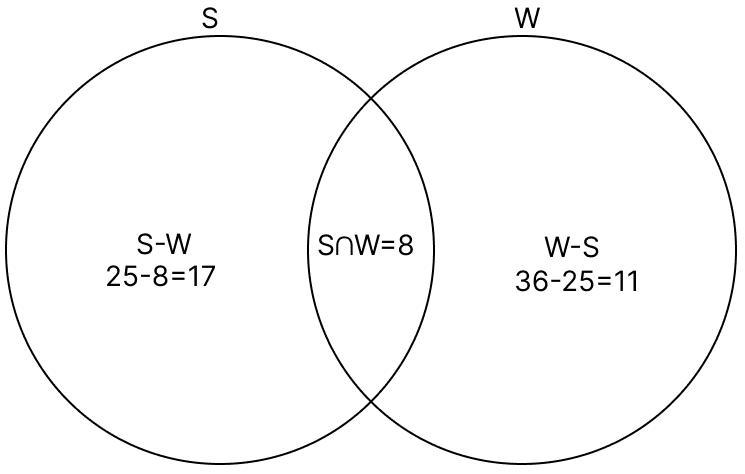
The Venn diagram is shown below:
Answered By
1 Like
Related Questions
In a class of 40 students, each one plays either Tennis or Badminton or both. If 28 play Tennis and 26 play Badminton, find
(i) how many play both the games;
(ii) how many play Tennis only;
(iii) how many play Badminton only.
In a class of 45 pupils, 21 play chess, 23 play cards and 5 play both the games. Find
(i) how many do not play any of the games;
(ii) how many play chess only;
(iii) how many play cards only.
In a group of 24 children, each one plays cricket or hockey or both. If 16 play cricket and 12 play cricket only, find how many play hockey only.
In a group of 40 persons, 10 drink tea but not coffee and 26 drink tea. How many drink coffee but not tea?