Mathematics
There is a group of 50 persons who can speak English or Tamil or both. Out of these persons, 37 can speak English and 30 can speak Tamil.
(i) How many can speak both English and Tamil?
(ii) How many can speak English only?
(iii) How many can speak Tamil only?
Answer
Given:
Total persons in the group: n(E ∪ T) = 50
Persons who can speak English: n(E) = 37
Persons who can speak Tamil: n(T) = 30
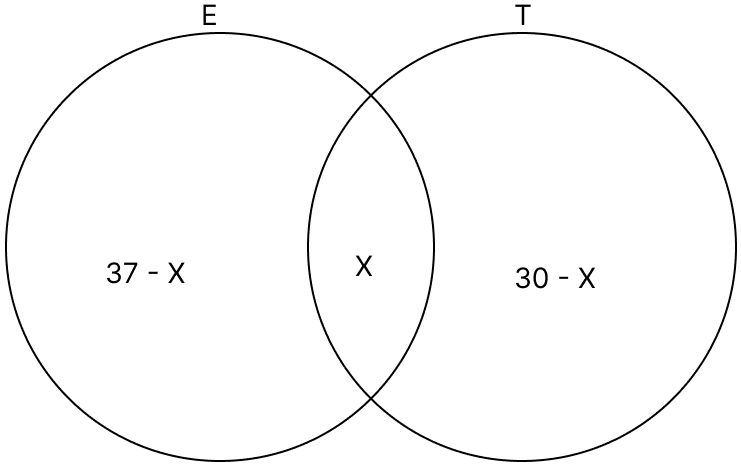
(i) How many can speak both English and Tamil?
This represents the intersection of the two sets, n(E ∩ T).
We use the formula:
n(E ∩ T) = n(E) + n(T) - n(E ∪ T)
Substituting the values in above, we get:
n(E ∩ T) = 37 + 30 - 50
n(E ∩ T) = 67 - 50
n(E ∩ T) = 17
∴ 17 persons can speak both English and Tamil.
(ii) How many can speak English only?
This represents the set E - T, consisting of people who speak English but not Tamil.
We use the formula:
n(E - T) = n(E) - n(E ∩ T)
Substituting the values in above, we get:
n(E - T) = 37 - 17
n(E - T) = 20
∴ 20 persons can speak English only.
(iii) How many can speak Tamil only?
This represents the set T - E, consisting of people who speak Tamil but not English.
We use the formula:
n(T - E) = n(T) - n(E ∩ T)
Substituting the values in above, we get:
n(T - E) = 30 - 17
n(T - E) = 13
∴ 13 persons can speak Tamil only.
Related Questions
Let P and Q be two sets such that n(P ∪ Q) = 70, n(P) = 45 and n(Q) = 38. Draw a Venn diagram and find :
(i) n(P ∩ Q)
(ii) n(P - Q)
(iii) n(Q - P)
In a city, there are 25 Hindi medium schools, 18 English medium schools and 7 schools have both the mediums. Find
(i) how many schools are there in all in the city ;
(ii) how many schools have Hindi medium only ;
(iii) how many schools have English medium only.
In a class of 40 students, each one plays either Tennis or Badminton or both. If 28 play Tennis and 26 play Badminton, find
(i) how many play both the games;
(ii) how many play Tennis only;
(iii) how many play Badminton only.
In a class of 45 pupils, 21 play chess, 23 play cards and 5 play both the games. Find
(i) how many do not play any of the games;
(ii) how many play chess only;
(iii) how many play cards only.