
Chemistry
Identify the following:
(a) A bond formed between two atoms by sharing of a pair of electrons, with both electrons being provided by the same atom.
(b) A salt formed by the complete neutralization of an acid by a base.
(c) A reaction in which the hydrogen of an alkane is replaced by a halogen.
(d) The energy required to remove an electron from a neutral gaseous atom.
(e) A homogenous mixture of two or more metals or a metal and a non-metal in a definite proportion in their molten state.
Chemical Bonding
ICSE Sp 2024
93 Likes
Answer
(a) Co-ordinate bond
(b) Normal salt
(c) Halogenation
(d) Ionisation energy
(e) Alloy
Answered By
49 Likes
Related Questions
Match the following Column A with Column B.
Column A Column B (a) Aluminium 1. Covalent compound (b) Sulphuric acid 2. Carbonate ore (c) Calcination 3. Hall Heroult's process (d) Calcium Chloride 4. Contact Process (e) Carbon tetrachloride 5. Electrovalent compound Complete the following by choosing the correct answers from the bracket:
(a) If an element has one electron in the outermost shell then it is likely to have the ……………. [smallest/ largest] atomic size amongst all the elements in the same period.
(b) ……………. [sulphuric acid/ hydrochloric acid] does not form an acid salt.
(c) A ……………. [reddish brown/ dirty green] coloured precipitate is formed when ammonium hydroxide is added to a solution of ferric chloride.
(d) Alkanes undergo ……………. [addition/ substitution] reactions.
(e) An ……………. [alkaline/acidic] solution will turn methyl orange solution pink.
(a) Draw the structural diagram for the following compounds:
- 1-propanal
- 1, 2 dichloro ethane
- But-2-ene
(b) Give the IUPAC name of the following organic compounds:
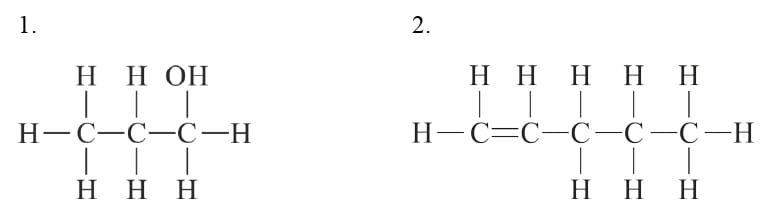
Identify the reactant and write the balanced equation for the following:
Nitric acid reacts with compound Q to give a salt Ca(NO3)2, water and carbon dioxide.