Commercial Applications
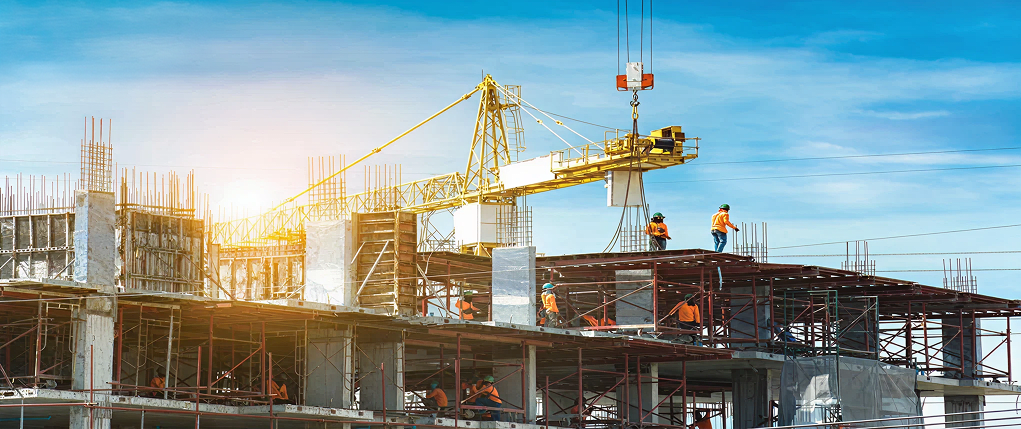
Identify the type of industry given in the picture below and explain its features.
Answer
Based on the picture, the industry shown is a Construction Industry. The image depicts a construction site with cranes, scaffolding and a building under construction.
Construction Industry — Construction industries are those industries which are engaged in the construction of buildings, roads, bridges, dams, flyovers, etc. These industries use the products of manufacturing industries (e.g., cement, iron, bricks) and extractive industries (e.g., sand, wood). Construction industries fall under the secondary sector.
Features of Construction Industries:
Use Products of Other Industries — Construction industries use products from both manufacturing industries (cement, iron and steel, glass, paints) and extractive industries (sand, stone, wood). This makes them dependent on other industries for raw materials.
Immovable Products — The products of construction industries are immovable as they are erected, built or fabricated at a fixed place. Buildings, bridges, and dams cannot be transported once built.
Part of Secondary Sector — Construction is classified as a secondary industry along with manufacturing, because it transforms raw materials and components into useful structures.
Capital and Labour Intensive — Construction projects require huge investment in machinery, equipment, and manpower. Large workforce of skilled and unskilled labour is needed.
Long Gestation Period — Construction projects often take months or years to complete, especially for major infrastructure like dams, highways, and metro systems.
Infrastructure Development — Construction industries play a crucial role in developing the physical infrastructure of a country — roads, railways, bridges, ports, airports, housing, and public buildings.
Project-Based Operations — Each construction project is unique with specific requirements, locations, designs and timelines. They are not standardised mass-production processes.
High Risk — Construction involves significant risks — accidents at sites, fluctuations in material prices, weather-related delays, and regulatory issues.
Subject to Government Regulation — Heavily regulated by building codes, environmental laws, labour laws, and safety standards.
Generates Employment — Construction industries are major sources of employment, especially for unskilled and semi-skilled workers.
Examples — DMRC (Delhi Metro Rail Corporation) for metro construction, L&T (Larsen & Toubro) for infrastructure projects, and various builders involved in housing, roads, bridges, and dams.
Related Questions
What is a commercial organisation? State its characteristics. Distinguish between commercial and non-commercial organisations.
Distinguish between an organisation, a firm and a company.
How do non-profit organisations contribute to society? Provide examples to illustrate their roles and functions.
Mr. Sharma, a farmer, grows wheat and sells it to a local flour mill. The flour mill processes the wheat into flour and sells it to a grocery store. The store sells the flour to customers in the neighbourhood.
(i) Identify the different types of industries involved in this case and explain their interdependence.
(ii) How does commerce facilitate the exchange of goods in this scenario?
(iii) Discuss how trade creates utilities in this example.