Mathematics
In a square ABCD, its diagonals AC and BD intersect each other at point O. The bisector of angle DAO meets BD at point M and the bisector of angle ABD meets AC at N and AM at L. Show that :
(i) ∠ONL + ∠OML = 180°
(ii) ∠BAM = ∠BMA
(iii) ALOB is a cyclic quadrilateral.
Circles
7 Likes
Answer
Square ABCD with diagonals AC and BD intersecting each other at point O is shown below:
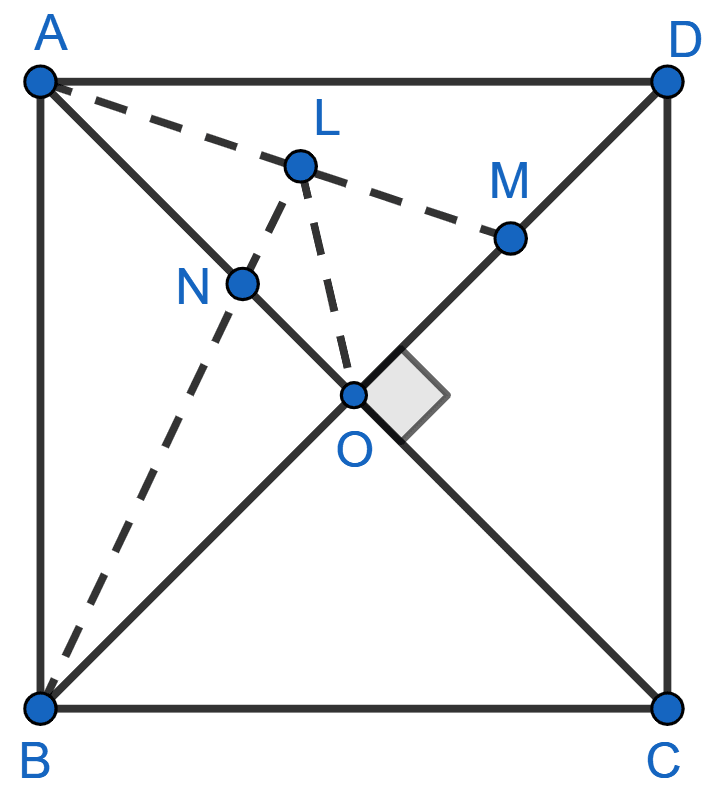
(i) As, diagonals of square intersect at right angles.
∴ ∠AOB = 90° and ∠AOD = 90°.
Diagonals of square bisect interior angles and each interior angle in a square = 90°.
∴ ∠NAB = 45°.
Since, BN is bisector of ∠OBA.
∴ ∠NBA = = 22.5°.
In △ANB,
⇒ ∠ANB + ∠NAB + ∠NBA = 180° [By angle sum property of triangle]
⇒ ∠ANB + 45° + 22.5° = 180°
⇒ ∠ANB + 67.5° = 180°
⇒ ∠ANB = 180° - 67.5°
⇒ ∠ANB = 112.5°.
From figure,
∠ONL = ∠ANB = 112.5° [Vertically opposite angles are equal.]
∴ ∠ONL = 112.5° ……………(1)
Since, AM is bisector of ∠OAD.
∴ ∠OAM = = 22.5°.
As, diagonals of square intersect at right angles.
∴ ∠AOM = 90°.
In △AMO,
⇒ ∠AMO + ∠AOM + ∠OAM = 180° [By angle sum property of triangle]
⇒ ∠AMO + 90° + 22.5° = 180°
⇒ ∠AMO + 112.5° = 180°
⇒ ∠AMO = 180° - 112.5°
⇒ ∠AMO = 67.5°
From figure,
⇒ ∠OML = ∠AMO
⇒ ∠OML = 67.5° …………..(2)
Adding (1) and (2), we get :
⇒ ∠ONL + ∠OML = 112.5° + 67.5° = 180°.
Hence, proved that ∠ONL + ∠OML = 180°.
(ii) Diagonals of square bisect interior angles and each interior angle in a square = 90°.
∴ ∠BAO = 45° and ∠OAD = 45°
Since, AM is bisector of ∠OAD.
∴ ∠OAM = = 22.5°.
From figure,
∠BAM = ∠BAO + ∠OAM = 45° + 22.5° = 67.5°.
As, diagonals of square intersect at right angles.
∴ ∠AOM = 90°.
In △OAM,
⇒ ∠OMA + ∠AOM + ∠OAM = 180° [By angle sum property of triangle]
⇒ ∠OMA + 90° + 22.5° = 180°
⇒ ∠OMA + 112.5° = 180°
⇒ ∠OMA = 180° - 112.5°
⇒ ∠OMA = 67.5°.
From figure,
∠BMA = ∠OMA = 67.5°.
Hence, proved that ∠BAM = ∠BMA.
(iii) In triangle ALB,
⇒ ∠BAL = ∠BAO + ∠OAL = 45° + 22.5° = 67.5°.
⇒ ∠ABL = 22.5°.
⇒ ∠ABL + ∠BAL + ∠ALB = 180° [Angle sum property of triangle]
⇒ 22.5° + 67.5° + ∠ALB = 180°
⇒ ∠ALB = 180° - 90° = 90°.
From figure,
∠AOB = 90° [As, diagonals of square intersect at right angle]
So,
∠ALB = ∠AOB.
We know that,
If a line segment joining two points subtends equal angles at two other points lying on the same side of the line containing the line segment, the four points lie on a circle (i.e. they are concyclic).
Hence, proved that ALOB is a cyclic quadrilateral.
Answered By
4 Likes
Related Questions
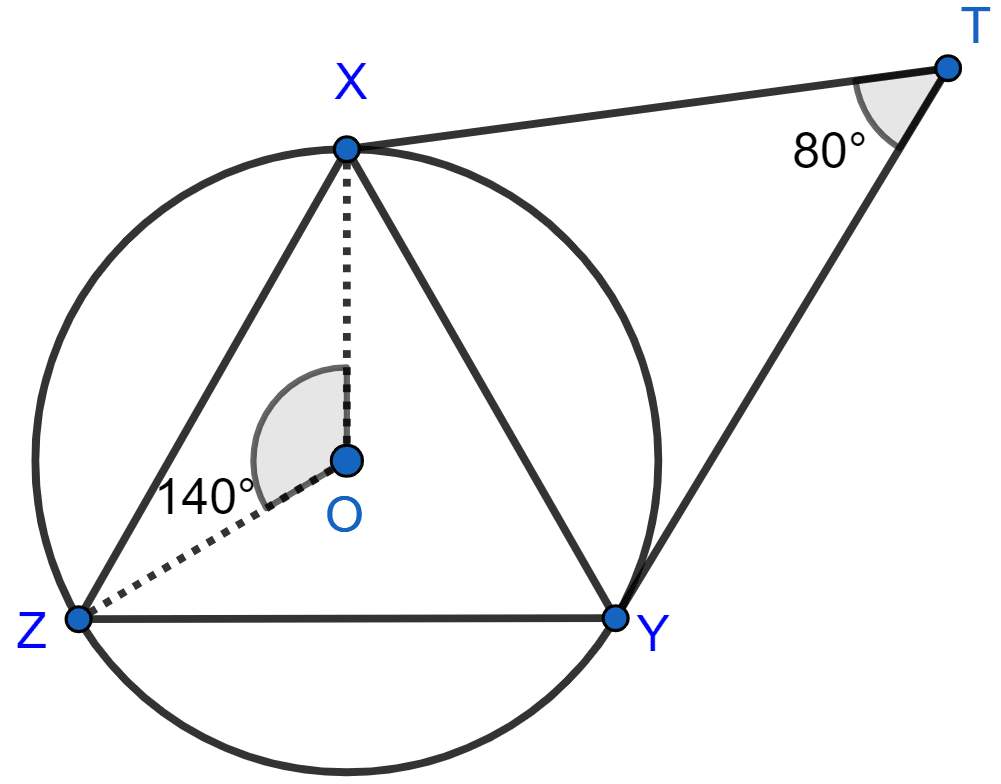
In the figure, given below, O is the center of the circumcircle of triangle XYZ. Tangents at X and Y intersect at point T. Given ∠XTY = 80° and ∠XOZ = 140°, calculate the value of ∠ZXY.
In the given figure, AE and BC intersect each other at point D. If ∠CDE = 90°, AB = 5 cm, BD = 4 cm and CD = 9 cm, find AE.

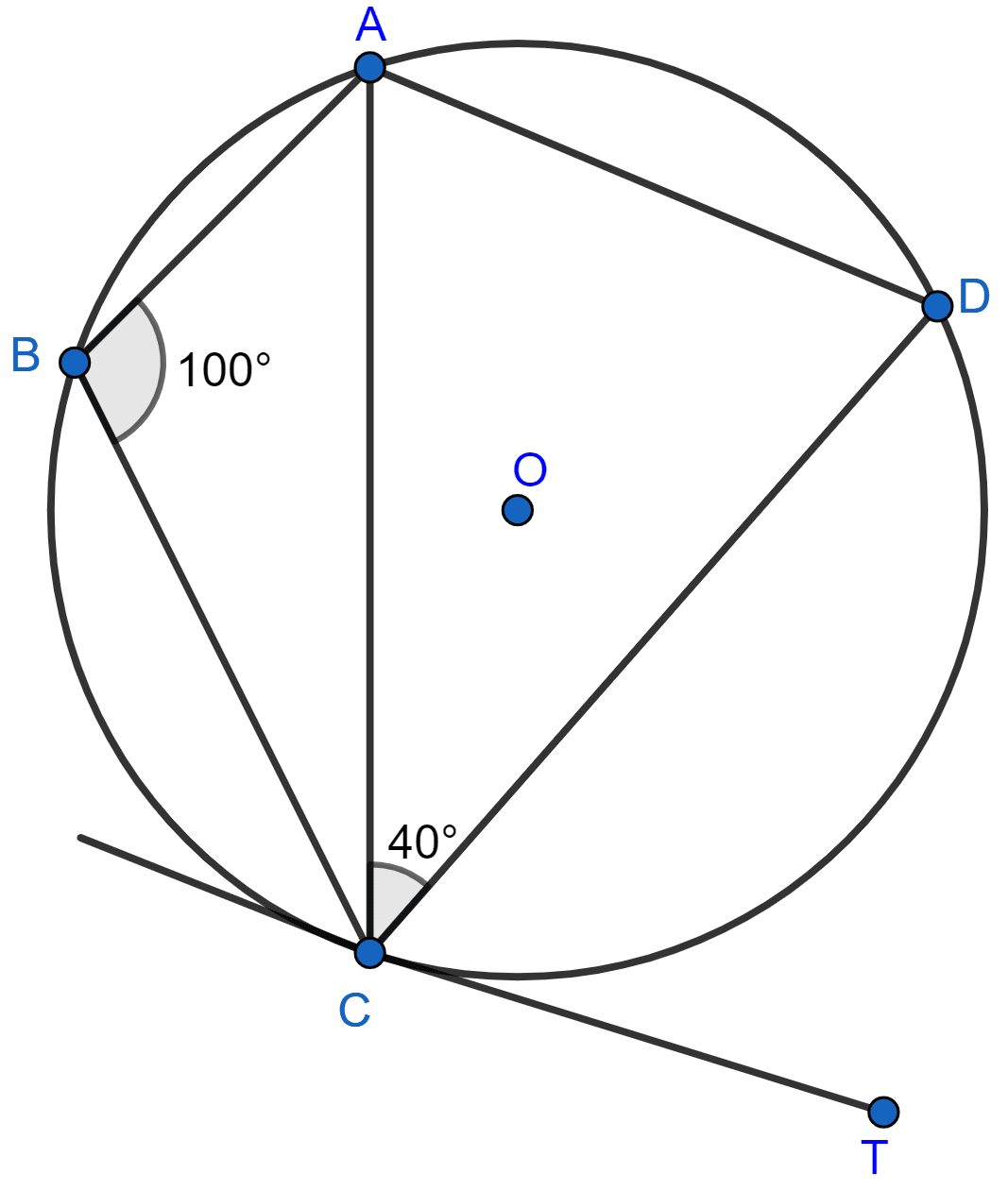
In the given circle with centre O, angle ABC = 100°, ∠ACD = 40° and CT is a tangent to the circle at C. Find ∠ADC and ∠DCT.
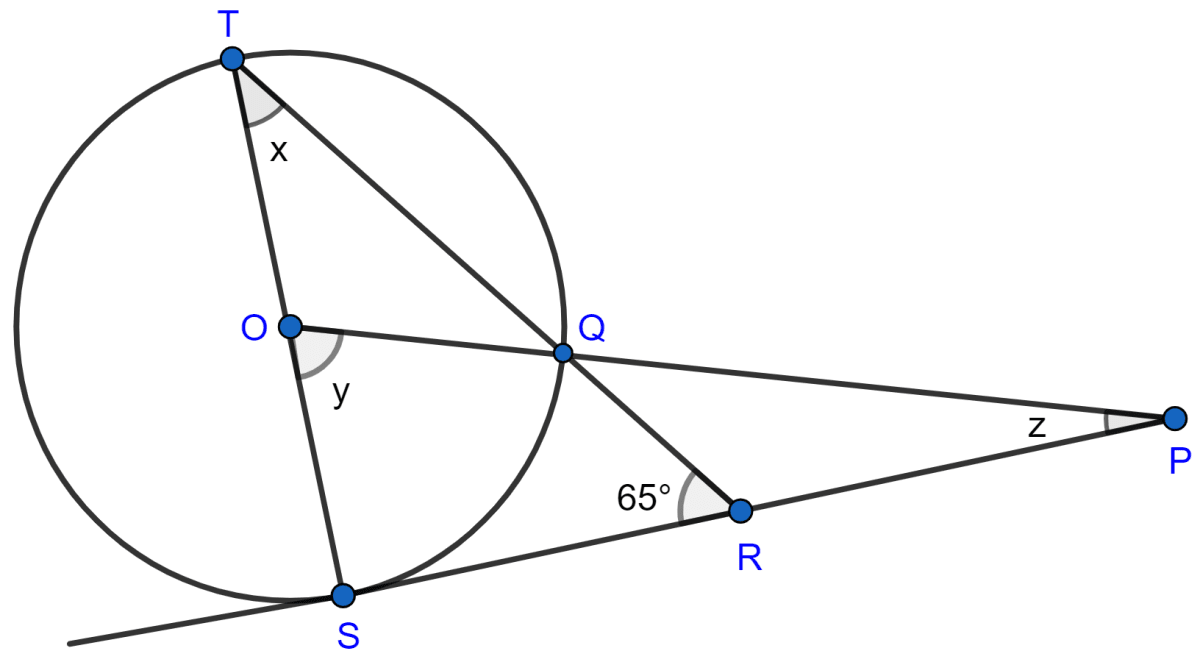
In the figure given below, O is the center of the circle and SP is a tangent. If ∠SRT = 65°, find the values of x, y and z.