Mathematics
In △ ABC, ∠B = 90°. Find the sides of the triangle, if :
(i) AB = (x - 3) cm, BC = (x + 4) cm and AC = (x + 6) cm
(ii) AB = x cm, BC = (4x + 4) cm and AC = (4x + 5) cm.
Pythagoras Theorem
13 Likes
Answer
(i) In right-angled triangle ABC,
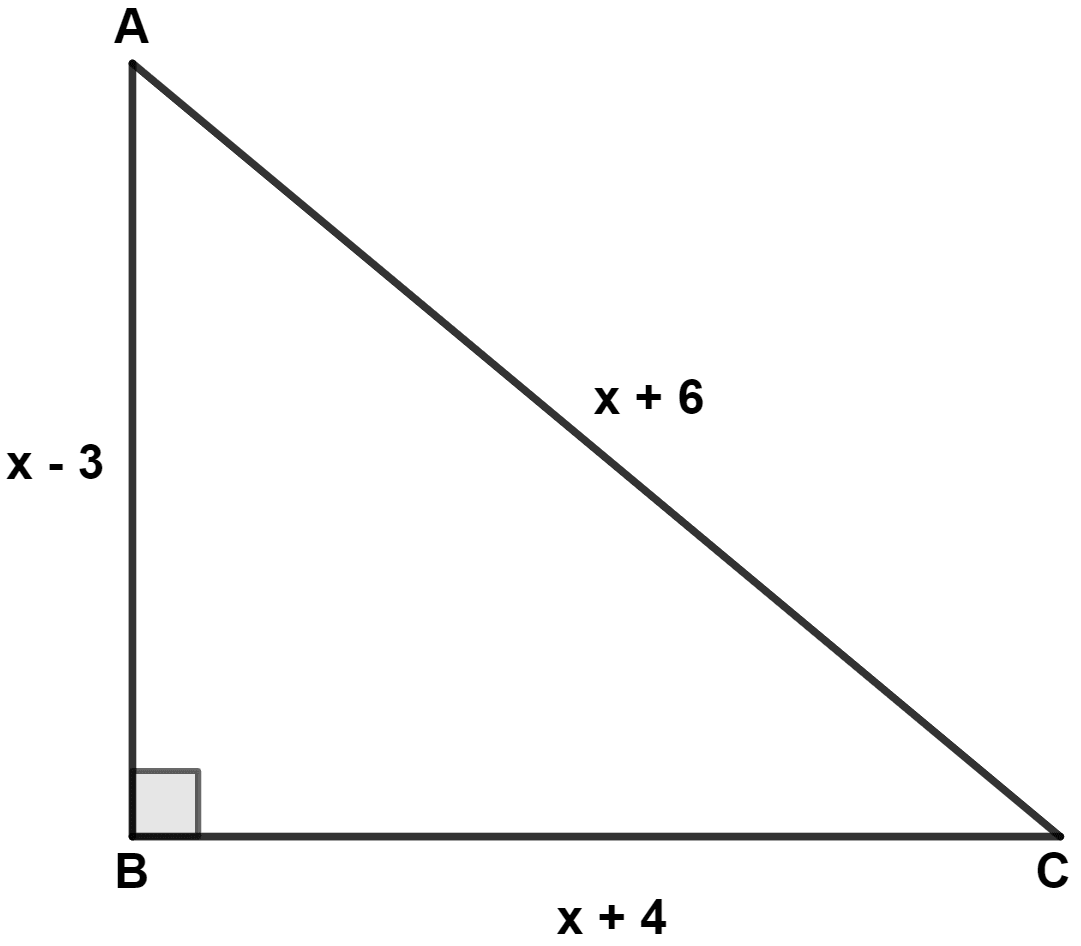
By pythagoras theorem,
⇒ (Hypotenuse)2 = (Perpendicular)2 + Base2
⇒ AC2 = AB2 + BC2
⇒ (x + 6)2 = (x - 3)2 + (x + 4)2
⇒ x2 + 62 + 12x = x2 + 9 - 6x + x2 + 16 + 8x
⇒ x2 + 36 + 12x = x2 + 9 - 6x + x2 + 16 + 8x
⇒ x2 + 36 + 12x = 2x2 + 25 + 2x
⇒ 2x2 - x2 + 2x - 12x + 25 - 36 = 0
⇒ x2 - 10x - 11 = 0
⇒ x2 - 11x + x - 11 = 0
⇒ x(x - 11) + 1(x - 11) = 0
⇒ (x + 1)(x - 11) = 0
⇒ x + 1 = 0 or x - 11 = 0
⇒ x = -1 or x = 11.
Since, side cannot be negative.
∴ x = 11.
AB = x - 3 = 11 - 3 = 8 cm,
BC = x + 4 = 11 + 4 = 15 cm,
AC = x + 6 = 11 + 6 = 17 cm.
Hence, AB = 8 cm, BC = 15 cm and AC = 17 cm.
(ii) In right-angled triangle ABC,
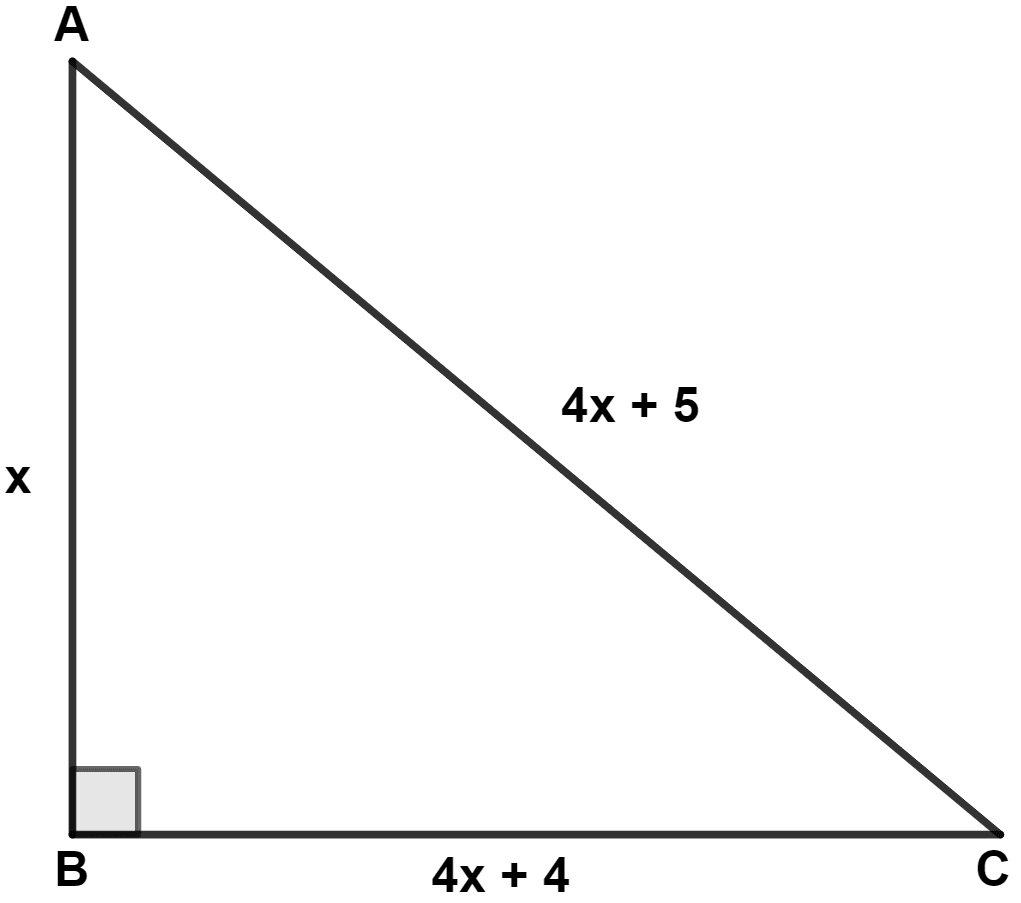
By pythagoras theorem,
⇒ (Hypotenuse)2 = (Perpendicular)2 + Base2
⇒ AC2 = AB2 + BC2
⇒ (4x + 5)2 = x2 + (4x + 4)2
⇒ (4x)2 + 52 + 2 × (4x) × 5 = x2 + (4x)2 + 42 + 2 × (4x) × 4
⇒ 16x2 + 25 + 40x = x2 + 16x2 + 16 + 32x
⇒ 16x2 + 25 + 40x = 17x2 + 16 + 32x
⇒ 17x2 - 16x2 + 16 - 25 + 32x - 40x = 0
⇒ x2 - 8x - 9 = 0
⇒ x2 - 9x + x - 9 = 0
⇒ x(x - 9) + 1(x - 9) = 0
⇒ (x + 1)(x - 9) = 0
⇒ x + 1 = 0 or x - 9 = 0
⇒ x = -1 or x = 9.
Since, side cannot be negative.
∴ x = 9.
AB = x = 9 cm,
BC = 4x + 4 = 4(9) + 4 = 36 + 4 = 40 cm,
AC = 4x + 5 = 4(9) + 5 = 35 + 5 = 41 cm.
Hence, AB = 9 cm, BC = 40 cm and AC = 41 cm.
Answered By
7 Likes
Related Questions
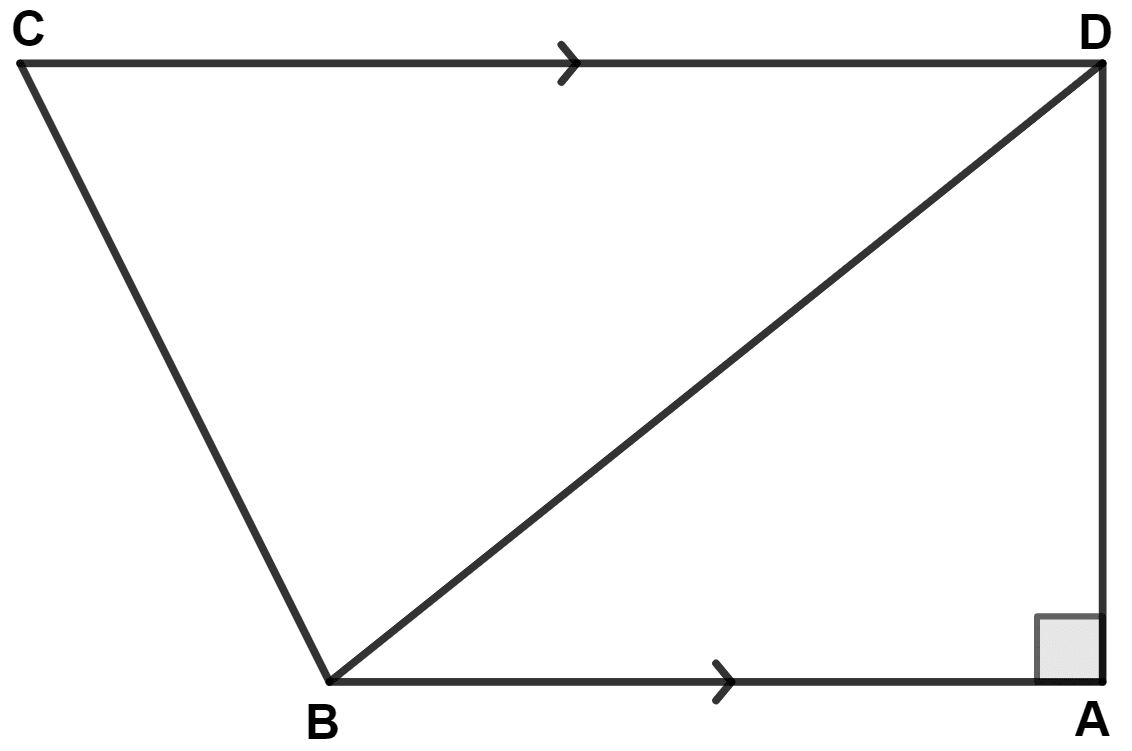
In the given figure, AB // CD, AB = 7 cm, BD = 25 cm and CD = 17 cm; find the length of side BC.
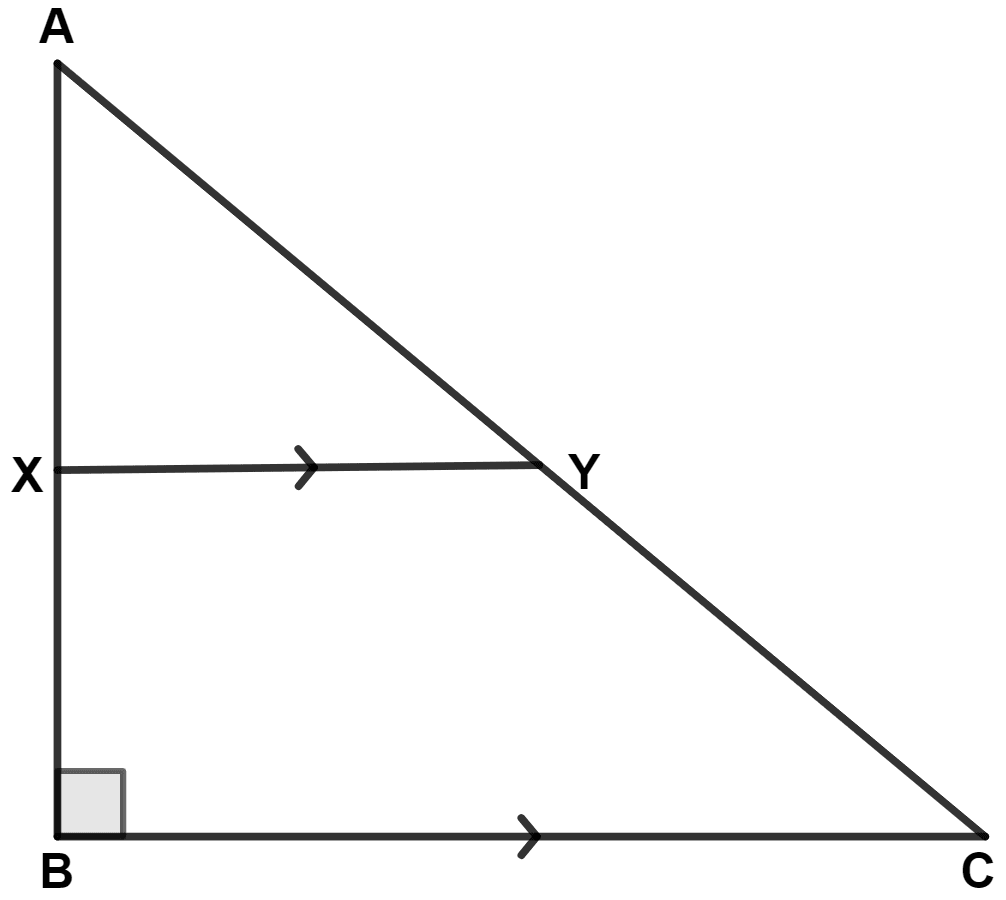
In the given figure, ∠B = 90°, XY // BC, AB = 12 cm, AY = 8 cm and AX : XB = 1 : 2 = AY : YC. Find the lengths of AC and BC.
If a side of a rhombus is 10 cm and one of the diagonals is 16 cm, find the other diagonal.
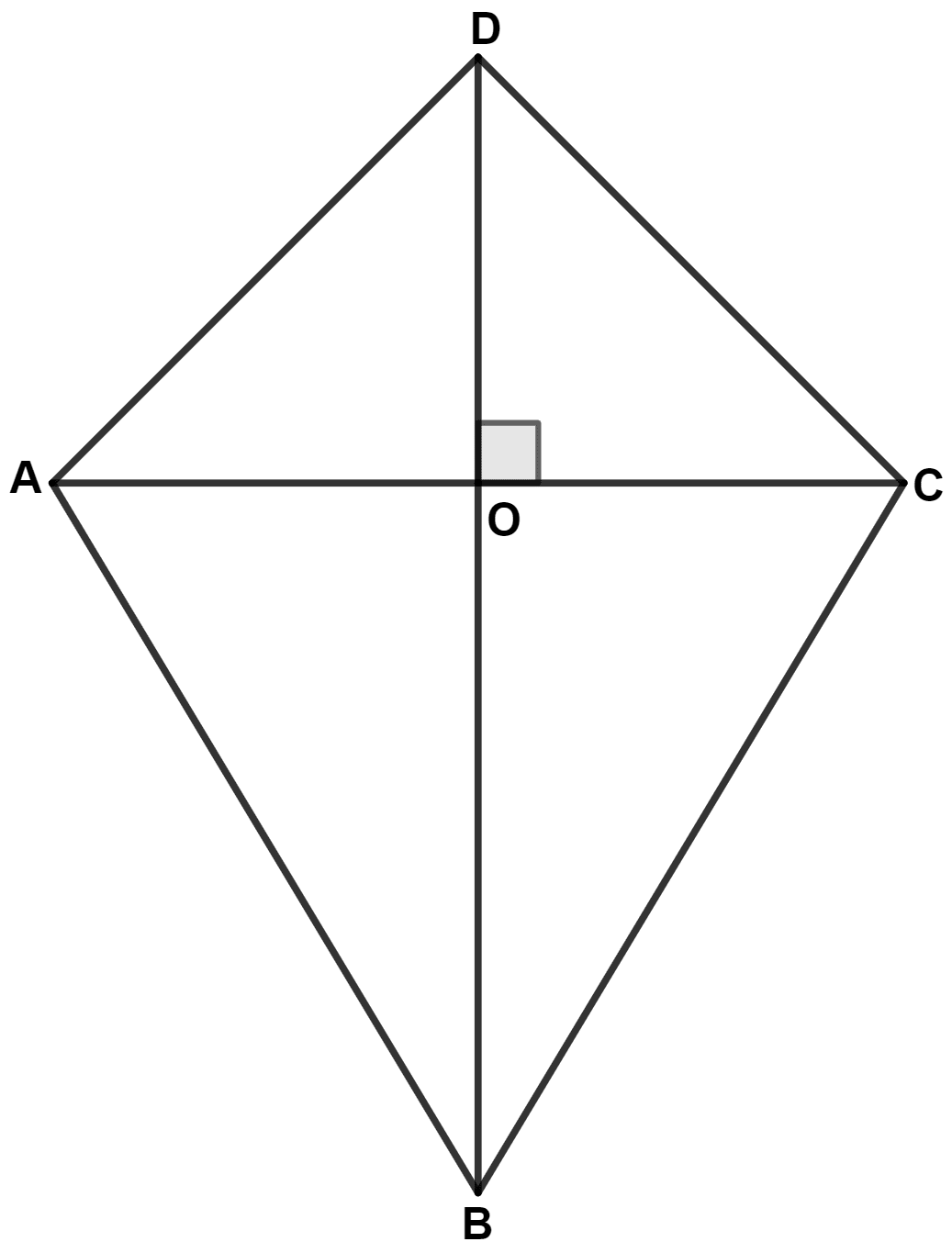
In the given figure, diagonals AC and BD intersect at right angle. Show that :
AB2 + CD2 = AD2 + BC2