
Mathematics
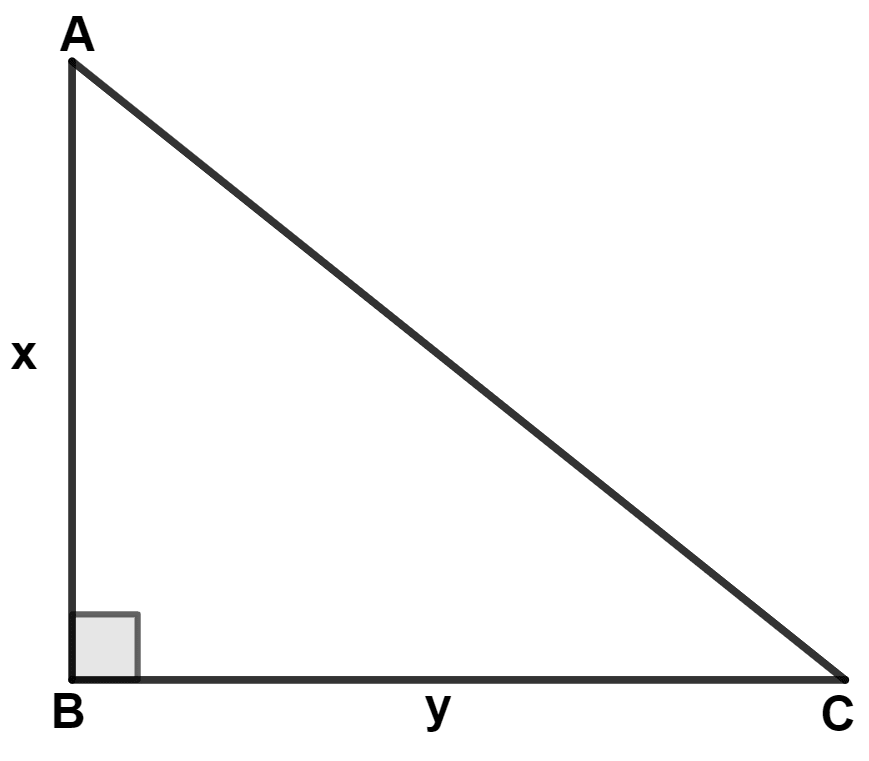
In the adjoining diagram, AB = x cm, BC = y cm and x - y = 7 cm. Area of △ ABC = 30 cm2. The length of AC is :
10 cm
12 cm
13 cm
15 cm
Quadratic Equations
46 Likes
Answer
By formula,
Area of triangle =
⇒ 30 =
⇒ 30 =
⇒ 30 =
⇒ xy = 60 ……..(1)
Given,
⇒ x - y = 7
⇒ x = 7 + y ……..(2)
Substituting value of x from equation (2) in (1), we get :
⇒ (7 + y)y = 60
⇒ 7y + y2 = 60
⇒ y2 + 7y - 60 = 0
⇒ y2 + 12y - 5y - 60 = 0
⇒ y(y + 12) - 5(y + 12) = 0
⇒ (y - 5)(y + 12) = 0
⇒ y - 5 = 0 or y + 12 = 0
⇒ y = 5 or y = -12.
Since, side cannot be negative,
∴ y = 5 cm.
Substituting value of y in equation (2), we get :
⇒ x = 7 + y = 7 + 5 = 12 cm.
In right angle triangle ABC,
By pythagoras theorem,
⇒ AC2 = AB2 + BC2
⇒ AC2 = x2 + y2
⇒ AC2 = 122 + 52
⇒ AC2 = 144 + 25
⇒ AC2 = 169
⇒ AC = = 13 cm.
Hence, Option 3 is the correct option.
Answered By
24 Likes
Related Questions
If x = -2 is one of the solutions of the quadratic equation x2 + 3a - x = 0, then the value of 'a' is :
-8
-2
In solving a quadratic equation, one of the values of the variables x is 233.356. The solution rounded to two significant figures is :
233.36
233.35
233.3
230
If p, q, and r are in continued proportion, then :
p : q = p : r
q : r = p2 : q2
p : q2 = r : p2
p : r = p2 : q2
The ratio of diameter to height of a Borosil cylindrical glass is 3 : 5. If the actual diameter of the glass is 6 cm, then the curved surface area of the glass is :
120π
60π
30π
18π