
Mathematics
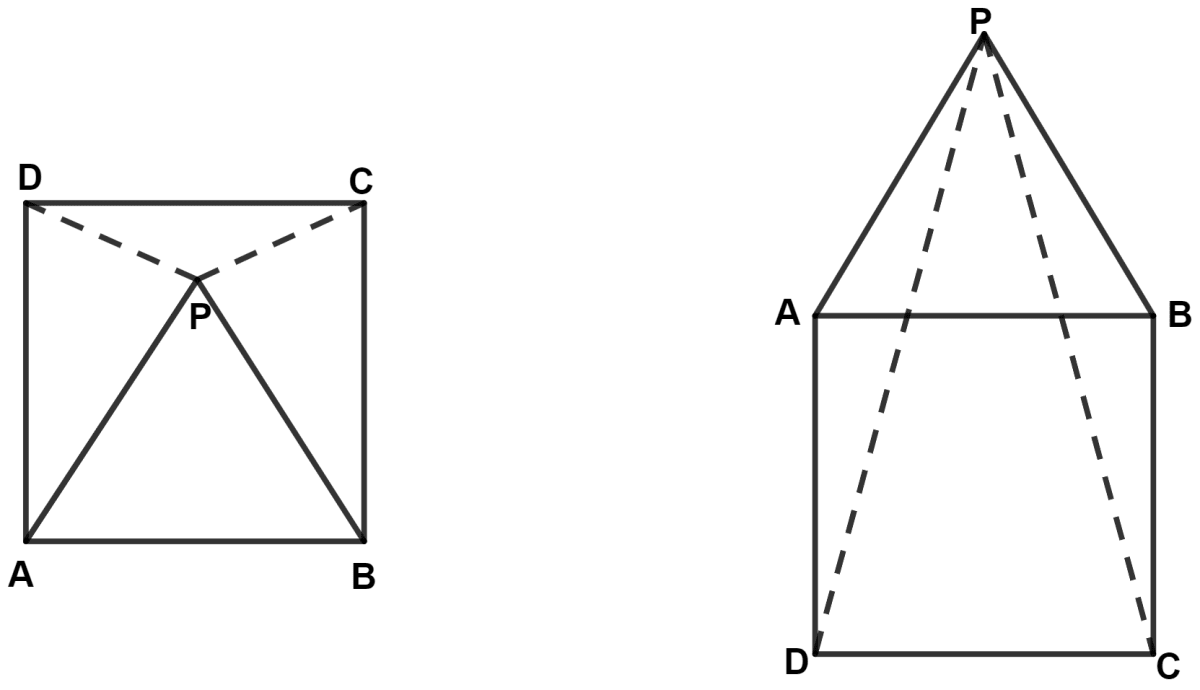
In the following diagrams, ABCD is a square and APB is an equilateral triangle. In each case,
(i) Prove that : △ APD ≅ △ BPC
(ii) Find the angles of △ DPC.
Triangles
85 Likes
Answer
For 1st case :
(i) We know that,
Each interior angle in a square is 90° and in an equilateral triangle is 60°.
From figure,
⇒ ∠DAP = ∠DAB - ∠PAB = 90° - 60° = 30°.
⇒ ∠CBP = ∠CBA - ∠PBA = 90° - 60° = 30°.
In △ APD and △ BPC,
⇒ ∠DAP = ∠CBP (Proved above)
⇒ AP = PB (Since, APB is an equilateral triangle)
⇒ AD = BC (Since, ABCD is a square)
∴ △ APD ≅ △ BPC (By S.A.S. axiom)
Hence, proved that △ APD ≅ △ BPC.
(ii) We know that,
⇒ AP = AB (Since, APB is an equilateral triangle)
⇒ AB = AD (Since, ABCD is a square)
∴ AP = AD
Thus, APD is an isosceles triangle.
We know that,
Angles opposite to equal sides are equal.
∴ ∠APD = ∠ADP = x (let)
In △ APD,
By angle sum property of triangle,
⇒ ∠APD + ∠ADP + ∠DAP = 180°
⇒ x + x + 30° = 180°
⇒ 2x + 30° = 180°
⇒ 2x = 180° - 30°
⇒ 2x = 150°
⇒ x = = 75°
⇒ ∠APD = ∠ADP = 75°.
From figure,
⇒ ∠ADC = 90° (Interior angle of a square is 90°)
⇒ ∠CDP = ∠ADC - ∠ADP = 90° - 75° = 15°.
Since, △ APD ≅ △ BPC,
⇒ DP = PC (By C.P.C.T.C.)
∴ DPC is an isosceles triangle.
⇒ ∠CDP = ∠DCP = 15° (Angles opposite to equal sides are equal)
In △ DCP,
By angle sum property of triangle,
⇒ ∠DCP + ∠CDP + ∠DPC = 180°
⇒ 15° + 15° + ∠DPC = 180°
⇒ 30° + ∠DPC = 180°
⇒ ∠DPC = 180° - 30° = 150°.
Hence, ∠CDP = ∠DCP = 15° and ∠DPC = 150°.
For 2nd case :
(i) We know that,
Each interior angle in a square is 90° and each interior angle in an equilateral triangle is 60°.
From figure,
⇒ ∠DAP = ∠DAB + ∠BAP
⇒ ∠DAP = 90° + 60° = 150°.
⇒ ∠CBP = ∠CBA + ∠ABP
⇒ ∠CBP = 90° + 60° = 150°.
In △ APD and △ BPC,
⇒ ∠DAP = ∠CBP (Both equal to 150°)
⇒ AP = PB (Since, APB is an equilateral triangle)
⇒ AD = BC (Since, ABCD is a square)
∴ △ APD ≅ △ BPC (By S.A.S. axiom)
(ii) ABCD is a square.
∴ AB = AD = DC = BC
APB is an equilateral triangle.
∴ AP = PB = AB
So, we get :
AP = AD and PB = BC
∴ △ APD and △ BPC are isosceles triangle.
We know that,
Angles opposite to equal sides are equal sides are equal.
∴ ∠APD = ∠ADP = x (let) and ∠BPC = ∠BCP = y (let)
In △ APD,
By angle sum property of triangle,
⇒ ∠APD + ∠ADP + ∠DAP = 180°
⇒ x + x + 150° = 180°
⇒ 2x + 150° = 180°
⇒ 2x = 180° - 150°
⇒ 2x = 30°
⇒ x = = 15°.
In △ BPC,
By angle sum property of triangle,
⇒ ∠BPC + ∠BCP + ∠PBC = 180°
⇒ y + y + 150° = 180°
⇒ 2y + 150° = 180°
⇒ 2y = 180° - 150°
⇒ 2y = 30°
⇒ y = = 15°.
From figure,
⇒ ∠PDC = ∠ADC - ∠ADP = 90° - 15° = 75°.
⇒ ∠PCD = ∠BCD - ∠BCP = 90° - 15° = 75°.
In △ DPC,
By angle sum property of triangle,
⇒ ∠DPC + ∠PDC + ∠PCD = 180°
⇒ ∠DPC + 75° + 75° = 180°
⇒ ∠DPC + 150° = 180°
⇒ ∠DPC = 180° - 150° = 30°.
Hence, ∠DPC = 30° and ∠PDC = ∠PCD = 75°.
Answered By
46 Likes
Related Questions
On the sides AB and AC of triangle ABC, equilateral triangles ABD and ACE are drawn. Prove that :
(i) ∠CAD = ∠BAE
(ii) CD = BE.
A line segment AB is bisected at point P and through point P another line segment PQ, which is perpendicular to AB, is drawn. Show that : QA = QB.
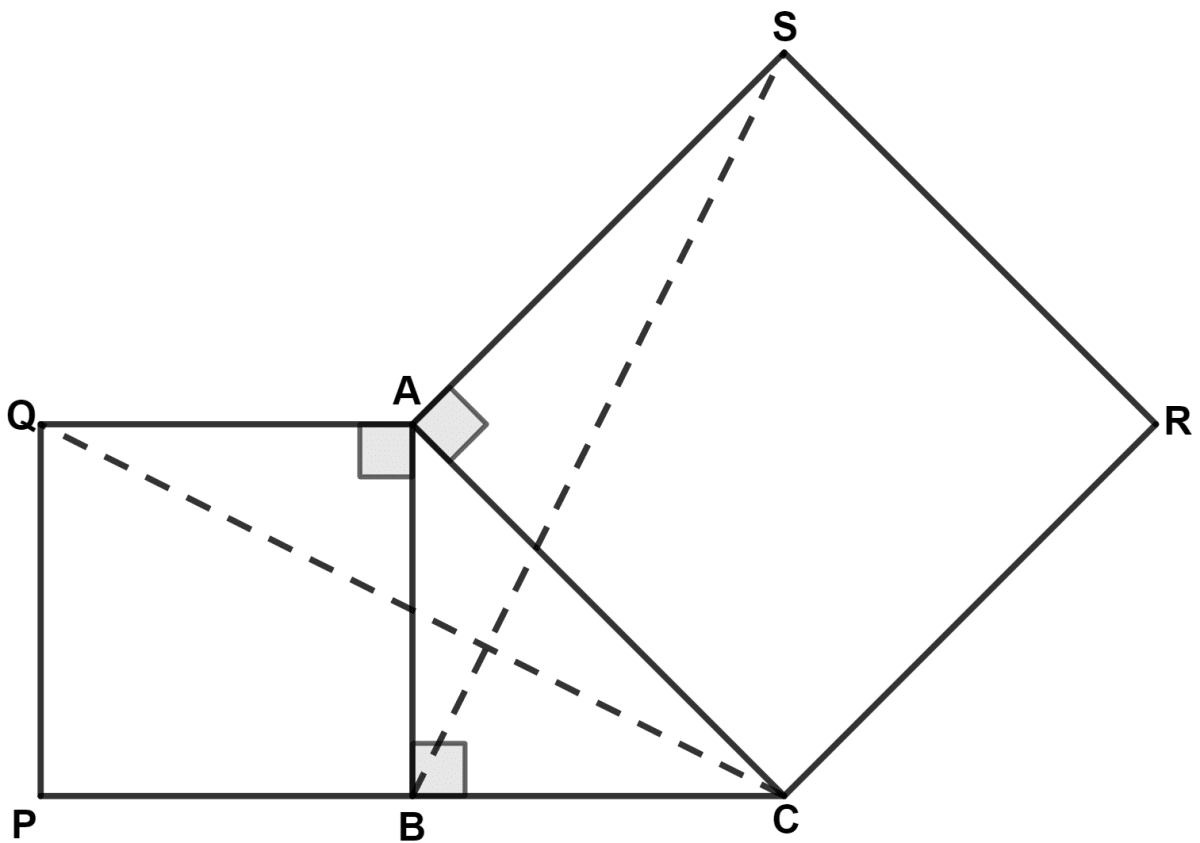
In the figure, given below, triangle ABC is right-angled at B. ABPQ and ACRS are squares. Prove that :
(i) △ ACQ and △ ASB are congruent.
(ii) CQ = BS.
In a △ ABC, BD is the median to the side AC, BD is produced to E such that BD = DE. Prove that : AE is parallel to BC.