
Mathematics
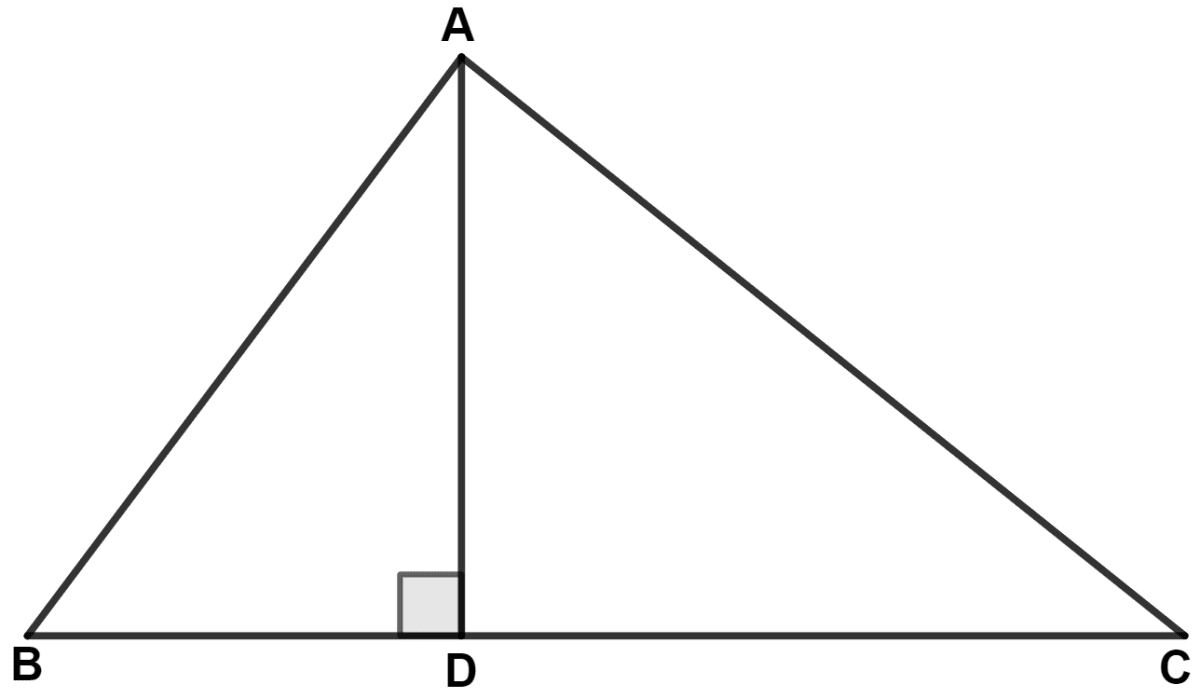
In the following figure, AD is perpendicular to BC and D divides BC in the ratio 1 : 3.
Prove that : 2AC2 = 2AB2 + BC2.
Pythagoras Theorem
8 Likes
Answer
Given,
D divides BC in the ratio 1 : 3.
⇒ BD : DC = 1 : 3
Let BD = x and DC = 3x
From figure,
⇒ BC = BD + DC = x + 3x = 4x.
In right angle triangle ADC,
By pythagoras theorem,
⇒ AC2 = AD2 + CD2 …………(1)
In right angle triangle ABD,
By pythagoras theorem,
⇒ AB2 = AD2 + BD2 …………(2)
Subtracting equation (2) from (1), we get :
⇒ AC2 - AB2 = AD2 + CD2 - (AD2 + BD2)
⇒ AC2 - AB2 = CD2 - BD2
Substituting value of BD and CD in above equation, we get :
Hence, proved that 2AC2 = 2AB2 + BC2.
Answered By
5 Likes
Related Questions
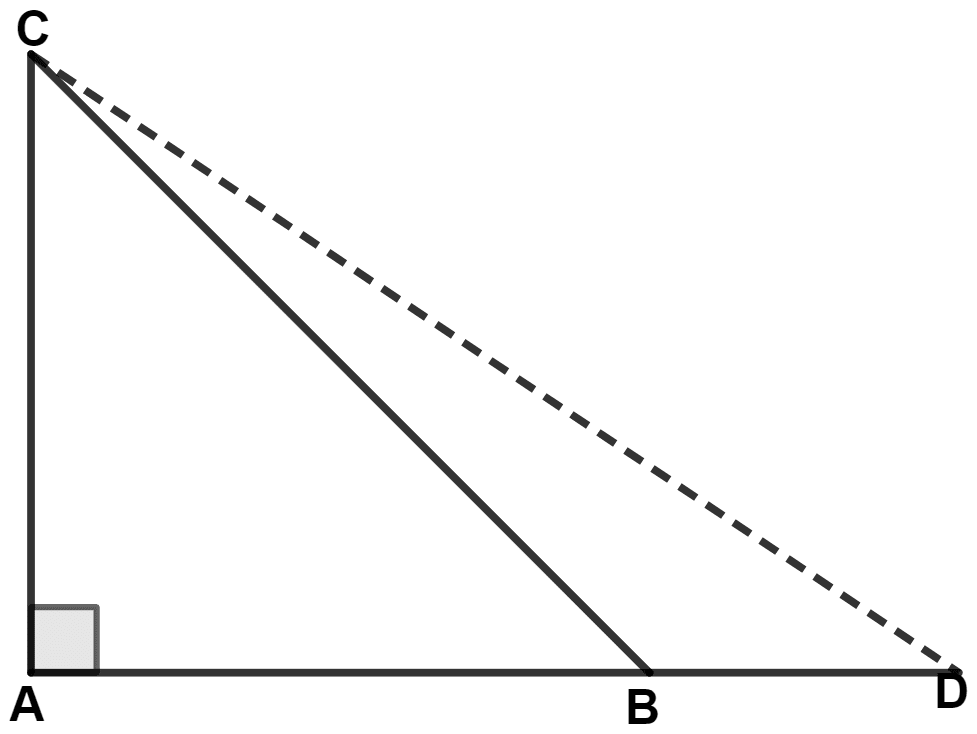
In triangle ABC, angle A = 90°, CA = AB and D is a point on AB produced. Prove that :
DC2 - BD2 = 2AB.AD.
In triangle ABC, AB = AC and BD is perpendicular to AC. Prove that :
BD2 - CD2 = 2CD × AD
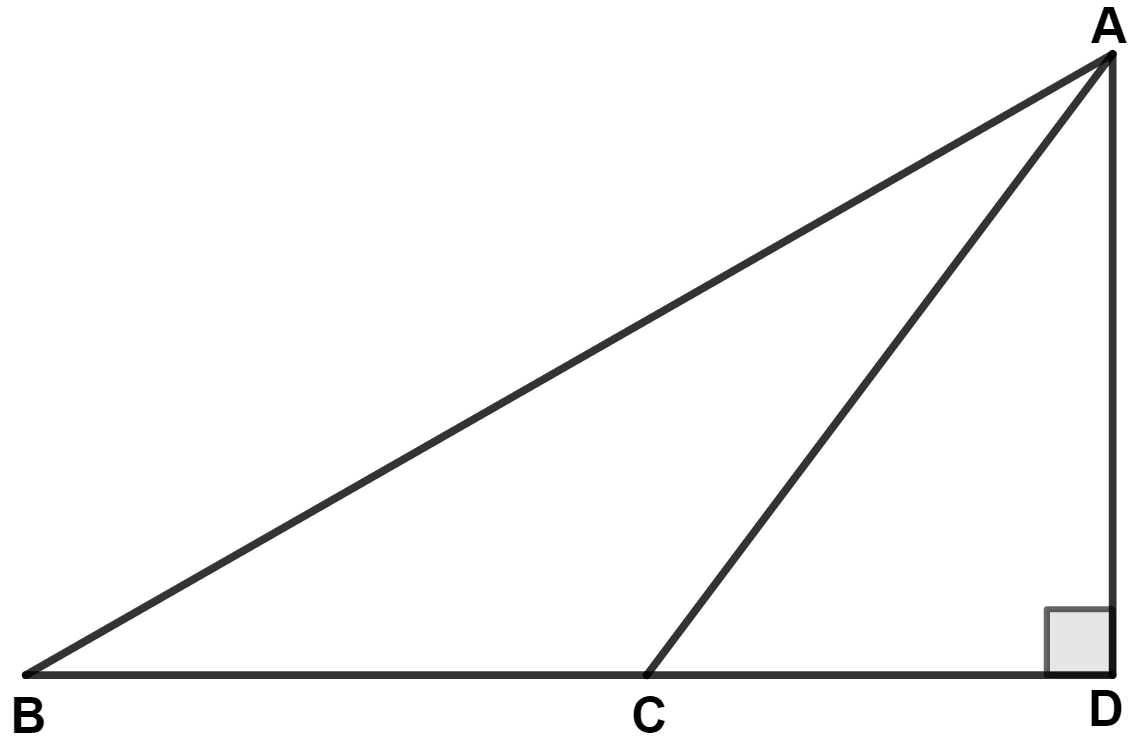
In the given figure, AB = 16 cm, BC = 12 cm and CA = 6 cm; find the length of CD.
In a quadrilateral ABCD, ∠A + ∠D = 90°, prove that : AC2 + BD2 = AD2 + BC2.