Chemistry
In the table below, H does not represent hydrogen. Some elements are given in their own symbol and position in the periodic table while others are shown with a letter.
| 1A 1 | IIA 2 | IIIA 13 | IVA 14 | VA 15 | VIA 16 | VIIA 17 | O 18 |
|---|---|---|---|---|---|---|---|
| Li | D | O | J | Ne | |||
| A | Mg | E | Si | H | K | ||
| B | C | F | G | L |
Answer the following questions.
Identify the most electronegative element.
Identify the most reactive element of group IA or 1.
Identify the element from period 3 with the smallest atomic size.
Identify the element with the highest ionization potential.
How many valence electrons are present in G ?
Which element from group 2 will have the least ionization energy ?
Identify the noble gas of the fourth period.
In the compound between A and H, what type of bond is formed ? Give its molecular formula.
Answer
J is the most electronegative element.
B is the most reactive element of group IA or 1.
K is the element from period 3 with smallest atomic size.
Ne the highest ionization potential.
5 valence electrons present in G.
C is the element from group 2 which has least ionization energy.
L is the noble gas of the fourth period.
ionic bond is formed between A and H.
The molecular formula is :
2A + H ⟶ A2H
Related Questions
The atomic number of an element Z is 20. State
(a) the number of valence electron(s) in the element.
(b) the position of Z in the periodic table.
(c) whether the element is a metal or a non-metal.
(d) State the formula of the compound between Z and hydrogen.
M is a metal and its oxide has the formula M2O. This oxide when dissolved in water forms the corresponding hydroxide which is a good conductor of electricity. In the above context, answer the following :
(i) State the number of electrons in the outermost shell of M ?
(ii) Name the group to which M belongs.
(iii) which element has more electronegativity, M or O?
The metals of Group 2 in the periodic table from top to bottom are — Be, Mg, Ca, Sr, and Ba.
(i) Which one of these elements will form ions most readily and why?
(ii) State the common feature in the electronic configuration of all these given elements.
You are provided with the table given below. Answer the questions that follow :
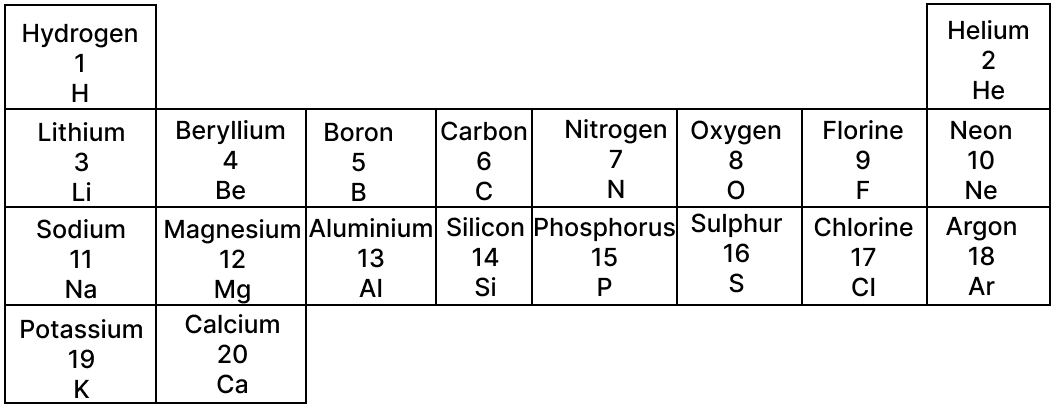
(a) Which element has the largest size ?
(b) Name the most non metallic element.
(c) Name the element with the lowest ionization potential.
(d) Write the formula of the sulphate of the element with atomic no. 13.
(e) What is the electronic configuration of the element in the fourth period that forms a dipositive ion ?
(f) Write the formula of the phosphate of the element in fourth period, second group.