
History & Civics
The All India Congress Committee which met at Bombay on 8th August, 1942 passed the famous Quit India Resolution.
In this context, answer the following questions :
(a) Mention the reasons that led to the passing of the Resolution.
(b) Explain the spread of the Quit India Movement.
(c) State the repressive measures practised by the British Government.
(d) State the importance of the Movement.
Quit India Movement
2 Likes
Answer
(a) The Quit India Movement started in 1942. The reasons for starting the same were the following :
- Failure of the Cripps Mission : The Cripps Mission (March 1942) failed to solve the constitutional problem of India. It led to discontent, dissatisfaction and anger. Indian people were filled with distrust and hostility towards the British.
- Japanese Threat : Japan was rapidly advancing towards India and there was a growing threat of Japanese invasion on India. The Congress leaders believed that to save India from the Japanese attack, the British must handover power to the Indians and quit the country.
(b) All India Congress Committee (AICC) was held at Bombay on August 8, 1942. It passed the famous Quit India resolution.
- Gandhiji raised the slogan 'Do or Die' and declared that it would be his final struggle for the freedom of the country.
- Gandhiji and other leaders of the Congress were arrested in the early hours of the morning of August 9, 1942.
- The Congress was declared illegal and its funds were confiscated.
- The people started the Quit India Movement over the whole of the country.
- The people were leaderless, unorganised, unprepared and undirected. So the movement assumed a violent turn.
- They observed hartals and took out processions and organised demonstrations. Public life came to a standstill and all business was suspended.
- People became violent and burnt post offices, telegraph offices, police stations, railway stations and other Government buildings. They cut off telegraph, telephone and electric lines. Bridges were blown up and roads were dug up.
- They shot down notorious police officers and hurled bombs upon them. The movement became a popular upsurge and the whole country rose to overthrow the British Rule.
(c) The repressive measures practised by the British Government are given below:
- Thousands of people were imprisoned without trial.
- The undertrials were tortured. Lathi-charge, firing, beating and flogging became the order of the day.
- The press was completely muzzled.
- Many villages were looted and burnt. Collective fines were also imposed on them.
- By using repressive measures the Government ultimately succeeded in crushing the movement within a few weeks.
- About 10,000 people died in firing and about 70,000 were put behind the bars.
(d) The Quit India Movement was short-lived but its results were of far-reaching consequences.
- It Demonstrated the Depth of the National Feelings : In the Quit India Movement people from all walks of life took part irrespective of religion, gender, caste, and creed. In some areas, the revolutionaries set up 'parallel governments'. It was clear that the national feelings had become too deep-rooted to be uprooted by any one.
- People Acquired Great Capacity for Struggle and Sacrifice : The Indians showed great capacity for struggle and sacrifice. It was made clear to the British that the Indians would accept no less than complete independence.
- It Made the English Realise that Their Days were Numbered in India : The pace and depth of the Quit India Movement made the English realise that their days were numbered in India. The tremor, though short-lived, left the British quite aghast and they read the writing on the wall.
Answered By
1 Like
Related Questions
‘The Quit India Movement made Independence of India as the only agenda of the National Movement. It proved that there could be no retreat and future negotiations could only be on the manner of the transfer of power.’
With reference to the above statement, enlist the impact of the Quit India Movement.
With reference to the Cripps Mission, explain :
(a) Why was the Cripps Mission sent to India?
(b) Mention four causes of their proposals.
(c) Why did both Congress and Muslim League reject it?
Netaji Subhas Chandra Bose played a great part in the National Movement. In this context, explain the following :
(a) Political aims of Netaji.
(b) Part played by him in liberating India from the British yoke.
Study the picture given and answer the following questions:
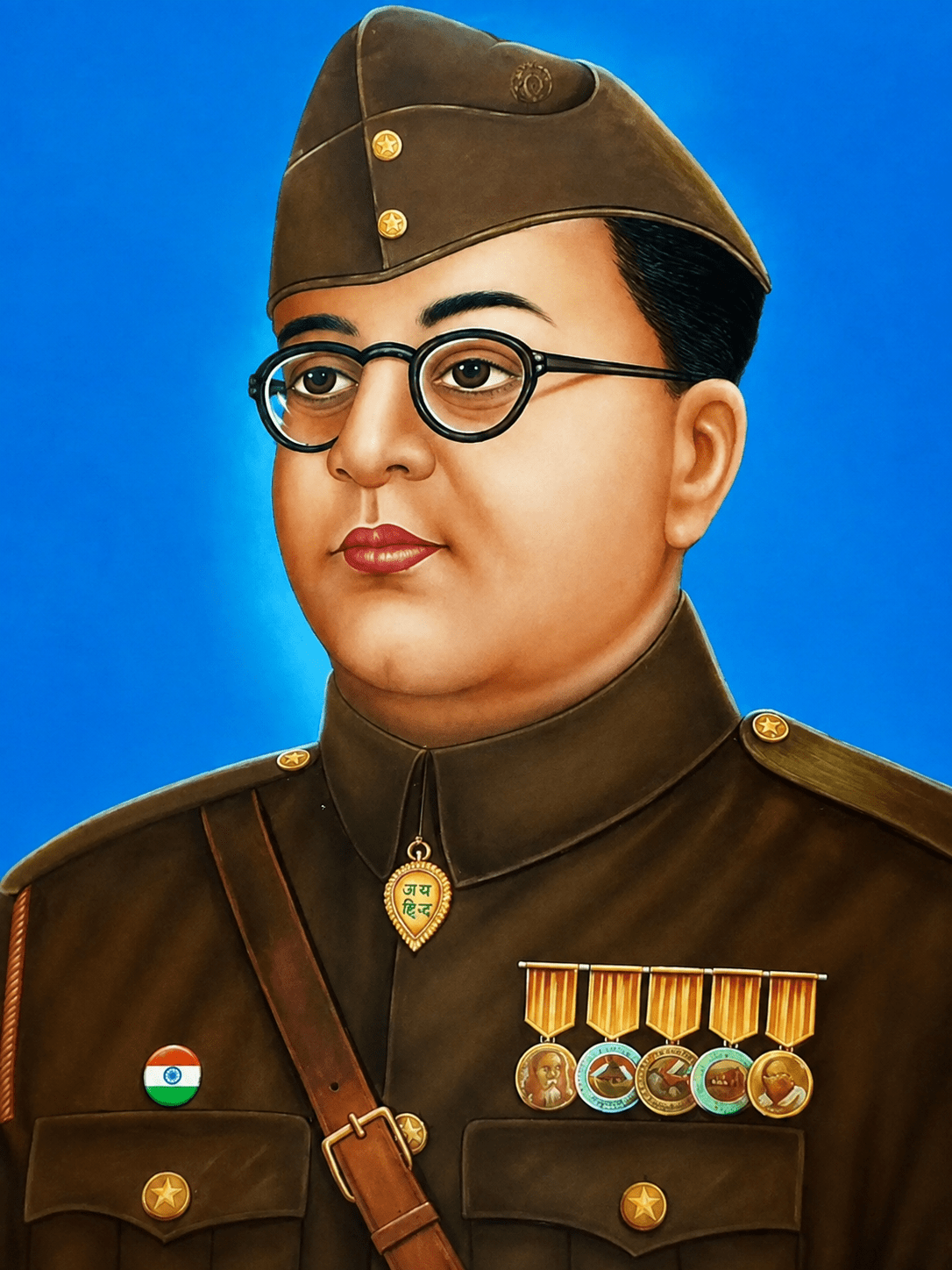
(a) Identify the leader given in the picture. Name the Political party and the Military Organisation that he formed.
(b) State any three objectives of the Political party that he founded.
(c) Mention any four objectives of the Military Organisation that he formed.