
Biology
The invention of the microscope was a great boon for people to study smaller objects or micro-organisms. Scientists made different microscopes by using different types of lenses for magnification.
Gaurav made a table of two scientists and the kind of microscope they invented.
| The kind of microscope | Scientist |
|---|---|
| P | Robert Hooke |
| Q | Antony Van Leeuwenhoek |
Identify P and Q
- P — Simple microscope, Q — Compound microscope.
- P — Electron microscope, Q — Simple microscope.
- P — Compound microscope, Q — Electron microscope.
- P — Compound microscope, Q — Simple microscope.
Cell
26 Likes
Answer
P — Compound microscope, Q — Simple microscope.
Reason — Compound microscope was invented by Robert Hooke and simple microscope was invented by Antony Van Leeuwenhoek.
Electron microscope was invented by Ernst Ruska.
Answered By
15 Likes
Related Questions
The pigment which is not found in plastids is:
- Xanthophyll
- Carotene
- Anthocyanin
- Chlorophyll
The tubules of Golgi Complexes are technically termed as:
- Cisternae
- Microtubules
- Cristae
- Vesicles
Given below is the structure of nucleus of a cell. Read the information below the diagram and fill in the blanks:
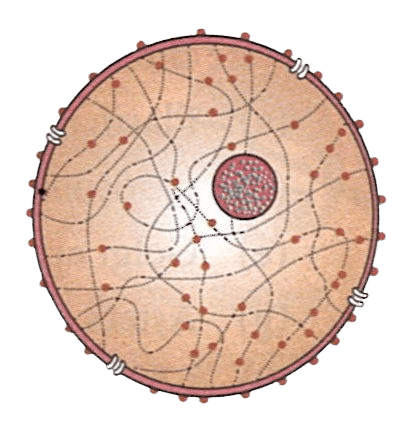
Nucleus is the most important part of the cell. It is located in the central area in animal cells but pushed towards the periphery in plant cells due to the presence of a large vacuole in the centre. It regulates and coordinates various life processes of the cell and also plays an important role in cell division.
Nucleus has a delicate, protective surrounding layer (a) …………… which is filled with a relatively dense fluid (b) …………… . There are certain thread-like structures suspended in the fluid called (c) …………… . These thin thread-like fine structures become thick and ribbon-like during the time of cell division. These prominent ribbon-like structures are called (d) …………… .Nucleus contains a spherical, dense body inside it, called as (e) …………… which participates in protein synthesis.
Name the part of the cell concerned with the following?
- Liberation of energy
- Synthesis of proteins
- Transmission of heredity characters from parents to offspring
- Initiation of cell division
- Hydrolytic in function
- Entry of only certain substances into and out of the cell.