
Mathematics
L and M are the mid-points of sides AB and DC respectively of parallelogram ABCD. Prove that segments DL and BM trisect diagonal AC.
Mid-point Theorem
28 Likes
Answer
From figure,
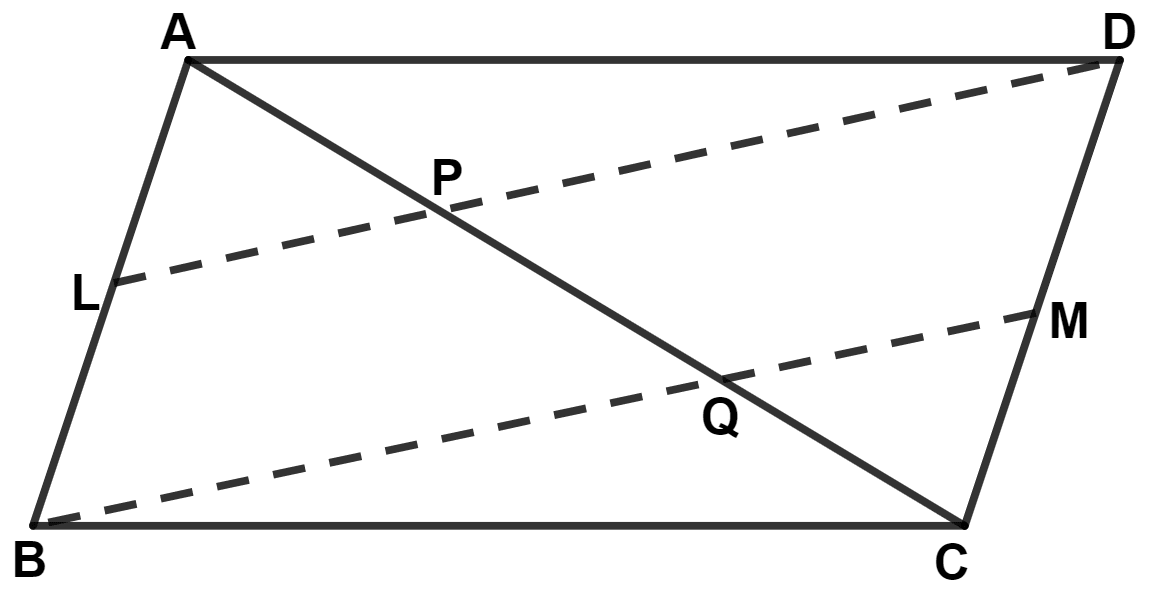
As, ABCD is a parallelogram.
∴ AB = CD
⇒
⇒ BL = DM
As, AB || CD
∴ BL || DM
Since, in quadrilateral DLBM,
BL = DM and BL || DM
∴ DLBM is a parallelogram.
So we get, DL parallel to MB.
Suppose DL and BM intersect AC at P and Q respectively.
By converse of mid-point theorem,
The straight line drawn through the mid-point of one side of a triangle parallel to another, bisects the third side.
In triangle ABQ,
⇒ PL || QB (As, DL || MB)
⇒ Given, L is the midpoint of AB.
∴ P is the mid point of AQ (By converse of mid-point theorem)
∴ AP = PQ ……..(1)
In triangle CDP,
⇒ QM || PD (As, BM || DL)
⇒ Given, M is the midpoint of CD.
∴ Q is the mid point of CP (By converse of mid-point theorem)
∴ PQ = CQ ……..(2)
From equations (1) and (2), we get,
⇒ AP = PQ = CQ.
Hence, proved that DL and BM trisect the diagonal AC.
Answered By
19 Likes
Related Questions
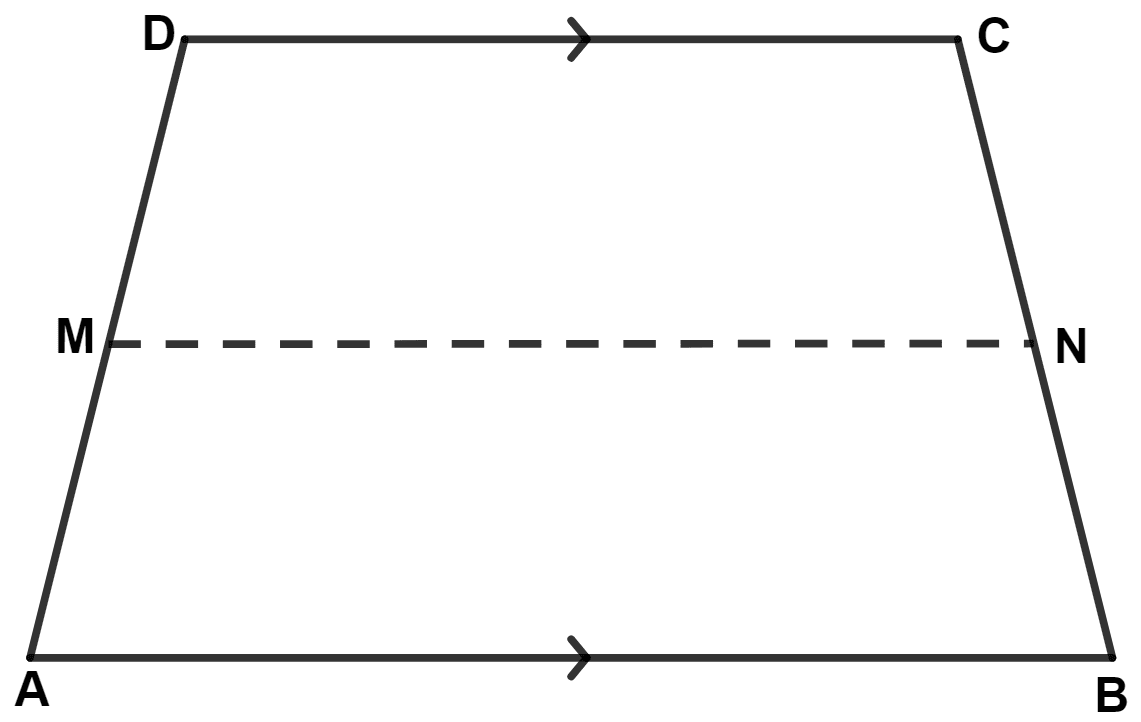
The figure, given below, shows a trapezium ABCD. M and N are the mid-points of the non-parallel sides AD and BC respectively. Find :
(i) MN, if AB = 11 cm and DC = 8 cm.
(ii) AB, if DC = 20 cm and MN = 27 cm.
(iii) DC, if MN = 15 cm and AB = 23 cm.
The diagonals of a quadrilateral intersect at right angles. Prove that the figure obtained by joining the mid-points of the adjacent sides of the quadrilateral is a rectangle.
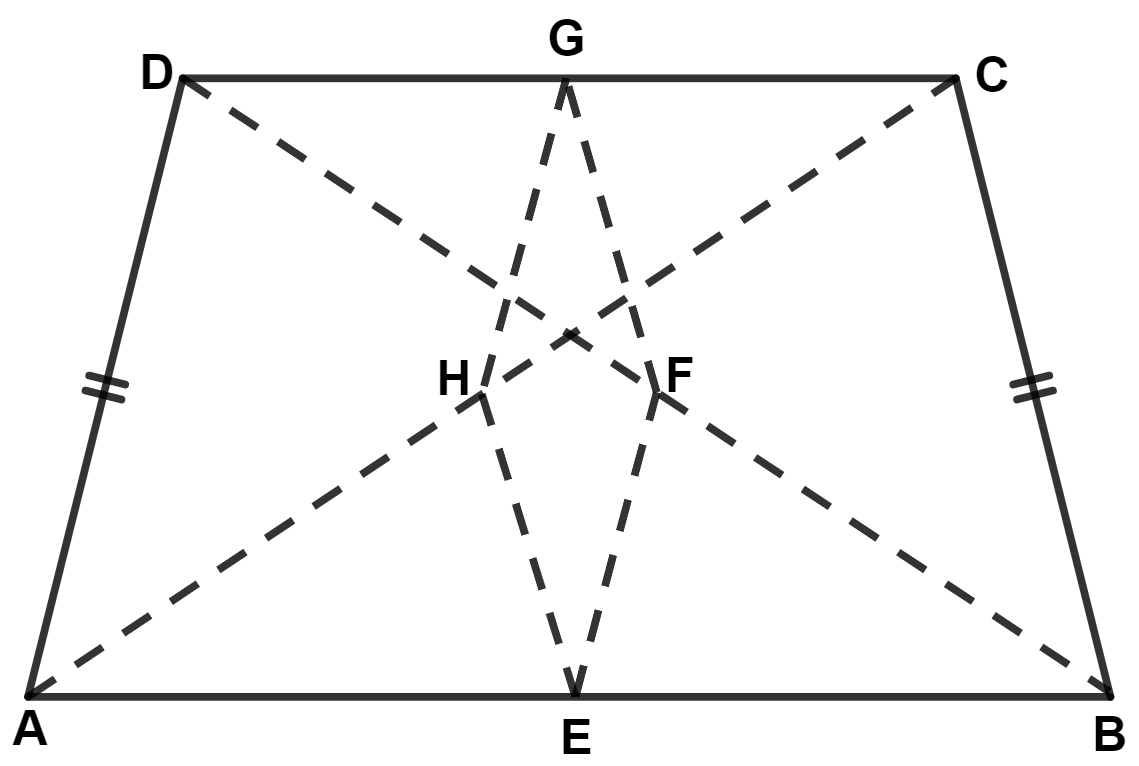
ABCD is a quadrilateral in which AD = BC. E, F, G and H are the mid-points of AB, BD, CD and AC respectively. Prove that EFGH is a rhombus.
A parallelogram ABCD has P the mid-point of DC and Q a point of AC such that CQ = . PQ produced meets BC at R.
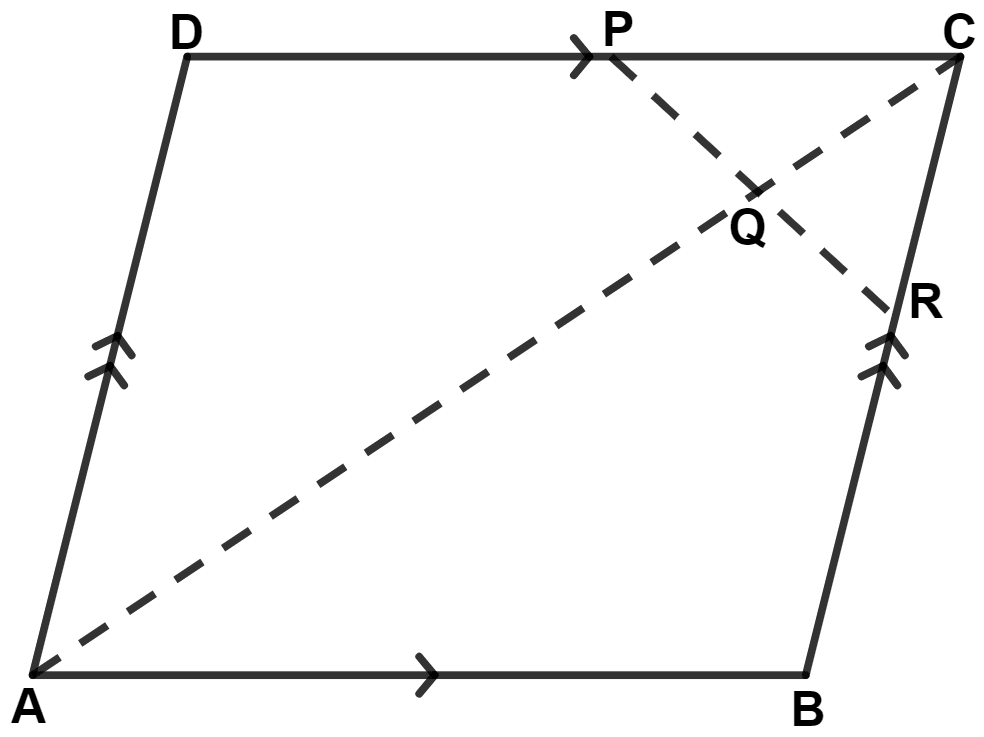
Prove that :
(i) R is the mid-point of BC,
(ii) PR = .