
Mathematics
Let A and B be two sets such that n(A) = 52, n(B) = 60 and n(A ∩ B) = 16. Draw a Venn diagram and find :
(i) n(A ∪ B)
(ii) n(A - B)
(iii) n(B - A)
Sets
2 Likes
Answer
Given:
n(A) = 52
n(B) = 60
n(A ∩ B) = 16
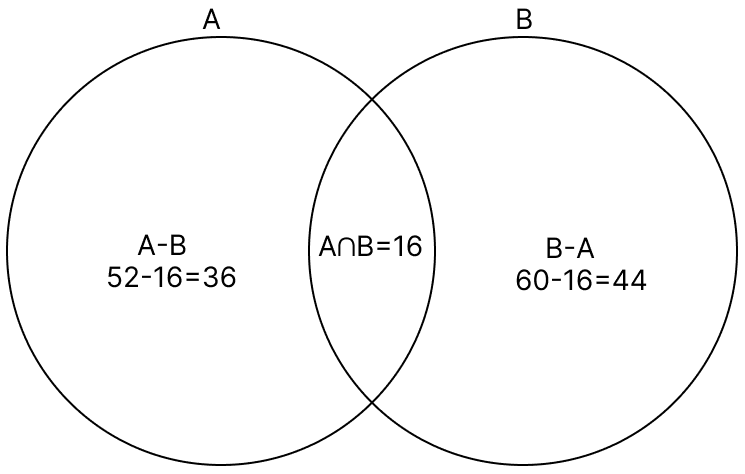
(i) n(A ∪ B)
The number of elements in the union of two sets is found using the formula:
n(A ∪ B) = n(A) + n(B) - n(A ∩ B)
Substituting the values in above, we get:
n(A ∪ B) = 52 + 60 - 16
n(A ∪ B) = 112 - 16
∴ n(A ∪ B) = 96
(ii) n(A - B)
The number of elements that belong to A but not to B is found by subtracting the intersection from n(A):
n(A - B) = n(A) - n(A ∩ B)
Substituting the values in above, we get:
n(A - B) = 52 - 16
∴ n(A - B) = 36
(iii) n(B - A)
The number of elements that belong to B but not to A is found by subtracting the intersection from n(B):
n(B - A) = n(B) - n(A ∩ B)
Substituting the values in above, we get:
n(B - A) = 60 - 16
∴ n(B - A) = 44
Answered By
1 Like
Related Questions
Let U = {a, b, c, d, e, f, g} be the universal set and let its subsets be A = {a, b, d, e} and B = {b, e, g}.
Verify that:
(i) (A ∪ B)' = (A' ∩ B')
(ii) (A ∩ B)' = (A' ∪ B')
Let U = {3, 6, 9, 12, 15, 18, 21, 24} be the universal set and let A = {6, 12, 18, 24} be its subset.
Verify that:
(i) A ∪ A = A
(ii) A ∩ A = A
(iii) A ∩ A' = Φ
(iv) A ∪ A' = U
(v) (A')' = A
Let P and Q be two sets such that n(P ∪ Q) = 70, n(P) = 45 and n(Q) = 38. Draw a Venn diagram and find :
(i) n(P ∩ Q)
(ii) n(P - Q)
(iii) n(Q - P)
In a city, there are 25 Hindi medium schools, 18 English medium schools and 7 schools have both the mediums. Find
(i) how many schools are there in all in the city ;
(ii) how many schools have Hindi medium only ;
(iii) how many schools have English medium only.