Mathematics
Let p(x) = ax + b and q(x) = cx + d be two linear polynomials such that:
(i) p(0) = 5.
(ii) The polynomial p(x) – q(x) cuts the x-axis at (3, 0).
(iii) The sum p(x) + q(x) is equal to 6x + 4 for all real x.
Find the polynomials p(x) and q(x).
Answer
Given:
p(x) = ax + b and q(x) = cx + d
Using condition (i): p(0) = 5
p(0) = a(0) + b
5 = b
⇒ b = 5
Using condition (iii): p(x) + q(x) = 6x + 4
p(x) + q(x) = (ax + b) + (cx + d)
= (a + c)x + (b + d)
Comparing with 6x + 4:
a + c = 6 …(i)
b + d = 4
Substituting b = 5:
5 + d = 4
⇒ d = -1
Using condition (ii): p(x) - q(x) cuts the x-axis at (3, 0)
p(x) - q(x) = (ax + b) - (cx + d)
= (a - c)x + (b - d)
Substituting b = 5 and d = -1:
p(x) - q(x) = (a - c)x + (5 - (-1)) = (a - c)x + 6
Since the graph cuts the x-axis at (3, 0), substituting x = 3, p(x) - q(x) = 0:
(a - c)(3) + 6 = 0
⇒ 3(a - c) = -6
⇒ a - c = -2 …(ii)
Solving (i) and (ii):
a + c = 6
a - c = -2
Adding:
2a = 4
⇒ a = 2
Substituting value of a in a + c = 6:
2 + c = 6
⇒ c = 4
So, a = 2, b = 5, c = 4, d = -1.
Hence, p(x) = 2x + 5 and q(x) = 4x - 1.
Related Questions
The work done by a body on the application of a constant force is the product of the constant force and the distance travelled by the body in the direction of the force. Express this in the form of a linear equation in two variables (work w and distance d), and draw its graph by taking the constant force as 3 units. What is the work done when the distance travelled is 2 units? Verify it by plotting it on the graph.
The graph of a linear polynomial p(x) passes through the points (1, 5) and (3, 11).
(i) Find the polynomial p(x).
(ii) Find the coordinates where the graph of p(x) cuts the axes.
(iii) Draw the graph of p(x) and verify your answers.Look at the first three stages of a growing pattern of hexagons made using matchsticks. A new hexagon gets added at every stage which shares a side with the last hexagon of the previous stage.
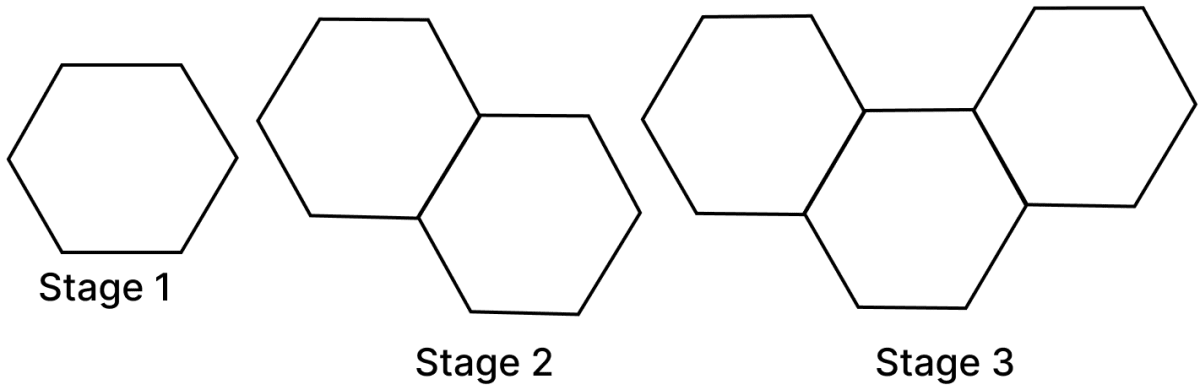
(i) Draw the next two stages of the pattern. How many matchsticks will be required at these stages?
(ii) Complete the following table.Stage Number 1 2 3 4 5 … n Number of matchsticks (iii) Find a rule to determine the number of matchsticks required for the nth stage.
(iv) How many matchsticks will be required for the 15th stage of the pattern?
(v) Can 200 matchsticks form a stage in this pattern? Justify your answer.Let p(x) = ax + b and q(x) = cx + d be two linear polynomials such that:
(i) The graph of p(x) passes through the points (2, 3) and (6, 11).
(ii) The graph of q(x) passes through the point (4, –1).
(iii) The graph of q(x) is parallel to the graph of p(x).Find the polynomials p(x) and q(x). Also, find the coordinates of the point where these lines meet the x-axis.