
Physics
A lift starts from rest at the ground floor and moves vertically upward along a straight shaft. During the first 4 s, the lift moves with uniform acceleration and attains a velocity of 2 m s-1. It then moves with uniform velocity for the next 6 s. Finally, it is brought to rest uniformly in 2 s at the top floor.
Assuming the motion to be one-dimensional, answer the following:
(a) Calculate the acceleration of the lift during the first 4 s.
(b) Calculate the total height between the ground floor and the top floor.
(c) Draw the velocity-time graph for the complete motion and mark the regions of acceleration, retardation and zero acceleration.
(d) Use the graph to calculate the average velocity of the lift during the upward journey.
(e) If the lift now moves downward following the same pattern, how would the signs of acceleration and displacement change?
(f) "The lift has maximum acceleration when it starts moving." Is this statement correct? Give reason.
Motion in One Dimension
6 Likes
Answer
Given,
- Intial velocity of the lift = 0 m s-1
- Final velocity of the lift after 4 s = 2 m s-1
- Time for which lift moves with uniform velocity = 6 s
- Final velocity at the top floor = 0 m s-1
- Time taken to bring the lift to rest = 2 s
(a) The lift starts from rest, so initial velocity u = 0 and after 4 s, the velocity becomes v = 2 m s-1
On using,
On putting values,
Hence, the acceleration of the lift during the first 4 s is 0.5 m s-2.
(b) Stage 1 : 0 – 4 s : Uniform acceleration
- u = 0 m s-1
- v = 2 m s-1
- a = 0.5 m s-2
- t = 4 s
On using,
Stage 2 : 4 – 10 s : Uniform velocity
- v = 2 m s-1
- a = 0 m s-2
- t = 6 s
Stage 3 : 10 – 12 s : Retardation
- u = 2 m s-1
- v = 0 m s-1
- t = 2 s
On using,
The total height is the sum of displacements in three stages i.e.,
Total height = H1 + H2 + H3 = 4 + 12 + 2 = 18 m
Hence, the total height between the ground floor and the top floor is 18 m.
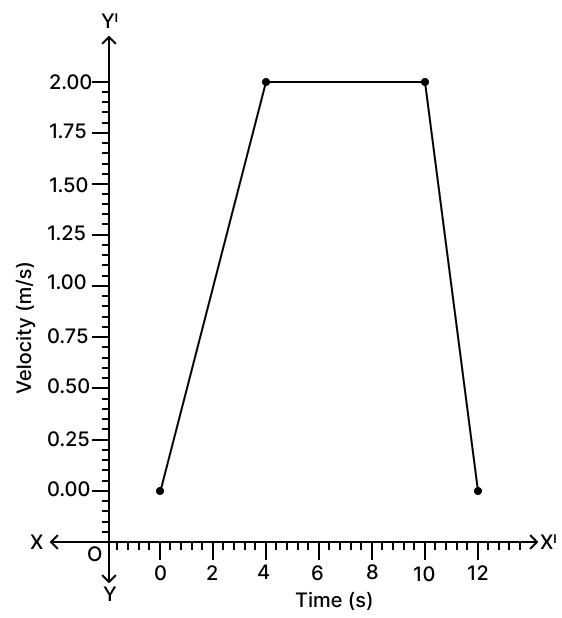
(c) The velocity–time graph has three straight segments:
- From 0–4 s: velocity increases from 0 to 2 m s-1 (uniform acceleration).
- From 4–10 s: horizontal line at 2 m s-1 (zero acceleration).
- From 10–12 s: velocity decreases from 2 m s-1 to 0 m s-1 (uniform retardation).
So, the velocity-time graph for the complete motion is shown below :
(d) Average veloctiy of the lift is given by,
Where the net displacement covered by an object is given by the area under velocity-time graph.
Then,
Net displacement = Area under v-t graph
= area of the triangle formed during 0 s - 4 s + area of the rectangle fromed during 4 s - 10 s + area of the triangle formed during 10 s - 12 s
= x (4 - 0) x 2 + (10 - 4) x 2 + x (12 - 10) x 2
= x 4 x 2 + 6 x 2 + x 2 x 2
= 4 + 12 + 2
= 18 m
On putting values,
Hence, the average velocity of the lift during the upward journey is 1.5 m s-1.
(e) If the lift moves downward, the direction of motion reverses. Therefore:
- Displacement becomes negative (taking upward as positive).
- Acceleration also becomes negative (taking upward as positive).
(f) No, the statement is not correct because the lift has uniform acceleration during the first 4 s, which means its acceleration remains constant, not maximum only at the start and it does not suddenly peak at the beginning; it remains the same throughout the acceleration phase.
Answered By
5 Likes
Related Questions
Assertion (A) : The slope of displacement-time graph gives the velocity.
Reason (R) : Velocity is the product of displacement and time.
- both A and R are true and R is the correct explanation of A
- both A and R are true and R is not the correct explanation of A
- assertion is false but reason is true
- assertion is true but reason is false
Assertion (A) : The velocity-time graph of a body in motion can be a straight line parallel to the time axis.
Reason (R) : This is because the motion of body is with non-uniform velocity.
- Both A and R are true and R is the correct explanation of A
- Both A and R are true and R is not the correct explanation of A
- Assertion is false but reason is true
- Assertion is true but reason is false
Assertion (A) : The acceleration-time graph of а body is a straight line parallel to time axis.
Reason (R) : This depicts the motion of freely falling body under gravity.
- both A and R are true and R is the correct explanation of A
- both A and R are true and R is not the correct explanation of A
- assertion is false but reason is true
- assertion is true but reason is false
Assertion (A) : Acceleration of a moving body is always positive.
Reason (R) : Acceleration is the rate of change of velocity with time.
- both A and R are true and R is the correct explanation of A
- both A and R are true and R is not the correct explanation of A
- assertion is false but reason is true
- assertion is true but reason is false