
Mathematics
A line segment AB is of length 8 cm. Draw a circle of radius 5 cm that passes through A and B.
Can you draw a circle of radius 3 cm passing through A and B ? Give reason in support of your answer.
Circles
3 Likes
Answer
Steps of construction:
Draw a line segment AB = 8 cm.
Draw the perpendicular bisector of AB.
Mark the intersection point of the perpendicular bisector and the line passing through midpoint of AB as O (the required center).
With center O and radius OA = 5 cm, draw a circle.
The circle will pass through both A and B.
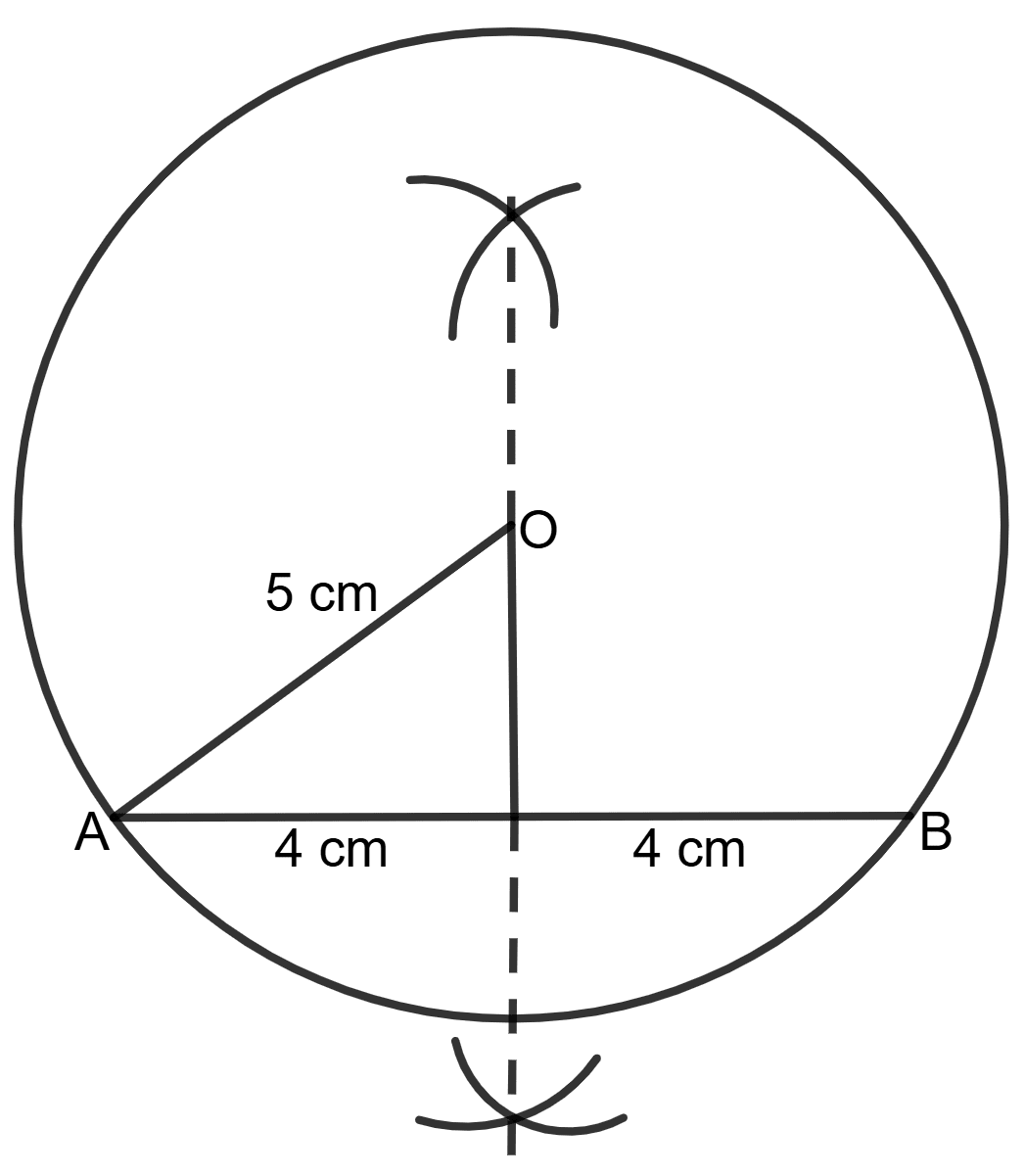
No, a circle of radius 3 cm cannot pass through A and B.
The maximum possible radius of a circle passing through A and B is half of AB, i.e., 4 cm (when the center is at the perpendicular bisector). If the radius is 3 cm, the total diameter of such a circle would be 6 cm, which is less than AB = 8 cm. Thus, it is not possible to draw a circle of radius 3 cm passing through A and B.
Hence, a circle of radius 3 cm cannot pass through A and B.
Answered By
1 Like
Related Questions
The area of the parallelogram ADFE is 275 cm2 and AD = 12.5 cm. Find the distance between point D and side EF.
Equal chords of a circle subtend equal angles at the centre, prove it.
Two circles of radii 10 cm and 17 cm intersecting each other at two points and the distance between their centres is 21 cm. Find the length of the common chord.
In the given circle, arc APB and arc BQC are in the ratio 2 : 5 and O is centre of the circle.
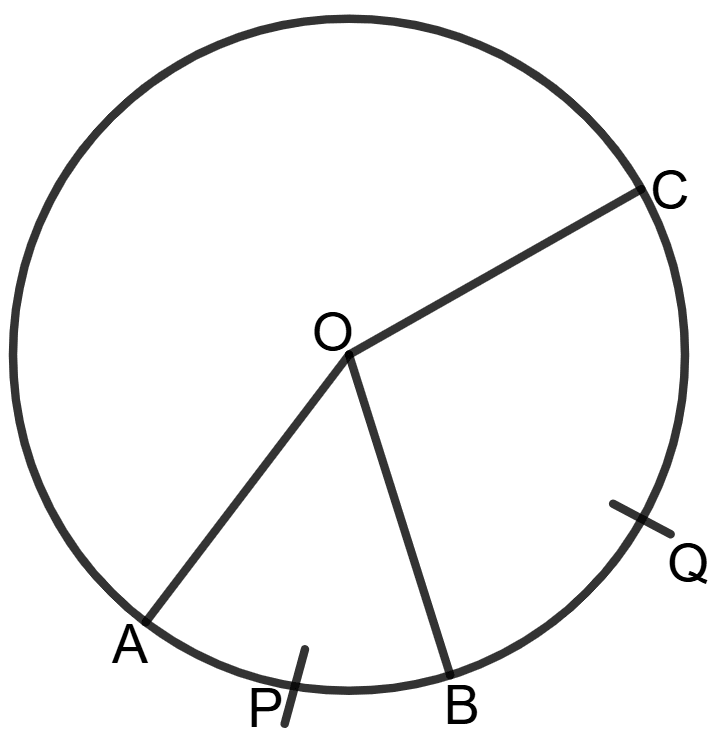
If angle AOB = 44°; find angle AOC.