
Mathematics
Look at the first three stages of a growing pattern of hexagons made using matchsticks. A new hexagon gets added at every stage which shares a side with the last hexagon of the previous stage.
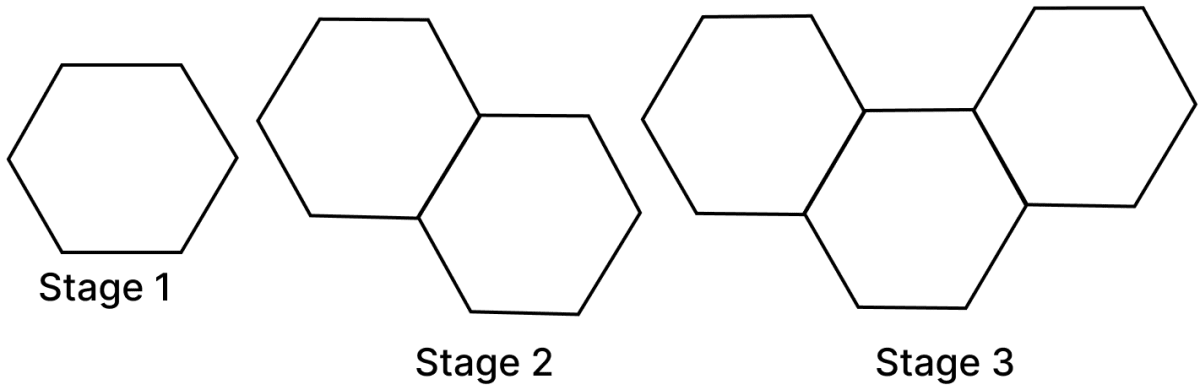
(i) Draw the next two stages of the pattern. How many matchsticks will be required at these stages?
(ii) Complete the following table.
| Stage Number | 1 | 2 | 3 | 4 | 5 | … | n |
|---|---|---|---|---|---|---|---|
| Number of matchsticks |
(iii) Find a rule to determine the number of matchsticks required for the nth stage.
(iv) How many matchsticks will be required for the 15th stage of the pattern?
(v) Can 200 matchsticks form a stage in this pattern? Justify your answer.
Polynomials
1 Like
Answer
From the pattern:
Stage 1 has 1 hexagon, requiring 6 matchsticks.
Stage 2 has 2 hexagons; the second hexagon shares one side with the first, so it adds 5 matchsticks. Total = 6 + 5 = 11 matchsticks.
Stage 3 has 3 hexagons; each new hexagon adds 5 matchsticks. Total = 11 + 5 = 16 matchsticks.
So, each new stage adds 5 more matchsticks to the previous stage.
(i) Stage 4 has 4 hexagons. Total matchsticks = 16 + 5 = 21
Stage 5 has 5 hexagons. Total matchsticks = 21 + 5 = 26
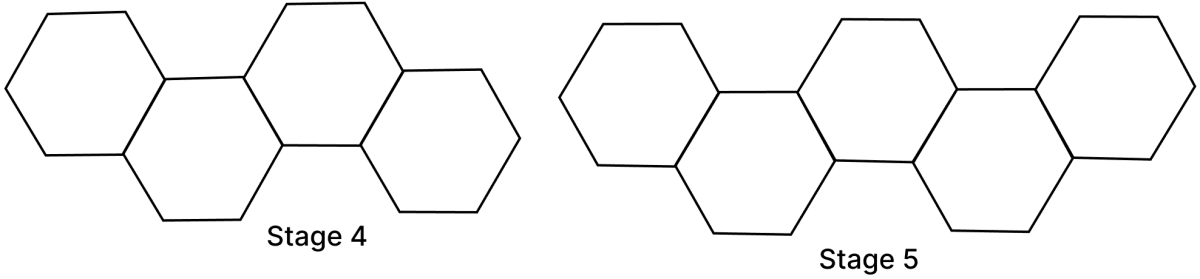
Hence, the 4th stage requires 21 matchsticks and the 5th stage requires 26 matchsticks.
(ii) Stage 1: 6 matchsticks
Stage 2: 11 matchsticks
Stage 3: 16 matchsticks
Stage 4: 21 matchsticks
Stage 5: 26 matchsticks
The completed table is:
| Stage Number | 1 | 2 | 3 | 4 | 5 | … | n |
|---|---|---|---|---|---|---|---|
| Number of matchsticks | 6 | 11 | 16 | 21 | 26 | … | 5n + 1 |
(iii) Each stage has 5 more matchsticks than the previous stage, starting with 6 in stage 1.
Stage 1: 6 = 5(1) + 1
Stage 2: 11 = 5(2) + 1
Stage 3: 16 = 5(3) + 1
Stage 4: 21 = 5(4) + 1
Stage 5: 26 = 5(5) + 1
In general, at the nth stage, the number of matchsticks = 5n + 1.
Hence, the rule is: Number of matchsticks at nth stage = 5n + 1.
(iv) Number of matchsticks at the 15th stage:
= 5(15) + 1
= 75 + 1
= 76
∴ The 15th stage requires 76 matchsticks.
(v) For 200 matchsticks to form a stage, we need:
5n + 1 = 200
⇒ 5n = 200 - 1
⇒ 5n = 199
⇒ n =
⇒ n = 39.8
Hence, 200 matchsticks cannot form a stage in this pattern, since 39.8 is not a whole number.
Answered By
1 Like
Related Questions
The graph of a linear polynomial p(x) passes through the points (1, 5) and (3, 11).
(i) Find the polynomial p(x).
(ii) Find the coordinates where the graph of p(x) cuts the axes.
(iii) Draw the graph of p(x) and verify your answers.Let p(x) = ax + b and q(x) = cx + d be two linear polynomials such that:
(i) p(0) = 5.
(ii) The polynomial p(x) – q(x) cuts the x-axis at (3, 0).
(iii) The sum p(x) + q(x) is equal to 6x + 4 for all real x.Find the polynomials p(x) and q(x).
Let p(x) = ax + b and q(x) = cx + d be two linear polynomials such that:
(i) The graph of p(x) passes through the points (2, 3) and (6, 11).
(ii) The graph of q(x) passes through the point (4, –1).
(iii) The graph of q(x) is parallel to the graph of p(x).Find the polynomials p(x) and q(x). Also, find the coordinates of the point where these lines meet the x-axis.
What do all linear functions of the form f(x) = ax + a, a > 0, have in common?