
Mathematics
A man invested in a company paying 12% dividend on its share. If the percentage return on his investment is 10%, then the shares are:
at par
below par
above par
cannot be determined
Shares & Dividends
36 Likes
Answer
Given,
Dividend rate = 12% of face value.
So, if face value = ₹100, dividend = ₹12.
Return = 10%
By formula,
Return % =
Investment on one share equals to the market value of the share.
Substituting values we get :
Since market value > face value, the shares are said to be above par.
Hence, option 3 is the correct option.
Answered By
18 Likes
Related Questions
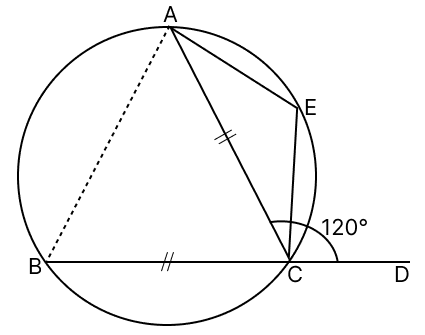
In the given diagram, chords AC and BC are equal. If ∠ACD = 120°, then ∠AEC is:
30°
60°
90°
120°
The factor common to the two polynomials x2 - 4 and x3 - x2 - 4x + 4
(x + 1)
(x - 1)
(x - 2)
(x - 4)
Statement 1: The point which is equidistant from three non-collinear points D, E and F is the circumcenter of the ΔDEF.
Statement 2: The incenter of a triangle is the point where the bisector of the angles intersects.
Both the statements are true.
Both the statements are false.
Statement 1 is true, and Statement 2 is false.
Statement 1 is false, and Statement 2 is true.
Assertion (A): If sin2 A + sin A = 1 then cos4 A + cos2 A = 1.
Statement 2: 1 - sin2 A = cos2 A
(A) is true, (R) is false.
(A) is false, (R) is true.
Both (A) and (R) are true, and (R) is the correct reason for (A).
Both (A) and (R) are true, and (R) is the incorrect reason for (A).