
Chemistry
Match the atomic numbers 4, 8, 10, 15 and 19 with each of the following:
(a) Element which can form trivalent ion.
(b) An element with 4 shells.
(c) Element with 6 valence electrons.
(d) Element which does not form an ion.
Atomic Structure
55 Likes
Answer
| Property | Atomic number |
|---|---|
| Element which can form trivalent ion | 15 |
| An element with 4 shells | 19 |
| Element with 6 valence electrons | 8 |
| Element which does not form ion | 10 |
Explanation:
- Electronic configuration of an element with atomic number 15 is [2, 8, 5], hence, it needs three electrons to complete its octet and forms a trivalent ion.
- Electronic configuration of an element with atomic number 19 is [2, 8, 8, 1], hence, it has K, L, M, N shells.
- Electronic configuration of an element with atomic number 8 is [2, 6], hence it has 6 electrons in the outermost shell called valence electrons.
- Electronic configuration of an element with atomic number 10 is [2, 8], so its octet is complete and it does not form ions.
Answered By
34 Likes
Related Questions
Select the correct statement(s) for the diagram shown below.
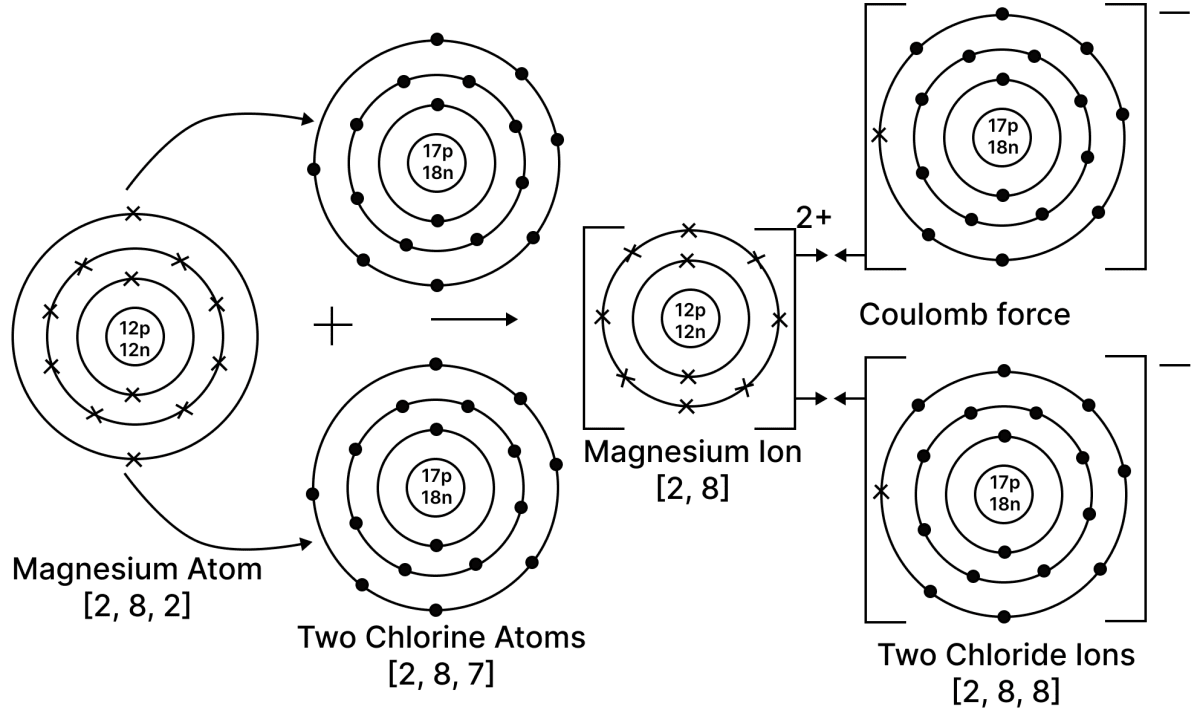
P — Mg loses electrons and undergoes reduction.
Q — Cl gains electrons and undergoes reduction.
R — Mg loses electrons and undergoes oxidation.
- Only P
- Only Q
- Only R
- Both Q and R
Select the correct statement(s) for the diagram shown below.
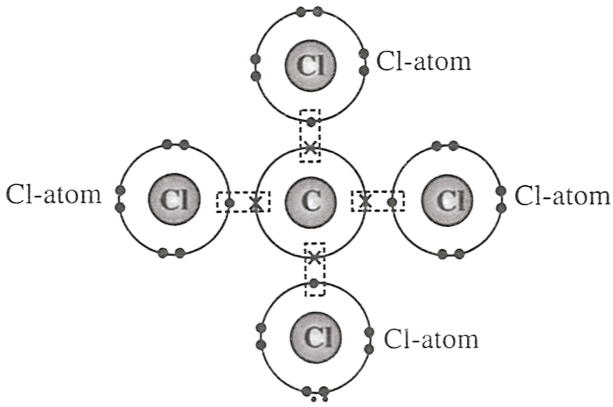
P — One atom of carbon transfers one electron to each chlorine atom.
Q — One atom of carbon shares four electron pairs, one with each of the four atoms of chlorine.
R — Carbon atom attains neon configuration and chlorine attains argon configuration after the combination.
- Only P
- Only Q
- Only R
- Both Q and R
Identify the following reactions as either oxidation or reduction:
(i) O + 2e- ⟶ O2-
(ii) K - e- ⟶ K+
(iii) Fe3+ + e- ⟶ Fe2+
(iv) Zn ⟶ Zn2+ + 2e-
Give the terms for the following definitions:
(a) A bond formed by a shared pair of electrons, each bonding atom contributing one electron to the pair.
(b) A bond formed by transfer of electron(s).