Mathematics
Mohit has a complex collection of lines drawn in a plane. He studies the angles formed due to the intersection of these lines. It is known that ∠DOH = 90°.
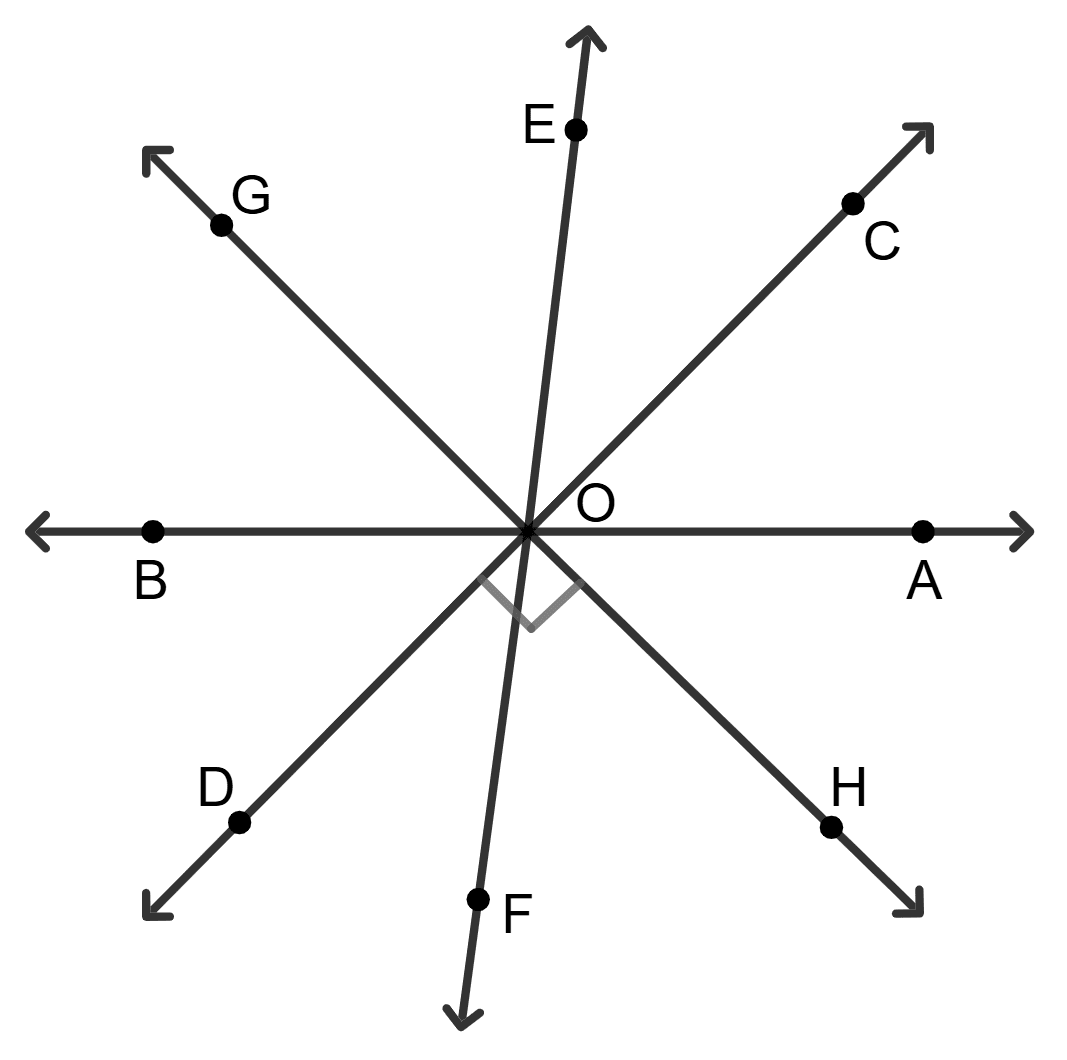
(1) Which of the following is a pair of vertically opposite angles ?
- ∠AOC, ∠BOG
- ∠BOG, ∠BOD
- ∠COE, ∠FOH
- ∠EOG, ∠FOH
(2) Which of the following is a pair of perpendicular lines ?
- AB, CD
- CD, GH
- AB, EF
- EF, GH
(3) Which of the following is a pair of complementary angles ?
- ∠AOC, ∠COE
- ∠COE, ∠EOG
- ∠EOG, ∠FOH
- ∠COG, ∠DOH
(4) Which of the following is a pair of supplementary angles ?
- ∠COE, ∠DOF
- ∠BOF, ∠AOH
- ∠AOE, ∠BOE
- ∠AOD, ∠BOG
Answer
(1)
Vertically opposite angles are formed when two straight lines intersect. In the diagram, line EF and line GH intersect at point O. This intersection creates the pair ∠EOG and ∠FOH, which are opposite each other.
Hence, option 4 is the correct option.
(2)
The problem states that ∠DOH = 90°. Perpendicular lines are lines that intersect at a right angle (90°). Since the angle between line CD and line GH is 90°, these two lines are perpendicular.
Hence, option 2 is the correct option.
(3)
Complementary angles are two angles whose sum is 90°.
Since ∠DOH = 90° and CD and GH are straight lines, the angle ∠COG which is vertically opposite to ∠DOH is also 90°.
∠COG is made up of two angles ∠COE and ∠EOG which are complementary angles.
Hence, option 2 is the correct option.
(4)
Supplementary angles are two angles that sum to 180°. These usually form a linear pair on a straight line. Angles ∠AOE and ∠BOE sit on the straight line AB. Therefore, their sum must be 180°.
Hence, option 3 is the correct option.
Related Questions
Fill in the blanks :
(i) An angle whose measure is more than 180° but less than 360° is called a …………… .
(ii) A straight line that intersects two or more lines in a plane is called a …………… .
(iii) A pair of adjacent angles is said to be a …………… if these angles have one arm common and other arms as opposite rays.
(iv) Two intersecting lines make …………… pairs of vertically opposite angles.
(v) Two lines are said to be …………… to each other if they intersect at right angles.
Write true (T) or false (F) :
(i) An angle whose measure is 90° is called a straight angle.
(ii) The sum of the angles of a linear pair is 180°.
(iii) When two straight lines cut each other, the sum of any two adjacent angles formed is 180°.
(iv) A line which intersects two other lines at their point of intersection is called a transversal.
(v) When two parallel lines are cut by a transversal, then the exterior opposite angles are supplementary.
Assertion: Two angles making a linear pair are always supplementary.
Reason: A pair of adjacent angles is said to be a linear pair, if these angles have one arm common and other arms as opposite rays.
- Both Assertion (A) and Reason (R) are true and Reason (R) is the correct explanation of Assertion (A).
- Both Assertion (A) and Reason (R) are true and Reason (R) is not the correct explanation of Assertion (A).
- Assertion (A) is true but Reason (R) is false.
- Assertion (A) is false but Reason (R) is true.
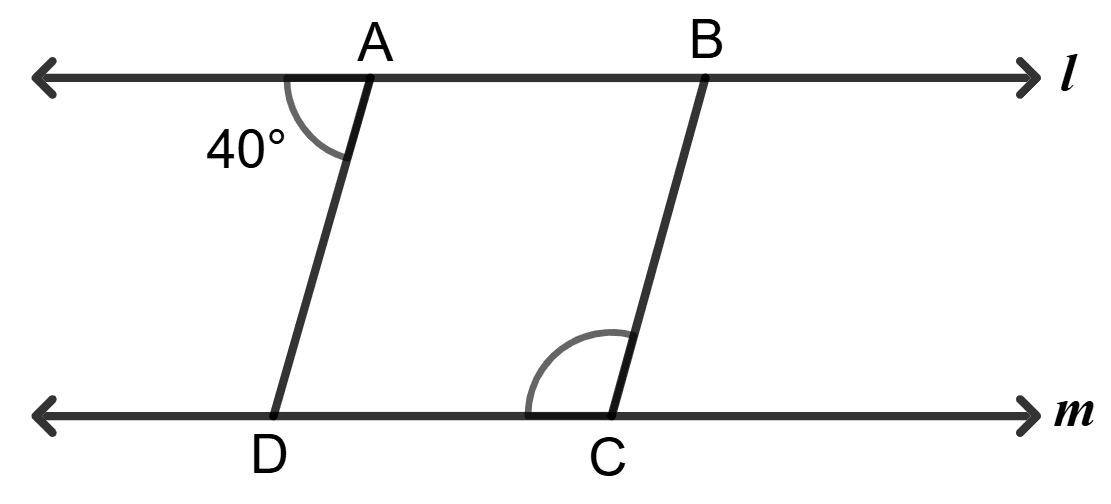
Assertion: In the figure l || m, AD || BC and ∠A = 40°. The measure of ∠BCD is 140°.
Reason: If two parallel lines are cut by a transversal, then the pair of corresponding angles are equal and the co-interior angles are supplementary.
- Both Assertion (A) and Reason (R) are true and Reason (R) is the correct explanation of Assertion (A).
- Both Assertion (A) and Reason (R) are true and Reason (R) is not the correct explanation of Assertion (A).
- Assertion (A) is true but Reason (R) is false.
- Assertion (A) is false but Reason (R) is true.