
Physics
A monochromatic ray strikes the surface of identical prisms (A, B and C) at different angles of incidence. The diagram below shows their refracted rays. Study the path of these refracted rays and identify in which of the diagrams:
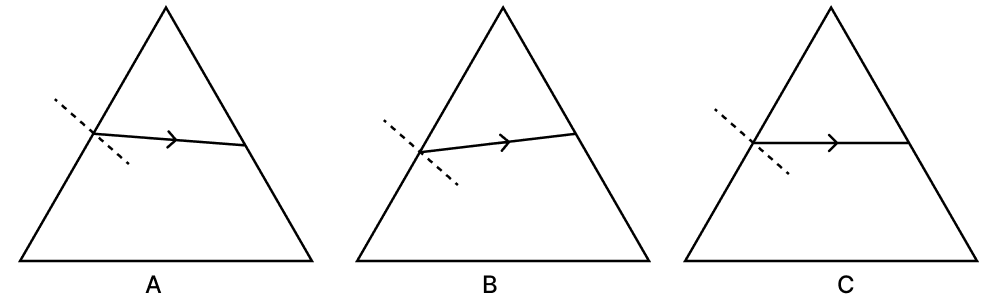
(a) the angle of incidence is maximum.
(b) the angle of incidence is minimum.
(c) the angle of incidence is equal to the angle of emergence.
Refraction Plane Surfaces
4 Likes
Answer
(a) The angle of incidence is maximum for prism B.
(b) The angle of incidence is minimum for prism A.
(c) The angle of incidence is equal to the angle of emergence for prism C.
Explanation:
For identical prisms, a larger angle of incidence produces a refracted ray inside the prism making a larger angle with the normal. Hence, diagram B corresponds to maximum incidence, while diagram A corresponds to minimum incidence.
When the angle of incidence is equal to the angle of emergence, the path of the ray through the prism is symmetrical, and the refracted ray inside the prism becomes parallel to the base. This is shown in diagram C.
Answered By
1 Like
Related Questions
In an AC generator, name the part which has the following functions:
(a) intensifies the magnetic field.
(b) maintains electrical contact between the rotating parts and the external circuit.
Give two differences between nuclear fission and nuclear fusion.
A ray of light enters a glass block from air and comes out from the opposite surface. If the angle of refraction at the first surface is not the same as the angle of incidence at the second surface, then:
(a) What is the product of the ratio at the first surface and at the second surface?
(b) State whether the opposite surfaces are parallel or not parallel.
(c) How did you reach the conclusion in (b) above?
A type of glass block has a refractive index of 1.8.
(a) Calculate the speed of light in this glass. (Given speed of light in air 3 x 10⁸ m s-1)
(b) If the width of this block is doubled, then what will be the speed of light in the block?