
Mathematics
The nature of roots of quadratic equation 3x2 − 6x − 3 = 0 are :
real and equal
real, distinct and rational
real, distinct and irrational
no real roots
Quadratic Equations
4 Likes
Answer
Comparing 3x2 − 6x − 3 = 0 with ax2 + bx + c = 0, we get :
a = 3, b = -6, c = -3.
We know that,
⇒ D = b2 - 4ac
⇒ D = (-6)2 - 4 × (3) × (-3)
⇒ D = 36 + 36
⇒ D = 72.
∴ D > 0 and not a perfect square. Roots are real, distinct and irrational.
Hence, option 3 is the correct option.
Answered By
2 Likes
Related Questions
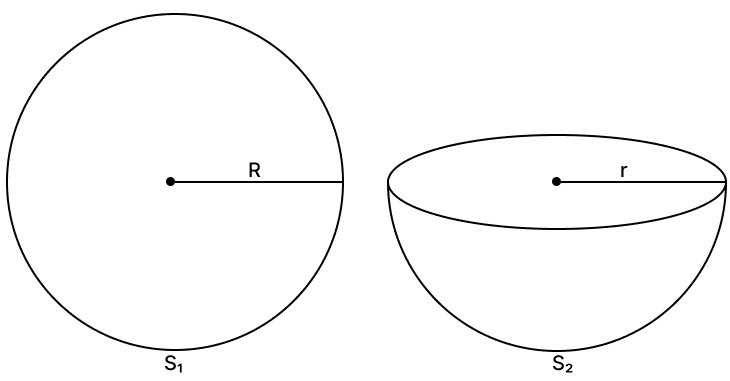
The total surface area of a solid sphere (S1) and a solid hemisphere (S2), as shown in the diagram, are equal. The ratio of radii R and r is :
1 : 1
2 : 1
: 2
2 :
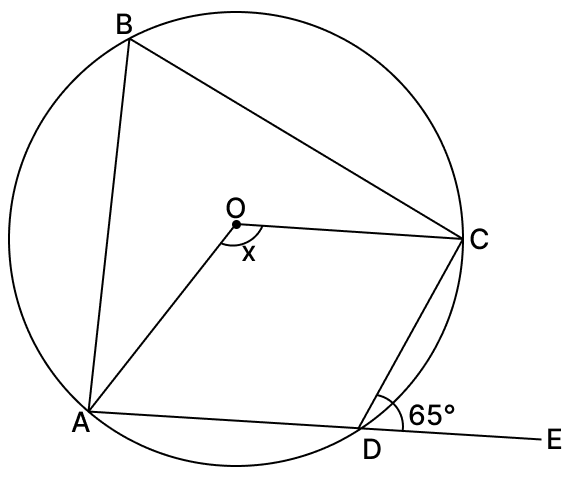
In the given diagram, O is the centre of the circle and ABCD is a cyclic quadrilateral. If ∠CDE = 65°, then the value of x is :
32.5°
65°
115°
130°
Assertion (A): If a die is rolled, the probability of getting a number greater than 6 is .
Reason (R): There are six possible outcomes when rolling a die, {1, 2, 3, 4, 5, 6}.
(A) is true and (R) is false.
(A) is false and (R) is true.
Both (A) and (R) are true and (R) is the correct explanation of (A).
Both (A) and (R) are true but (R) is not the correct explanation of (A).
If the areas of two similar triangles are in the ratio 9 : 64, then the ratio of their corresponding altitudes is:
3 : 8
2 : 1
9 : 64
8 : 3