
Physics
An object placed in front of a convex lens, forms an image of same size on a screen. Moving the object 12 cm closer to the lens results in the formation of a real image which is three times the size of the object. Calculate the focal length of the lens.
Refraction Lens
3 Likes
Answer
(a) Initially,
Let, initial object distance be u, image distance be v and focal length be f.
According to question,
Since the image is formed on a screen so it is real and inverted and it is also of the same size as the object which means magnification produced by the lens is -1.
Magnification (m) of a lens is given by,
From lens formula,
Let, final object distance be u' and final image distance be v'.
According to question,
u' = u + 12 and m' = -3
Magnification (m') of a lens is given by,
From lens formula,
Hence, the focal length of the lens is 18 cm.
Answered By
2 Likes
Related Questions
A type of glass block has a refractive index of 1.8.
(a) Calculate the speed of light in this glass. (Given speed of light in air 3 x 10⁸ m s-1)
(b) If the width of this block is doubled, then what will be the speed of light in the block?
(a) Name the electromagnetic radiation used to detect fake currency.
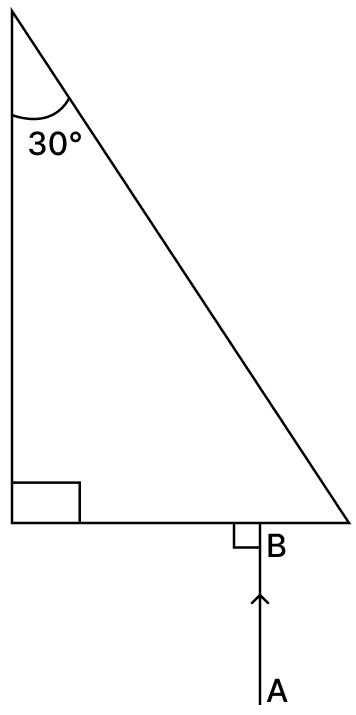
(b) Redraw the diagram given below and complete the path of the light ray AВ through the glass prism till it emerges out of the prism. Critical angle of the glass is 42°.
(a) Atmospheric temperature after a hailstorm is greater than the temperature during the hailstorm. State True or False.
(b) Which thermal physical quantity of a frying pan changes by making its base heavier?
(c) State the principle of Calorimetry.
The given graph represents the cooling curve of a liquid.
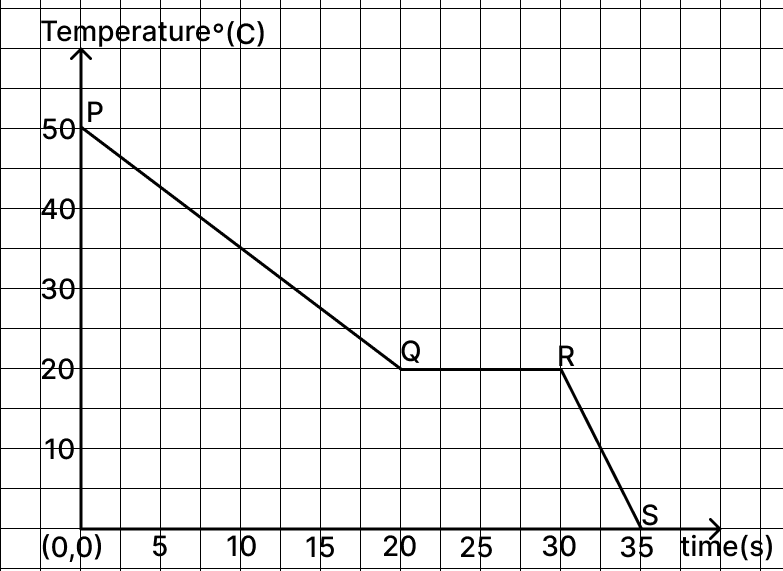
(a) State the freezing temperature of the liquid.
(b) Name the phase change happening at the region QR.
(c) In which state (solid / liquid) does the above substance liberate heat at a faster rate? Justify.