Mathematics
Observe the following pattern and answer the questions that follow :
1 + 2 + 3 + 4 + 5 = 15
2 + 3 + 4 + 5 + 6 = 20
3 + 4 + 5 + 6 + 7 = 25
(i) By which number should we multiply the middle number to get the sum?
(ii) Write the row of the pattern which gives the sum as 75.
(iii) Can there be any row of the pattern which gives the sum as 92?
Whole Numbers
1 Like
Answer
(i) Observing the pattern:
1 + 2 + 3 + 4 + 5 = 15. The middle number is 3 and 3 x 5 = 15.
2 + 3 + 4 + 5 + 6 = 20. The middle number is 4 and 4 x 5 = 20.
3 + 4 + 5 + 6 + 7 = 25. The middle number is 5 and 5 x 5 = 25.
The pattern shows that we should multiply the middle number by 5 to get the sum.
(ii) Using the rule from part (i), we can find the middle number for a sum of 75:
Middle number = 75 ÷ 5 = 15.
The row consists of five consecutive numbers with 15 as the middle number.
The two numbers before 15 are 13 and 14.
The two numbers after 15 are 16 and 17.
Hence, the row is 13 + 14 + 15 + 16 + 17 = 75.
(iii) For a sum of 92, the middle number would have to be:
Middle number = 92 ÷ 5 = 18.4
Since the numbers in the pattern are always integers, the middle number must also be an integer. As 92 is not exactly divisible by 5 (it has a remainder of 2), there cannot be a row of this pattern that gives a sum of 92.
Hence, there will not be any row of the above pattern which gives the sum as 92.
Answered By
3 Likes
Related Questions
Study the following pattern. In each case write the next three steps :
999999 x 1 = 0999999
999999 x 2 = 1999998
999999 x 3 = 2999997
999999 x 4 = 3999996
Study the following pattern. In each case write the next three steps :
12345679 x 9 = 111111111
12345679 x 18 = 222222222
12345679 x 27 = 333333333
12345679 x 36 = 444444444
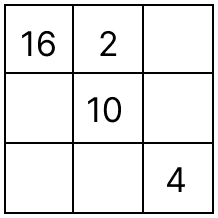
Complete the following magic square by supplying the missing numbers :
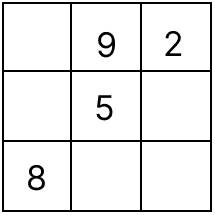
Complete the following magic square by supplying the missing numbers :