
Chemistry
Observe the reactions given below and answer the following questions:
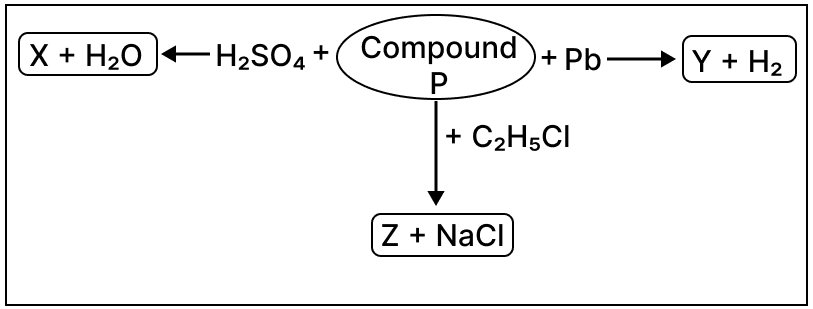
(a) Identify compound P.
(b) Give the chemical formula of Z.
(c) Write the reaction taking place between the identified compound P and sulphuric acid.
(d) Name compound Y.
Analytical Chemistry
2 Likes
Answer
(a) NaOH
(b) C2H5OH
(c) 2NaOH + H2SO4 ⟶ Na2SO4 + 2H2O
(d) Sodium plumbite
Answered By
2 Likes
Related Questions
Amit found that 30g of a gas occupied 1000 c.c at STP.
(a) What will the gram molecular weight and the vapour density of this gas be?
(b) How many molecules of this gas will be present in 44.8 l of it?
An element X combines with oxygen to form an oxide X2O3. This oxide is a good conductor of electricity and can be reduced to its metal only by electrolysis.
(a) Write the equation for the reaction formed when the oxide (X2O3) combines with hydrochloric acid.
(b) How many valence electrons are present in the outermost shell of X?
(c) Will element X undergo oxidation or reduction?
Study the information given in the table below and answer the questions that follow. (Note- the letters do not represent the actual symbols of the elements)
Element Electronic configuration Ionisation energy kjmol-1 X 2,2 900 Y 2,8,2 738 Z 2,8,8,2 590 (a) Explain why element X has highest ionisation energy.
(b) To which period does Z belong?
(c) Draw the electron dot structure of the compound formed between Z and oxygen.
A student prepared a Potassium sulphite solution in the lab and added few drops of barium nitrate solution to it. He observed a white precipitate being formed in the test tube. On addition of dilute hydrochloric acid to the white precipitate and mixing it, he observed that the precipitate disappeared.
(a) Name the white precipitate.
(b) Write a balanced chemical equation for the reaction between dilute hydrochloric acid and the white precipitate.
(c) Name the gas evolved in the above reaction.