
Biology
Omar accompanied his uncle to the hospital after he complained of sharp pain in his lower back. An ultrasound revealed tiny stones in his kidneys. The doctor explained that waste materials had crystallised because they were not flushed out properly. He advised his uncle to drink more water to prevent future stone formation.
(a) Name two substances that commonly form crystals in the excretory system.
(b) What happens when these crystals accumulate in the urinary tract?
(c) How can such crystals be removed from the urinary tract?
(d) Is the presence of excess uric acid in urine harmful? Why?
(e) Mention two other body parts where stone formation may occur apart from kidneys.
Excretory System
1 Like
Answer
(a) Two substances that commonly form crystals in the excretory system are calcium oxalate and uric acid.
(b) When these crystals accumulate in the urinary tract, they form kidney stones which may block the flow of urine, causing severe pain, infection and difficulty in urination.
(c) These crystals can be removed by drinking plenty of water to flush them out, by medications, or in severe cases, by medical procedures such as surgery.
(d) Yes, the presence of excess uric acid in urine is harmful because it can crystallise to form stones, which may block urine flow and cause pain and kidney damage if untreated.
(e) Two other body parts where stone formation may occur apart from kidneys are urinary bladder and gall bladder.
Answered By
1 Like
Related Questions
Distinguish between the following pairs on the basis of the words indicated in the brackets [] :
Urinary bladder and urethra [Function]
Draw a neat diagram of the vertical section of a human kidney and label its five important parts : Capsule, Renal cortex, Renal medulla, Papilla of medulla and Renal pelvis.
Given alongside is the diagram of an organ system of humans. Study the same and answer the following questions :
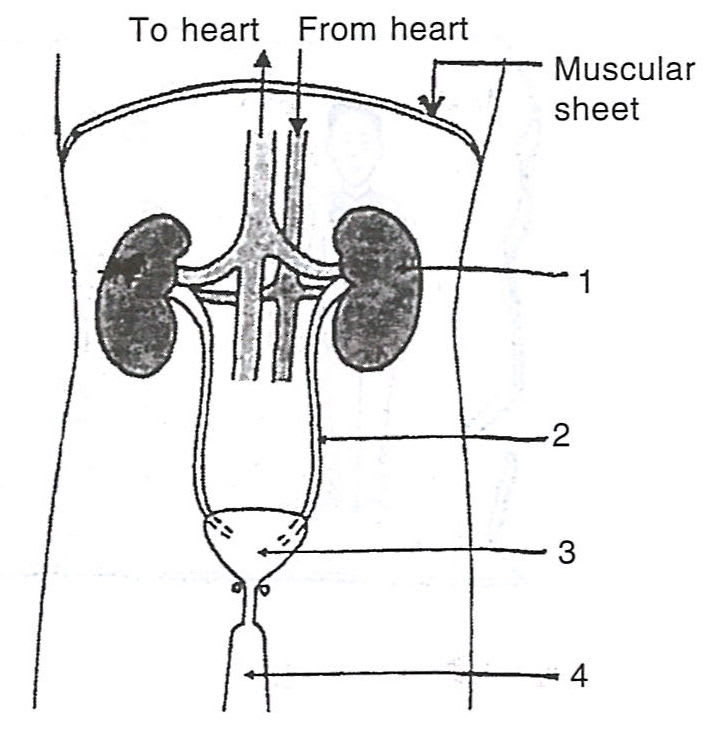
- Name the organ systems shown completely and partially respectively.
- Label the guidelines 1 to 4.
- Name the muscular sheet which divides the thorax and abdomen.
- Mention the blood vessel which supplies blood from the heart to the kidney.
- Name the blood vessel which carries deoxygenated blood that is devoid of nitrogenous wastes.
The figure shown alongside represents a process for the treatment of a person. Study the same and answer the following questions.
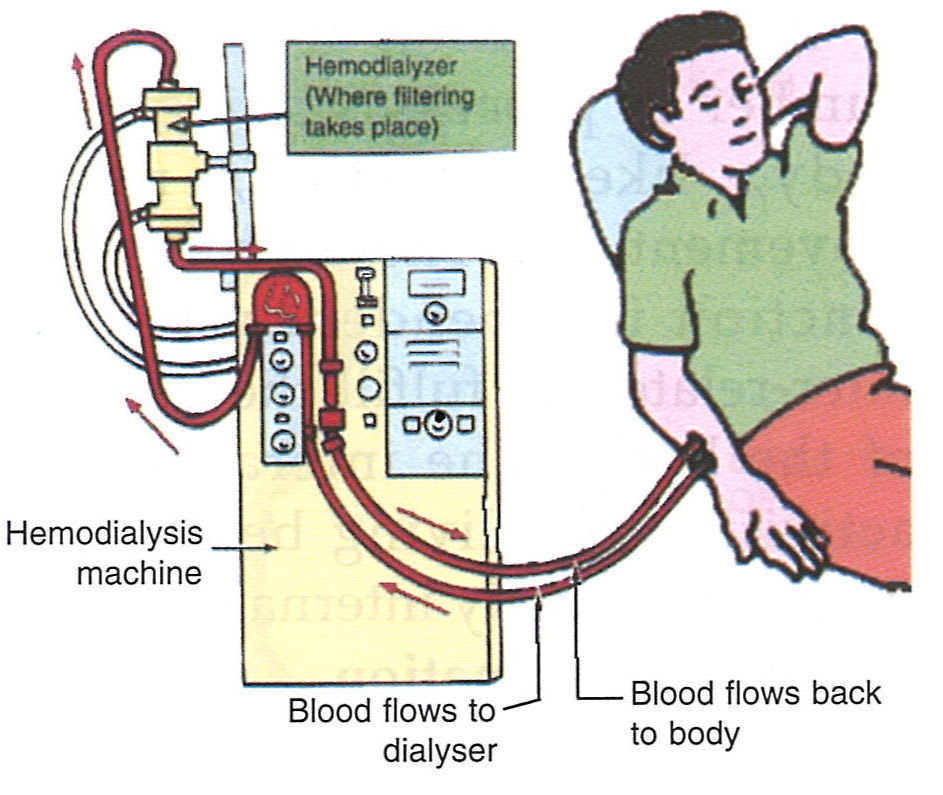
- Name the process.
- In what condition of the patient, is this treatment suggested by the doctors ?
- What other kind of treatment is suggested by the doctors, if both kidneys fail to work ?
- Can a person survive normally with one kidney ?
- Write one important function of the Hemodialysis machine.