Science
Answer
Mitochondria are known as the powerhouse of the cell because they carry out cellular respiration, in which glucose and other molecules are broken down to release energy that is stored as ATP. If all the mitochondria are removed from a eukaryotic cell, the cell would not be able to produce energy through cellular respiration. Without ATP, the cell could not carry out its energy-requiring activities such as the synthesis of materials, transport, and movement. As a result, the cellular activities would stop and the cell would eventually die.
Related Questions
Carry out the following experiment:
Take four peeled potato halves and scoop each one out to make potato cups. One of these potato cups should be made from a boiled potato. Place each of the potato cups in a beaker containing water (Fig. 2.22). Now, set up the experiment as follows:
(a) Keep Cup A empty.
(b) Add one teaspoon sugar in Cup B.
(c) Add one teaspoon salt in Cup C.
(d) Add one teaspoon sugar in the boiled potato in Cup D.
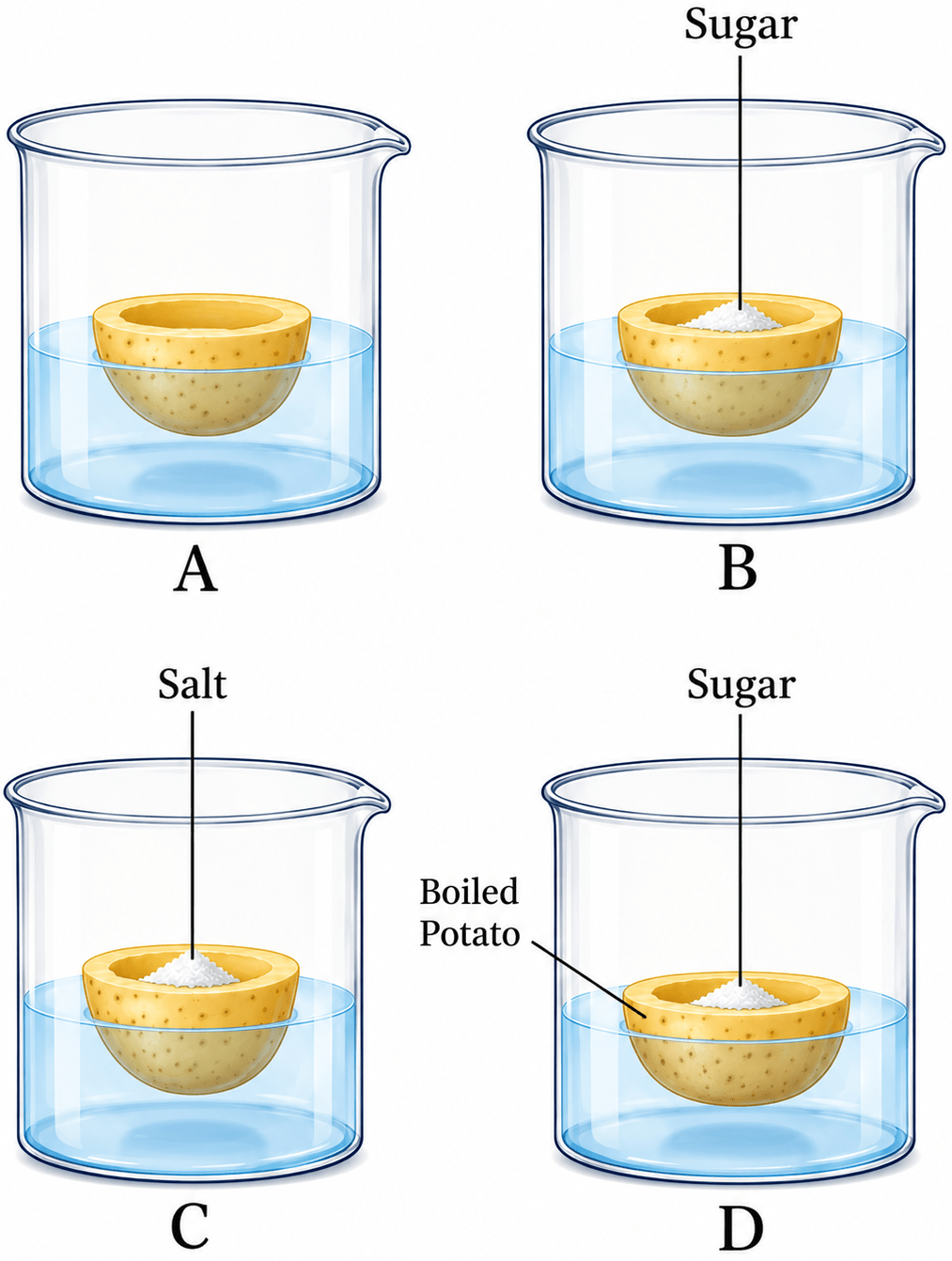
Observe the four potato cups for at least two hours and answer the following questions:
(i) Explain why water gathers in the hollowed portion of Cup B and Cup C.
(ii) Why is Cup A necessary for this experiment?
(iii) Explain why water does not gather in the hollowed portions of Cups A and D.
Identify the pair that incorrectly matches the cell organelle with its function.
(i) Ribosome — Protein synthesis
(ii) SER — Lipid and cellulose synthesis
(iii) Lysosome — Digestion of foreign agents
Which phenomenon inhibits the formation of tumors in the human body? Can plants also develop tumors? Explain.
The cell membrane of a cell is made up of proteins and lipids. Which cell organelles help in the synthesis of cell membrane? Write the path of these compounds from their site of synthesis to the cell membrane and show this through a labelled diagram.