Mathematics
Answer
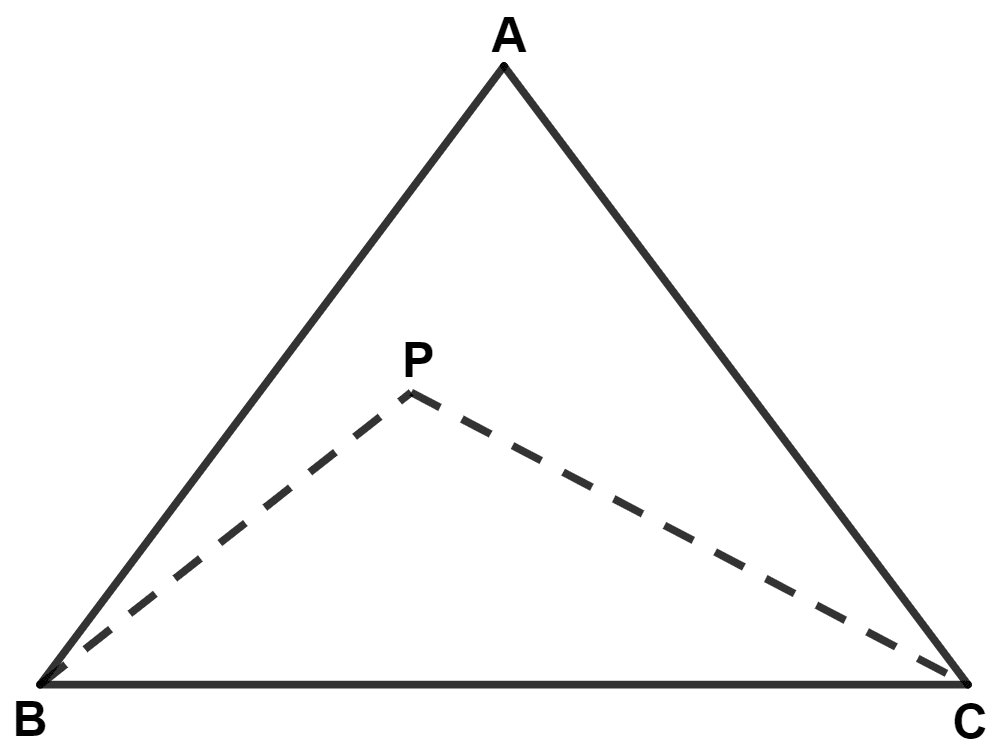
Let ∠PBC = x and ∠PCB = y.
In △ BPC,
By angle sum property of triangle,
⇒ ∠BPC + ∠PBC + ∠PCB = 180°
⇒ ∠BPC + x + y = 180°
⇒ ∠BPC = 180° - x - y
⇒ ∠BPC = 180° - (x + y).
Let ∠ABP = a and ∠ACP = b
In △ BAC,
By angle sum property of triangle,
⇒ ∠ABC + ∠BCA + ∠BAC = 180°
⇒ (∠ABP + ∠PBC) + (∠BCP + ∠ACP) + ∠BAC = 180°
⇒ (a + x) + (y + b) + ∠BAC = 180°
⇒ (a + b) + (x + y) + ∠BAC = 180°
⇒ ∠BAC = 180° - (x + y) - (a + b)
⇒ ∠BAC = ∠BPC - (a + b)
⇒ ∠BPC = ∠BAC + (a + b)
⇒ ∠BPC > ∠BAC.
Hence, proved that ∠BPC > ∠BAC.
Related Questions
In a quadrilateral ABCD; prove that :
(i) AB + BC + CD > DA
(ii) AB + BC + CD + DA > 2AC
(iii) AB + BC + CD + DA > 2BD
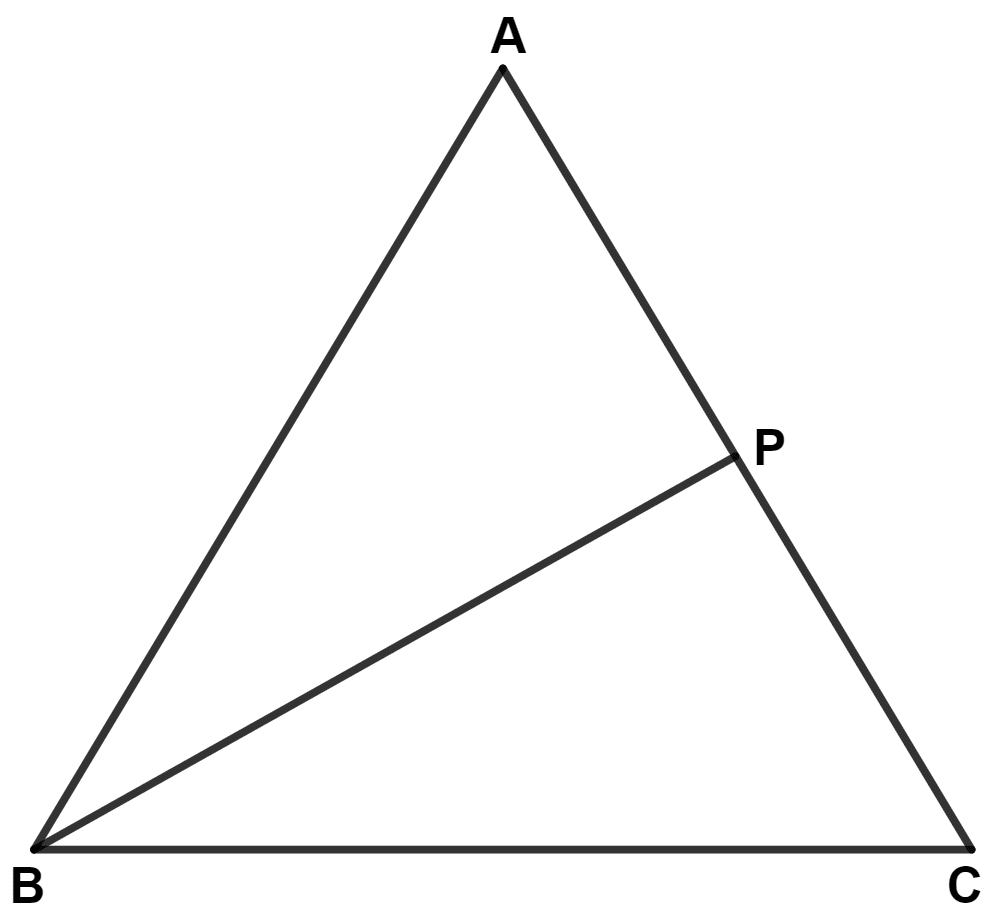
In the following figure, ABC is an equilateral triangle and P is any point in AC; prove that :
(i) BP > PA
(ii) BP > PC
Prove that the straight line joining the vertex of an isosceles triangle to any point in the base is smaller than either of the equal sides of the triangle.
In the following diagram; AD = AB and AE bisects angle A. Prove that :
(i) BE = DE
(ii) ∠ABD > ∠C