
Mathematics
The perimeter of a rectangle is 36 cm. What will be length and breadth (in natural numbers) of that rectangle whose area is
(i) maximum?
(ii) minimum?
Mensuration
2 Likes
Answer
Given:
Perimeter of rectangle = 36 cm
Perimeter of rectangle = 2(length + breadth)
⇒ 36 = 2(length + breadth)
⇒ length + breadth =
⇒ length + breadth = 18 cm
The possible pairs of (length, breadth) in natural numbers with sum 18 are:
| Length | Breadth | Area (length × breadth) |
|---|---|---|
| 17 | 1 | 17 sq. cm |
| 16 | 2 | 32 sq. cm |
| 15 | 3 | 45 sq. cm |
| 14 | 4 | 56 sq. cm |
| 13 | 5 | 65 sq. cm |
| 12 | 6 | 72 sq. cm |
| 11 | 7 | 77 sq. cm |
| 10 | 8 | 80 sq. cm |
| 9 | 9 | 81 sq. cm |
(i) The maximum area is 81 sq. cm when length = 9 cm and breadth = 9 cm.
Hence, for maximum area, length = 9 cm and breadth = 9 cm.
(ii) The minimum area is 17 sq. cm when length = 17 cm and breadth = 1 cm.
Hence, for minimum area, length = 17 cm and breadth = 1 cm.
Answered By
1 Like
Related Questions
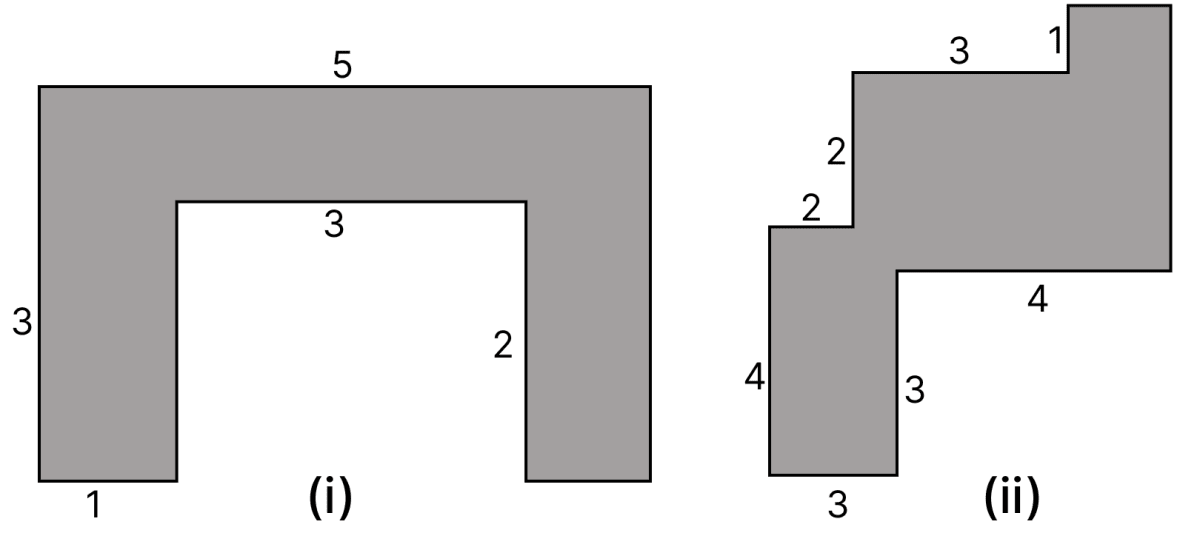
By splitting the following figures into rectangles, find their areas (The measures are given in centimetres).
How many envelopes of size 25 cm × 15 cm can be made from a rectangular sheet of size 4 m × 1.2 m?
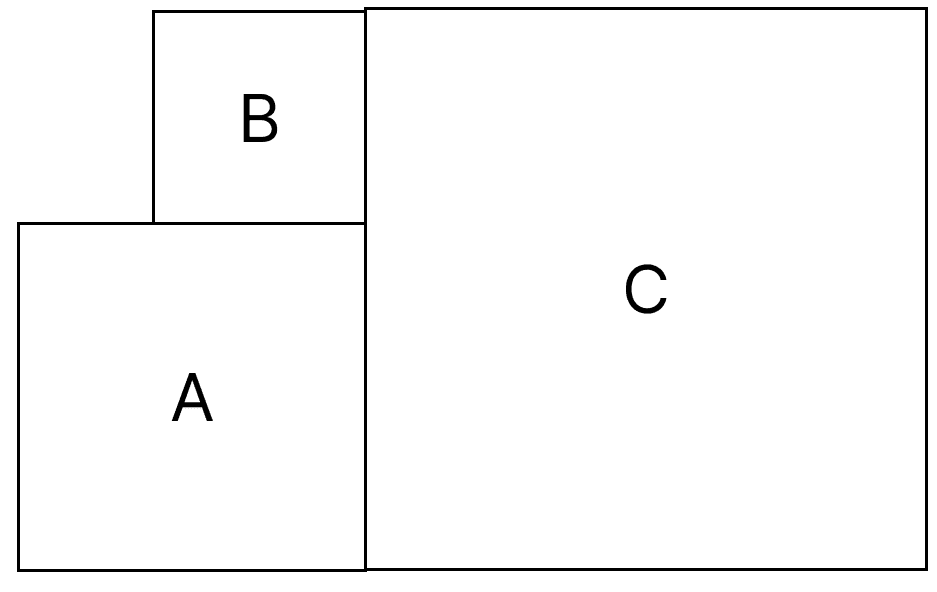
In the adjoining figure, A, B and C are squares. If the area of the square A is 25 sq. cm and the perimeter of the square B is 12 cm, then find the perimeter and the area of the square C.
Study the following floor plan of a house prepared by an architect.
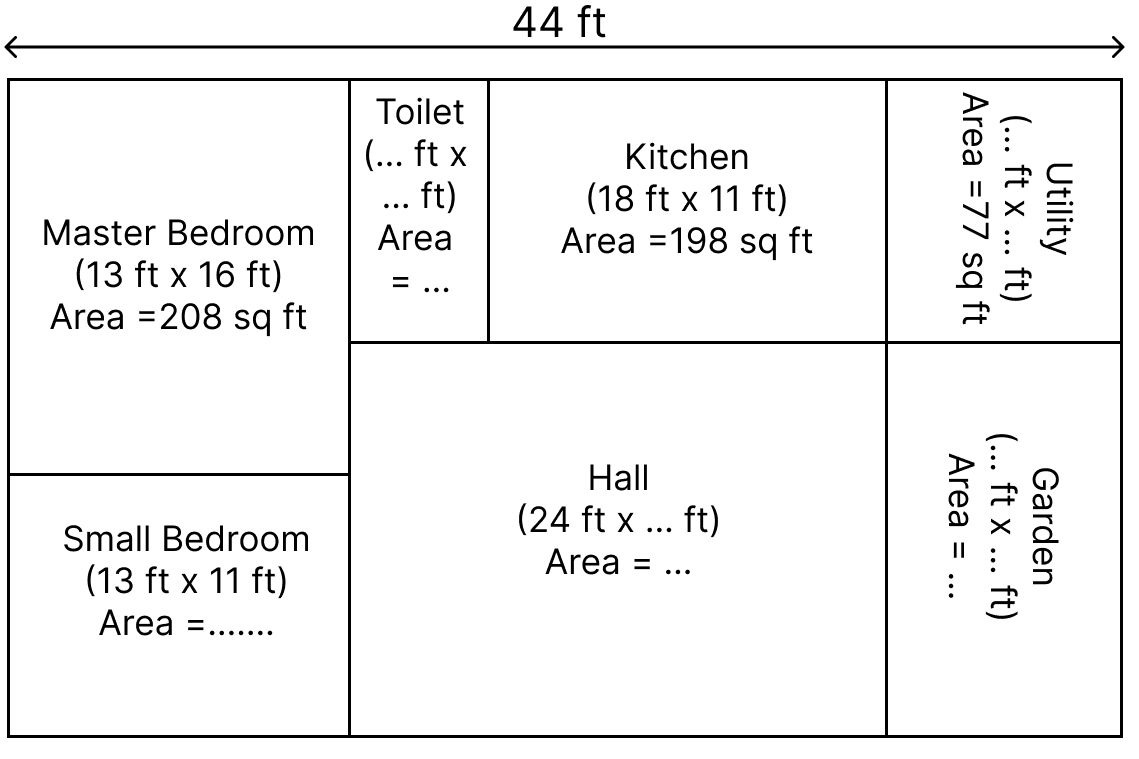
Some of the measurements are given.
(i) Find the missing measurements.
(ii) Find out the total area of the house (including the Garden).