
Physics
A person standing between two vertical cliffs and 640 m away from the nearest cliff produces a sound. He hears the first echo after 4 s and the second echo 3 s later. Calculate :
(a) The speed of sound in air and
(b) The distance between the cliffs
Sound
5 Likes
Answer
Figure given below shows that two cliffs and the position of the person.
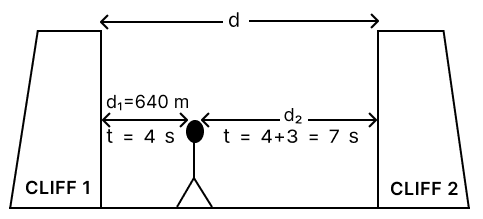
(a) First echo is heard from the nearest cliff.
Let d1, be the distance of the nearest cliff 1 from the person.
Total distance travelled by the sound in going and then coming back = 2d₁ = 2 x 640 m = 1280 m
Time taken (t) = 4 s
(b) The second echo is heard from the farther cliff 2. If d2 is the distance of the farther cliff 2 from the person, then total distance travelled by the sound in going and then coming back = 2d2.
Time taken (t) = 4 + 3 = 7 s
Now,
Distance between the two cliffs = d1 + d2 = 640 m + 1120 m = 1760 m
Hence, speed of sound in air is 320 ms-1 and distance between the cliffs is 1760 m.
Answered By
3 Likes
Related Questions
The diagram given below shows a ski jump. A skier weighing 60kgf stands at A at the top of ski jump. He moves from A and takes off for his jump at B.
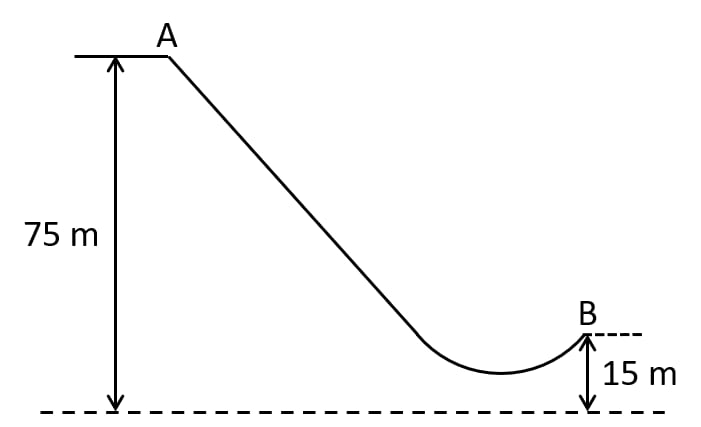
(a) Calculate the change in the gravitational potential energy of the skier between A and B.
(b) If 75% of the energy in part (a) becomes the kinetic energy at B, calculate the speed at which the skier arrives at B.
(Take g = 10 ms-2).
(c) Does total mechanical energy change during the ski jump?
A block and tackle has two pulleys in each block with the tackle tied to the hook of the lower block and the effort being applied upwards.
(a) Draw a neat diagram to show this arrangement and calculate its mechanical advantage.
(b) If the load moves up by a distance x, by what distance will the free end of the string move up?
Two pendulums C and D are suspended from a wire as shown in the given figure. Pendulum C is made to oscillate by displacing it from it's mean position. It is seen that D also starts oscillating.
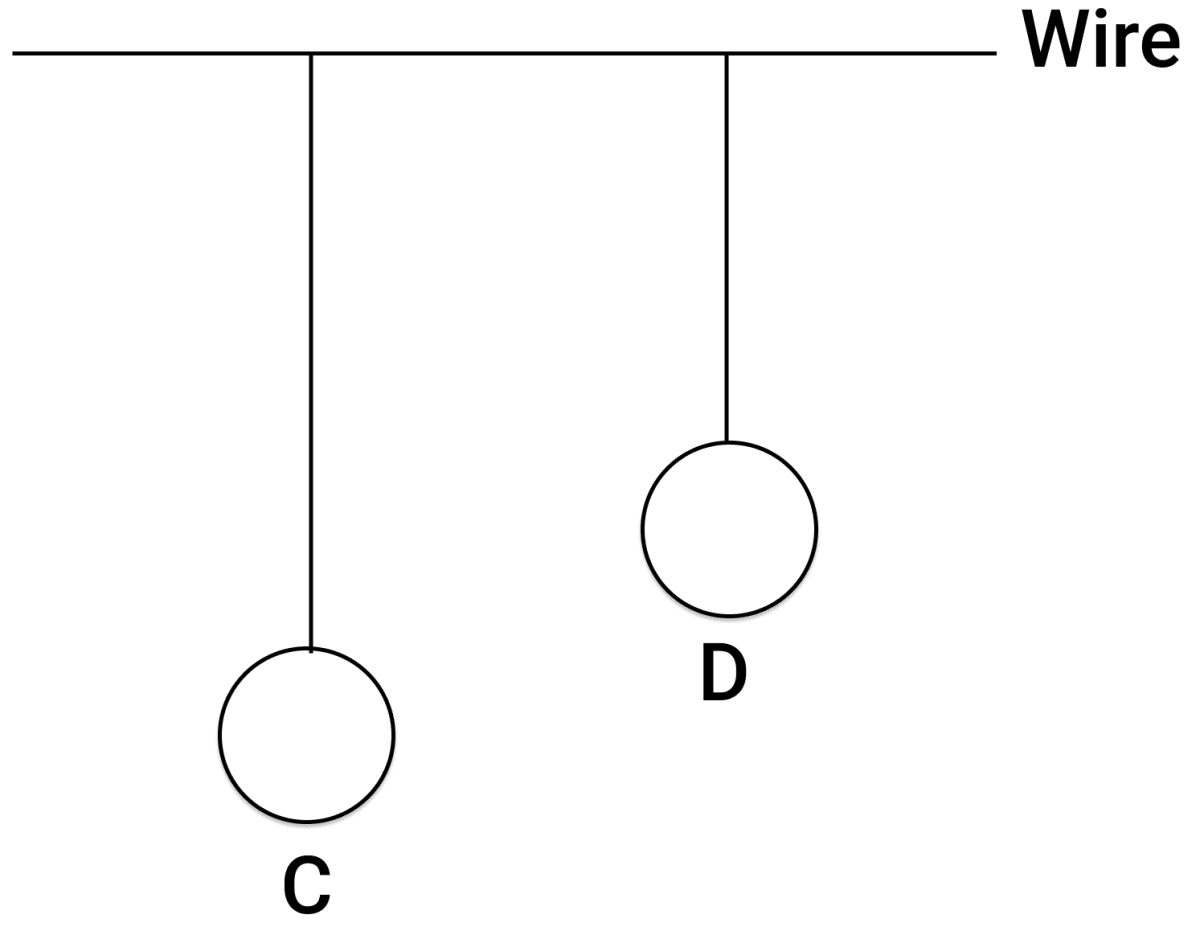
(i) Name the type of oscillation, C will execute.
(ii) Name the type of oscillation, D will execute.
(iii) If the length of D is made equal to C, then what difference will you notice in the oscillations of D?
(iv) What is the name of the phenomenon when the length of D is made equal to C?
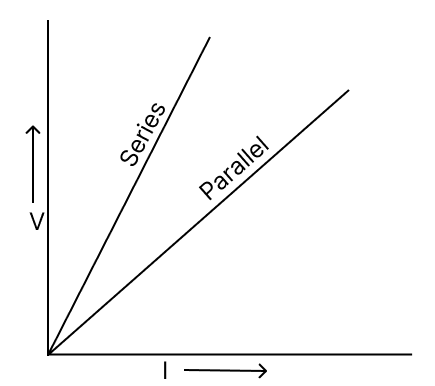
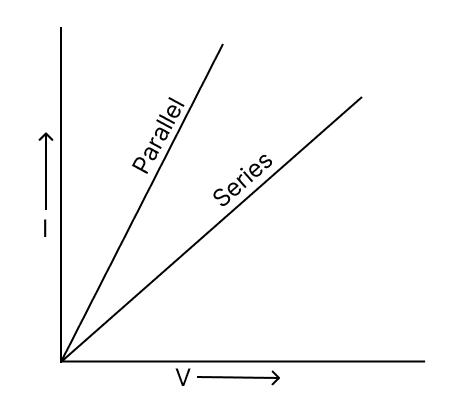
(a) Students of a class perform an experiment on series and parallel combinations of two resistances R1 and R2. Some of the students plotted graph (1) and remaining plotted graph (2). Identify the correct graph and give reason.
A
B
(b) The length of an electric wire is increased by 25%. What is the percentage increase in the resistance and resistivity?
(c) Same current flows through an electric live wire and a bulb filament, but only the filament glows. Give reason.