Biology
After playing outside on a hot sunny afternoon, Aarav came home sweating and drank a lot of water. Later in the evening, he noticed that the plant on his study table looked dull and droopy. Wondering if plants also "get hot" in summer, he asked his mother what was wrong. She told him that just like humans sweat to cool down, plants also lose water through a process that helps them stay cool. But when too much water is lost, the plant starts to droop.
(a) What is the process by which plants lose water through their leaves?
(b) Through which part of the leaf does this water loss mainly happen?
(c) Besides cooling the plant, how else does transpiration help the plant?
(d) In transpiration, water is lost from the plant in the form of ………… (water vapour /water droplets).
(e) Draw a simple flow chart showing water movement from roots to leaves and then out of the plant.
(f) Aarav's mother said that once he waters the plant, it will look fresh again. What is the process by which roots absorb water from the soil?
Answer
(a) The process by which plants lose water through their leaves is called transpiration.
(b) Water loss mainly happens through stomata.
(c) Besides cooling, transpiration also helps in upward movement of water and minerals from roots to leaves (transpiration pull). It maintains turgidity and helps in distribution of minerals throughout the plant.
(d) In transpiration, water is lost from the plant in the form of water vapour (water vapour /water droplets).
(e)
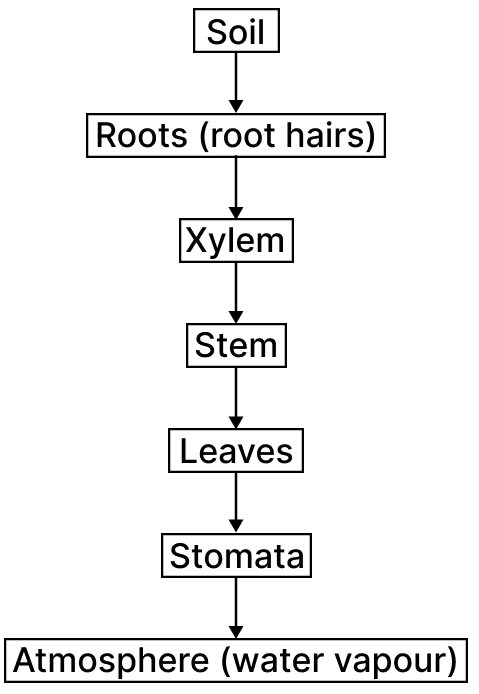
(f) The process by which roots absorb water from the soil is called osmosis.
Related Questions
The set up shown alongside was kept in sunlight for an hour. It was observed that drops of water appeared on the inside surface of the polythene bag.

(a) Name the process which is being demonstrated.
(b) Why was the pot with its soil left uncovered by the polythene bag?
(c) Why was the pot left in sunlight?
(d) Suppose that the pot in this experiment was placed inside a dark room instead of placing it in sunlight for some time. What difference would be noticed?
Briefly explain, how transpiration helps in the upward conduction of water in plants?
How does temperature, light intensity and wind affect transpiration?
Draw a magnified view of the root hair and label all its parts neatly. From the parts labelled by you, name the parts matching the description given below:
(a) Outermost layer of the root
(b) Unicellular outgrowth
(c) Part that is freely permeable
(d) Part that is semi-permeable