
Mathematics
A point P moves so that its perpendicular distance from two given parallel lines AB and CD are equal. Then, the locus of the point P is:
a line l anywhere in between AB and CD and parallel to them.
a line l perpendicular to both AB and CD.
a line l in the midway of AB and CD and parallel to them.
none of these
Locus
1 Like
Answer
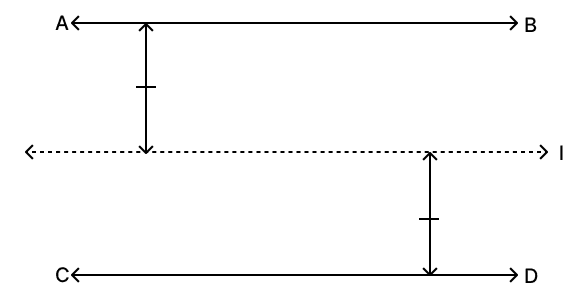
If the perpendicular distances of a moving point from two parallel lines are equal, then the point must lie exactly halfway between them.
The set of all such points forms a single line parallel to both AB and CD, drawn exactly midway between them.
Hence, option 3 is the correct option.
Answered By
3 Likes
Related Questions
If A and B are two fixed points, then the locus of a point P such that ∠APB = 90°, is the:
square
rectangle
circle
rhombus
A point P moves such that its distance from a fixed line AB is always the same. What is the relation between AB and the path traveled by P ?
It is a set of two lines perpendicular to AB.
It is a set of two lines parallel to AB drawn on either side at equal distance from it.
It is a set of two concentric circles.
It is a set of two intersecting lines with AB bisecting the angle between them.
The locus of a point equidistant from two concentric circles is:
a circle concentric with the given circles and inside the smaller circle.
a circle concentric with the given circles and outside the larger circle.
a circle concentric with the given circles and midway between them.
the common centre of the two circles.
The locus of a point which is equidistant from a given circle consists of:
a pair of circles concentric with the given circle.
a circle concentric with the given circle and inside it.
a circle concentric with the given circle and outside it.
a pair of lines parallel to each other on either side of the centre.