
Mathematics
If the points A(-2, -1), B(1, 0), C(a, 3) and D(1, b) form a parallelogram, find the values of a and b.
Section Formula
2 Likes
Answer
We know that,
Diagonals of a parallelogram bisect each other.
Since, ABCD is a // gm.
Thus, Mid-point of AC = Mid-point of BD.
Given,
A(-2, -1), B(1, 0), C(a, 3) and D(1, b)
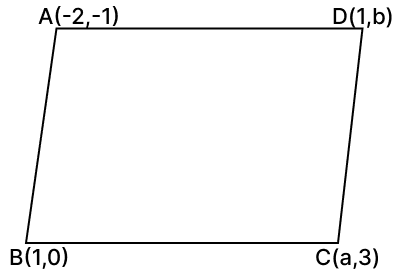
By using mid-point formula,
(x, y) =
Mid-point of AC :
Midpoint of Diagonal BD :
Equating the x-coordinates of mid-points of AC and BD, we get :
⇒ = 1
⇒ -2 + a = 2
⇒ a = 2 + 2
⇒ a = 4.
Equating the y-coordinates:
⇒ 1 =
⇒ b = 2.
Hence, a = 4 and b = 2.
Answered By
2 Likes
Related Questions
The mid-points of the sides BC, CA and AB of ΔABC are D(2, 1), E(-1, -3) and F(4, 5) respectively. Find the co-ordinates of A, B and C.
Prove that the points A(-2, -1), B(1, 0), C(4, 3) and D(1, 2) are the vertices of a parallelogram ABCD.
The three vertices of a parallelogram ABCD, taken in order, are A(-1, 0), B(3, 1) and C(2, 2). Find the co-ordinates of the fourth vertex of the parallelogram.
Find the lengths of the medians of a ΔABC whose vertices are A(-1, 3), B(1, -1) and C(5, 1). Also, find the co-ordinates of the centroid of ΔABC.