Mathematics
PQR is a right-angled triangle with PQ = 3 cm and QR = 4 cm. A circle which touches all the sides of the triangle is inscribed in the triangle. Calculate the radius of the circle.
Circles
4 Likes
Answer
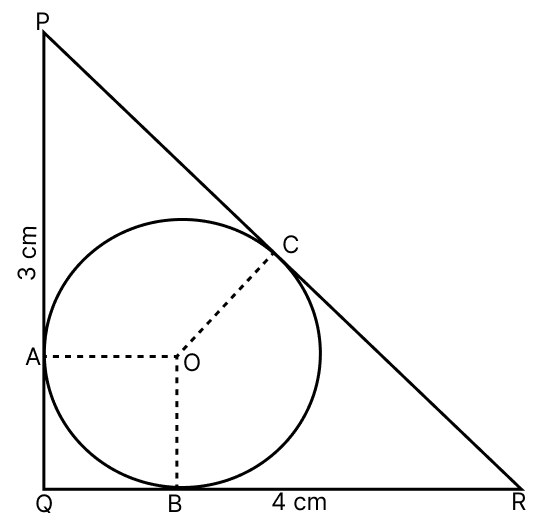
Let the inscribed circle touch the sides PQ, QR and PR at A, B and C respectively.
PQR is a right-angled triangle with PQ = 3 cm and QR = 4 cm.
By pythagoras theorem,
⇒ PR2 = PQ2 + QR2
⇒ PR2 = 32 + 42
⇒ PR2 = 9 + 16
⇒ PR2 = 25
⇒ PR = 5 cm.
By tangent property we have,
∠OAQ = ∠OBQ = 90°
∠AQB = 90°
Since, all the angles of OAQB equals to 90°.
From figure,
OAQB is a square.
OA = OB = AQ = BQ = x (let)
PA = PQ - AQ = (3 - x) cm
PA = PC = (3 - x) cm.[∵ Tangents from exterior point are equal in length.]
RB = RQ - QB = (4 - x) cm
RC = RB = (4 - x) cm.[∵ Tangents from exterior point are equal in length.]
PR = PC + RC = 3 - x + 4 - x = 7 - 2x
5 = 7 - 2x
2x = 7 - 5
2x = 2
x = 1 cm.
Hence, radius of the circle inscribed in the triangle equals to 1 cm.
Answered By
1 Like
Related Questions
With the vertices of Δ PQR as centres, three circles are described, each touching the other two externally. If the sides of the triangle are 7 cm, 8 cm and 11 cm, find the radii of the three circles.
ΔABC is a right-angled triangle in which ∠A = 90°, AC = 12 cm and BC = 13 cm. A circle with centre O has been inscribed inside the triangle. Calculate the value of x, the radius of the inscribed circle.
In the given figure, O is the centre of each one of two concentric circles of radii 4 cm and 6 cm respectively. PA and PB are tangents to outer and inner circle respectively. If PA = 10 cm, find the length of PB, upto two places of decimal.
In the given figure, ΔABC is circumscribed. The circle touches the sides AB, BC and CA at P, Q, R respectively. If AP = 5 cm, BP = 7 cm, AC = 14 cm and BC = x cm, find the value of x.