Mathematics
The quadrilateral formed by angle bisectors of a cyclic quadrilateral is :
cyclic
square
rectangle
parallelogram
Circles
1 Like
Answer

Given,
ABCD is a cyclic quadrilateral in which AP, BP, CR and DR are the angle bisectors of ∠A, ∠B, ∠C and ∠D respectively, forming quadrilateral PQRS.
In ΔPAB,
∠APB + ∠PAB + ∠PBA = 180° [Sum of the angles of a triangle is 180°]
But,
∠PAB = ∠A and ∠PBA = ∠B [AP and BP are angle bisectors]
So,
∠APB + ∠A + ∠B = 180° …(i)
Similarly, in ΔRCD,
∠CRD + ∠RCD + ∠RDC = 180° [Sum of the angles of a triangle is 180°]
But,
∠RCD = ∠C and ∠RDC = ∠D [CR and DR are angle bisectors]
So,
∠CRD + ∠C + ∠D = 180° …(ii)
Adding (i) and (ii),
∠APB + ∠CRD + (∠A + ∠B + ∠C + ∠D) = 360°
But,
∠A + ∠B + ∠C + ∠D = 360° [Sum of angles of a quadrilateral]
So,
∠APB + ∠CRD + × 360° = 360°
∠APB + ∠CRD + 180° = 360°
∠APB + ∠CRD = 180°
Since a pair of opposite angles of quadrilateral PQRS is supplementary,
PQRS is a cyclic quadrilateral.
Hence, option 1 is the correct option.
Answered By
3 Likes
Related Questions
An isosceles trapezium is always :
a parallelogram
a square
a rectangle
a cyclic quadrilateral
Which of the following quadrilaterals is not always a cyclic quadrilateral?
square
rhombus
rectangle
an isosceles trapezium
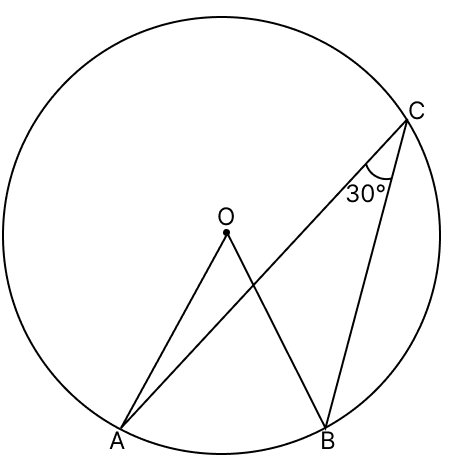
In the given figure, O is the centre of the circle and ∠ACB = 30°. Then, ∠AOB = ?
15°
30°
60°
90°
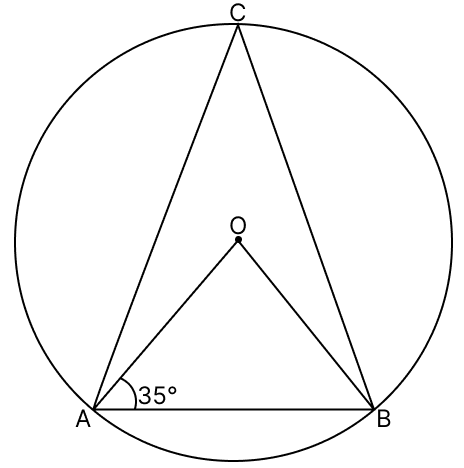
In the given figure, O is the centre of the circle. If ∠OAB = 35° and C is a point on the circle, then ∠ACB = ?
35°
55°
45°
75°